Home › Persimmon Soap › How to use persimmon soap
Persimmon SoapHow to Use Persimmon Soap: Where, How Often, and Where Not To
Where you use it matters more than which brand you buy. Here's the routine that comes up again and again from people who say it worked, plus the mistakes that sting.

Disclosure: The Soap Digest is owned by the same company that makes TanniBar. We rank it first and we earn money when you buy it. Every other brand here is linked without payment, and we try to describe each one fairly. Check the facts for yourself. How we handle this.
In this guide
- Step 1: Know where nonenal actually lives
- Step 2: The shower routine
- Rinse it off or leave it on?
- Using it with deodorant, glycolic acid or retinoids
- Step 3: How often
- What if the smell got worse after you started?
- Why the same bar behaves differently on different parts of the body
- Where not to use it
- Step 4: Make the bar last
- Step 5: Wash the fabrics, too
- Quick answers
Persimmon soap isn’t a normal soap you use everywhere and forget about. It’s a targeted cleanser for one kind of odor, and people who get good results tend to use it in a particular way. We pieced this routine together from the research on where nonenal forms and from hundreds of comments by people who use it.
Step 1: Know where nonenal actually lives
2-Nonenal forms when certain skin oils oxidize, so it concentrates where oil glands are densest. Researchers studying it chose the nape of the neck as their sampling site for that reason. (Our nonenal research index lists those studies, and what nonenal actually smells like covers whether the smell you are chasing is this one at all.) Skin oil is not spread evenly: in 713 people aged six months to 94, sebum measured on the forehead was higher than on the forearm in both sexes (Man et al., 2009). Users most often describe the smell coming from:
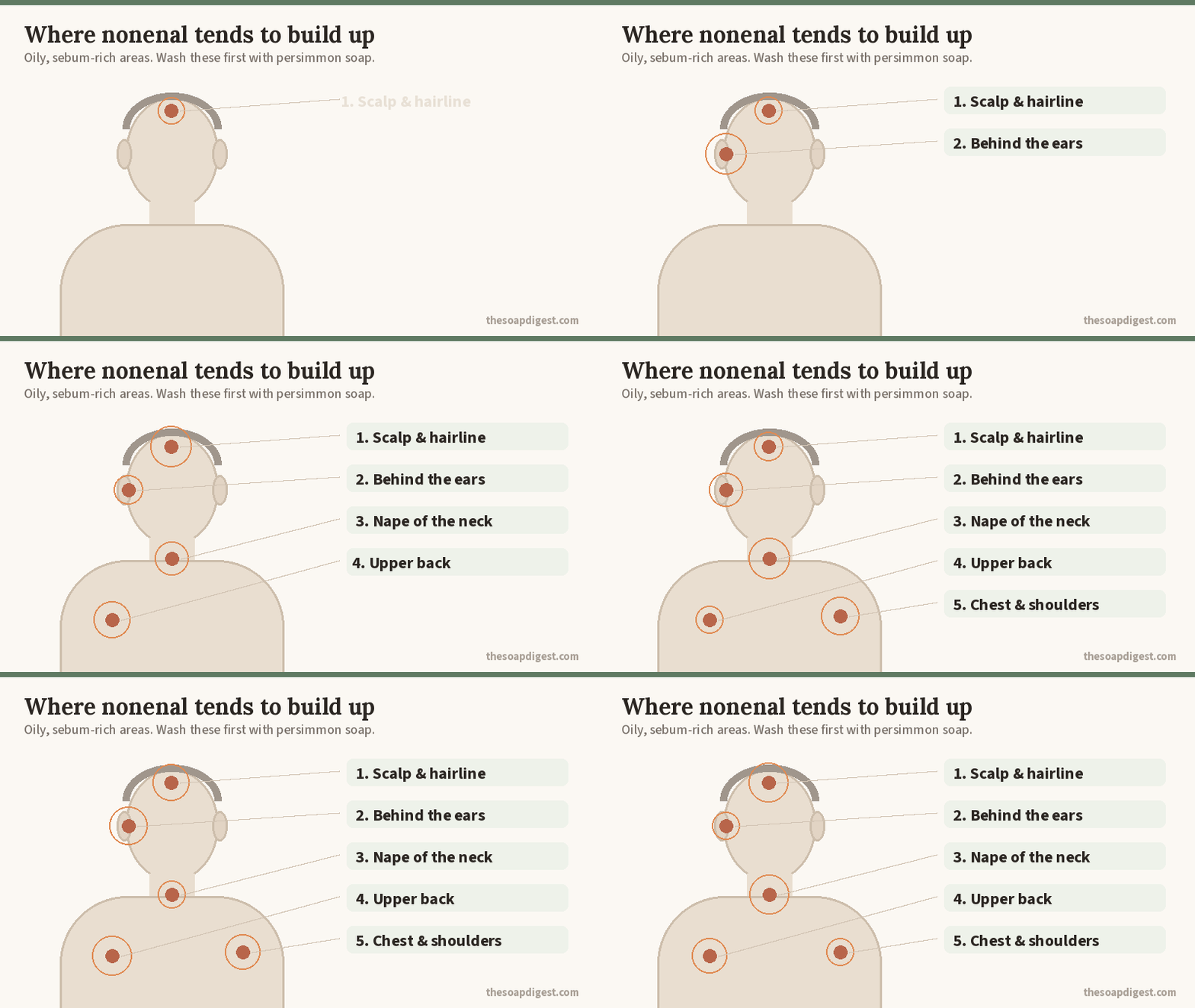
- The scalp and hairline, especially if hair is short or thinning.
- Behind the ears — and the folds in front of them. The crease behind the ear is the spot people know about. Readers also report the grooves on the front of the ear, just above the canal, as a place that gets missed by both face washing and showering, because neither routine quite reaches it.
- The nape and sides of the neck.
- The upper back between the shoulder blades.
- The chest and shoulders.
“Use it on the back of your neck and behind your ears since that's where nonenal accumulates.”
Step 2: The shower routine
- Rinse first with warm (not hot) water. Hot water strips more oil and can make tannin feel harsher.
- Lather in your hands or on a soft washcloth. Work the bar between wet palms until you have a thin lather.
- Wash the five hot spots first. Use your fingertips on the scalp and behind the ears. A washcloth makes the back of the neck and upper back easier to reach.
- Give it a moment, then move on. Many people leave the lather on those areas while they wash the rest of the body with their usual product. That’s a habit, not a tested step. See “Rinse it off or leave it on?” below.
- Rinse thoroughly. Tannin residue can feel tight if it’s left on.
- Pat dry and moisturize anywhere that feels tight. The American Academy of Dermatology recommends warm (not hot) showers and applying a fragrance-free moisturizer right after you pat dry. An unscented lotion keeps the “no added smell” benefit.
Rinse it off or leave it on?
Rinse it off. Readers in r/Menopause ask this a lot, and it’s a fair question, because some glycolic-acid and deodorant routines really are leave-on.
- Persimmon soap is a rinse-off product. TanniBar, for example, is a true soap, which makes it alkaline (brand page). Soap left on the skin is more likely to leave it tight and dry.
- Nobody has tested contact time. The only human test of persimmon tannin on body odor that we know of is in a 2001 Menard patent (JP2001-302483A). It used leave-on lotions, gels and mists, not soap, and people rated their own results. So there’s no evidence for leaving soap lather on longer, or for how long.
- What you rinse away is the point. Nonenal forms in skin oil, and washing removes that oil. A thorough wash of the right areas probably matters more than how long the lather sits. We explain the evidence in does persimmon soap work?
If you want a product that stays on the skin, use it after the shower, on dry skin. See the next section.
Using it with deodorant, glycolic acid or retinoids
Many readers combine persimmon soap with a leave-on product, usually on the underarms. A sensible order:
- Shower with persimmon soap on the hot spots (Step 1).
- Dry off fully.
- Apply your leave-on product (deodorant, antiperspirant or a glycolic-acid toner) to the areas it’s meant for.
Two cautions:
- Don’t stack actives on the same patch. The American Academy of Dermatology warns that prescription retinoids, retinol and benzoyl peroxide can make skin more sensitive or peel. It also warns that over-exfoliating leaves skin red and irritated. Tannin is astringent, so if you use an acid or retinoid, use it on different areas from the persimmon soap, or on alternate days. Moisturize, and stop if your skin turns red.
- An acid is a product with a dose, not a harmless wipe. The FDA notes that the Cosmetic Ingredient Review Expert Panel concluded glycolic and lactic acid products are safe for consumers at 10 per cent or less, at a final pH of 3.5 or above, and when the product either protects against increased sun sensitivity or tells you to use daily sun protection. The agency also logged 114 adverse dermatologic reports for alpha hydroxy acid products between 1992 and February 2004, most commonly burning, dermatitis or rash, and swelling, with the more serious reactions concentrated in the products that exfoliated most. Four weeks of an AHA cream raised sensitivity to UV-induced reddening by 18 per cent and roughly doubled sensitivity to UV-induced cellular damage, reversibly — which is worth knowing if you are using one below the neck in summer. Our guide to glycolic acid for body odor walks through which step of that argument has actually been measured, and which has not.
- Soap won’t fix underarm odor on its own. Sharp underarm odor usually comes from bacteria breaking down sweat. That’s a different problem from nonenal. Our perimenopause body odor guide explains how to tell them apart, and persimmon soap vs Lume sets out why a rinse-off soap and a leave-on whole-body deodorant are aimed at different molecules rather than competing.
Step 3: How often
Start with once a day. Many users stay there. If your skin starts feeling dry or itchy, drop to every other day on the body and keep daily washing for the neck and scalp. Give it two weeks before judging, and see Step 5.
There is no tested frequency to point you at — the only human test of persimmon tannin we know of ran for two weeks on leave-on products, not soap, and measured nothing but how people rated themselves. What is measured is the cost of washing more. Skin surface pH rises after a single wash — after rinsing with water alone, in fact — and takes up to several hours to come back down (Blaak and Staib, 2018). A true soap is alkaline, and at pH 10 the stratum corneum swells even with no surfactant present at all (Ananthapadmanabhan et al., 2004; the authors are Unilever-affiliated). That is the argument for once a day on the hot spots rather than three times a day everywhere, and for moisturizing after.
Two practical notes readers keep raising. The scalp is a frequency problem of its own. If the nape and the scalp are the two biggest sources and the hair is washed twice a week, washing the neck daily leaves most of the source untouched — a point made repeatedly by carers in these threads. Carers also ask whether to use the bar on the scalp or buy a persimmon shampoo, and there is no evidence either way, because no persimmon product of any kind has been tested on human body odour; pick whichever one actually gets used. If the scalp is flaking or itching as well as smelling, that is a separate question, and whether a fungal problem can cause body odor covers what is and is not known about it. And a shorter interval is not a stronger dose. If once a day on the right areas isn’t working after two weeks, washing more often is unlikely to be the missing variable; the reasons it fails are mostly about place, fabric and expectation.
What if the smell got worse after you started?
This comes up often enough to deserve a straight answer. In one r/AskWomenOver60 thread, a woman bought a persimmon bar for her husband, who has serious health problems and had developed a non-sweaty “old person smell” — and reported that afterwards he smelled worse.
“Now he smells really unpleasant.”
Nobody has studied this. A PubMed search for 2-nonenal together with soap returns no records at all (searched 1 October 2026), so what follows is four candidate explanations, ranked by how much support each actually has — not a diagnosis.
- The reservoir refills, and one wash doesn’t empty it. 2-Nonenal is generated when omega-7 unsaturated fatty acids in skin surface lipid are oxidatively degraded, with lipid peroxides acting as the initiator (Haze et al., 2001). Washing removes what is on the surface; the oil underneath is replaced on a measurable timescale, and sebum replacement time has been quantified directly (Piérard-Franchimont and Piérard, 2002). So a clean day is not the same as a solved problem, and the first days can feel like going backwards.
- The fabric is putting it back. The odor travels in oil that transfers onto collars, pillowcases and chairs, and textiles differ in how much sebum they absorb — polyester absorbed more sebum, and adhered more bacteria, than cotton (Møllebjerg et al., 2021). If the bedding and shirts were not washed on day one, a cleaner person is being re-dressed in the old smell. This is the single most common fixable version of “it got worse.”
- Something changed about the skin, not the smell. Washing raises skin surface pH for hours (Blaak and Staib, 2018), and soap is alkaline. That makes skin feel tight, dry or raw, which is easy to read as a change in odor — but tightness is not a smell, and the fix is less frequency plus a fragrance-free moisturizer, not a different bar.
- The smell was never the soap’s business. This is the possibility we would check first in the case above, and it is not a hygiene question at all. The NHS advises seeing a GP if body odour hasn’t improved with self-care, if it’s affecting self-esteem, if you notice a change in how it usually smells, or if you suddenly begin to sweat much more than usual. A new or changed smell in someone who is unwell belongs in a consulting room before it belongs in a shopping basket. If you are the one noticing it on someone else, our guide on how to raise it kindly covers the order of operations.
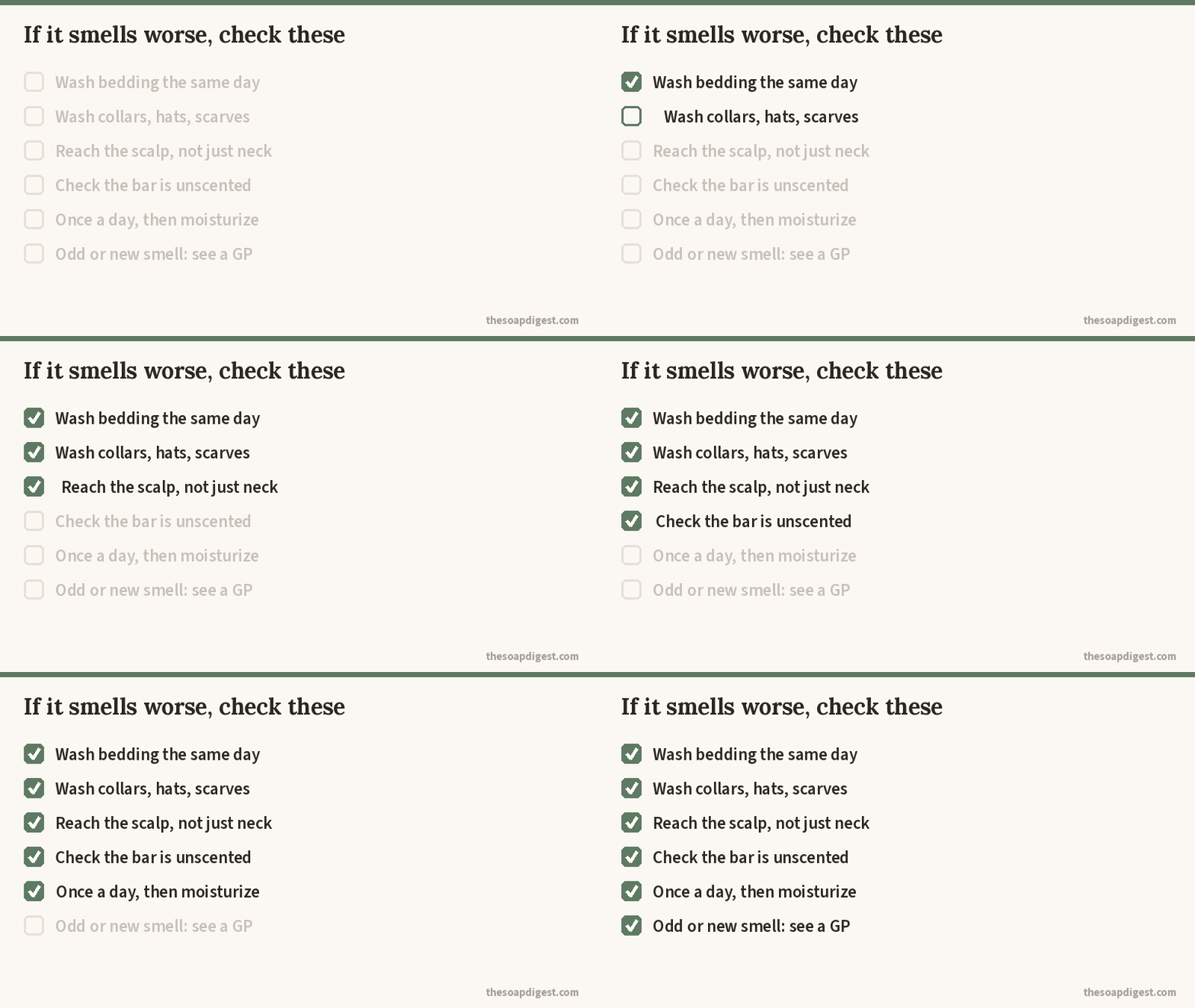
One more thing it is probably not: a reaction to the soap’s own smell. A fragrance-free bar has very little odor of its own, so if a new smell appeared, it is worth checking whether the bar is scented before assuming the tannin caused it. The label is worth a second look generally: brand names and claims vary far more than the formulas do, and how to tell whether a persimmon soap is legit sets out the one check that works, which is whether persimmon tannin or kakishibu is named as an ingredient.
Why the same bar behaves differently on different parts of the body
The routine above sends you to five places and tells you to skip others, and that is not squeamishness. Skin is not one material, and the two properties that vary most across it are the two that decide how a tannin bar behaves: how much oil a site makes, and how easily that site is damaged.
Oil is the first, and it is why Step 1 exists rather than “wash all over” — a wash aimed at an oxidation product of skin oil is worth aiming at the places the oil is.
Damage is the second, and the published work here is unusually specific. Vulvar tissue is more permeable than exposed skin, and a review of the resulting testing problem names four reasons for it: structure, occlusion, hydration and susceptibility to friction (Farage and Maibach, 2004; both authors worked in Procter and Gamble’s feminine care research unit, which is worth knowing). The same paper notes that testing products on the vulva “is not routinely feasible”, which is why its authors were developing a behind-the-knee test instead. So an identical lather meets a more permeable, more occluded, more rub-prone tissue — and nobody is going to run the trial that would clear a soap for it.
Notice that friction sits in that list beside chemistry, as a mechanism of its own. That matters in the shower, because the commonest version of “persimmon soap burned me” involves a mesh or plastic soap bag rather than the bar. The r/Menopause thread this guide draws on has since grown past a hundred comments, and the replies worked that out without prompting: several told the original poster that abrasion from the bag, not tannin in the bar, was the likely culprit, and that a lathered hand and a thorough rinse would have been fine. The bag is a lathering tool and a way to reach your own back. It is not a scrubbing tool, and nothing thin-skinned should meet it.
Then the uncomfortable part. There are few national or international guidelines on vulvar hygiene at all, and the one recent review we could find is blunt about the trade-off: washing there with soap “alters the stratum corneum proteins and lipids, increases skin water loss, and accentuates the risk of irritation”, while repeated washing with water alone also exposes the stratum corneum to damage — so the common advice to use water only is not a free pass either. What that review lands on is syndet-based products, synthetic detergents blended to sit at a pH suited to the area (Bohbot et al., 2025; the authors declare extensive industry relationships). A triple-milled persimmon bar is the opposite of that: a true soap, and therefore alkaline. Ours included. For that one site, our own product sits in the category this review advises against, and we would rather say so than let the omission stand.
If the smell really is coming from there, it is a different problem with a different biology. The subregions of the vulva differ in sweat and sebaceous glands, keratin, water content, pH and resident bacteria — which include Corynebacterium, the same genus behind ordinary underarm odour (Bohbot et al.). The remedy passed around in these threads for it is boric acid, and that has in fact been studied: 52 women with recurrent bacterial vaginosis, all of whom had already failed metronidazole or clindamycin, took 600 mg intravaginally for 14 days, after which reported odour fell from 92.3 per cent of them to 1.9 per cent (Caliskan et al., 2025). Read what that is before borrowing it. It is a vaginal treatment for a diagnosed infection in women for whom antibiotics had not worked, from a single-arm retrospective study whose own authors write that the design “preclude[s] definitive conclusions about treatment efficacy”. It is not a deodorant and not a soap substitute. A new or persistent smell from that area is a reason to get a diagnosis.
As for whether persimmon tannin has ever been looked at on that tissue: a title-and-abstract search of PubMed for persimmon with any vulva word, run on 20 October 2026, returns exactly one record — a new species of soil nematode collected from the root zone of a persimmon tree in Guilan Province, Iran, identified partly by the diameter of its own vulva. Both words are true of it. Neither is about human skin. Searching instead for 2-nonenal alongside any genital word returns one record too, and that one is about 4-hydroxynonenal in cervical disease, a different aldehyde we keep having to separate from this one. Nobody has measured 2-nonenal from that area.
Where not to use it
Keep it off intimate and broken skin. In an r/Menopause thread titled “Ouch…”, a user who washed external vulvar skin with persimmon soap in a mesh pouch described burning that lasted days. Replies were near-unanimous: no scrubbing pouches on delicate skin, and a mild cleanser used externally only. Also avoid eyes, open cuts and any area with an active eczema or psoriasis flare.
Some people are simply sensitive to persimmon or to tannins. One commenter in that thread mentioned a food allergy to the persimmon family. If you get a rash, stop using it and patch-test before you try again. Our guide to persimmon soap side effects walks through the patch test and when to see a doctor.
Step 4: Make the bar last
Persimmon bars can soften fast, and glycerin-based ones even faster. Users’ best tips:
- Keep it out of standing water. Use a draining dish, or a mesh soap-saver bag hung from a hook so the bar dries between showers. (Use the bag for lathering on the body, not on sensitive skin.)
- Cut large bars in half and store the spare somewhere dry.
- Unwrap new bars early. One user leaves them unwrapped in a dark, airy spot so they harden before use.

Step 5: Wash the fabrics, too
The odor transfers to pillowcases, collars, knitwear and upholstery, and it lingers there after your skin is clean. On the day you start:
- wash all bedding and use a fresh pillowcase,
- wash the shirts, cardigans and hats you wear most,
- wipe down or air the car seat headrest and your favorite chair.
If the smell is in the house itself, in sofas, curtains or carpets, washing yourself won’t reach it. Our room-by-room guide covers that, and upholstery and mattresses are enough of their own problem to have a guide to themselves — a chair holds a lipid reservoir that keeps generating odor after the surface has been cleaned. If you were about to buy an antibacterial fabric spray for this, read what hypochlorous acid can and can’t do first.
Then change your pillowcase every few days for the first two weeks. It’s also the easiest way to tell whether the soap is working. Our pillowcase check explains how. If items still smell after a normal wash, this laundry guide covers why nonenal survives a cool cycle and what to do instead.
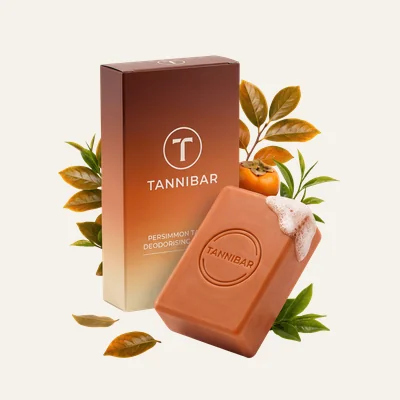
TanniBar Persimmon Tannin Bar
A fragrance-free bar keeps the test honest, because there's no perfume to confuse your nose. TanniBar also adds glycerin and shea for drier skin.
Check price →We own TanniBar and earn from sales. 30-day refund, no return needed.Quick answers
- Can the whole family use it? It’s a cleanser, so yes, unless someone reacts to it. But teens’ odor usually comes from underarm sweat, which needs a different approach.
- Can I use it with my normal body wash? Yes. Persimmon soap on the hot spots, your usual wash everywhere else.
- Is it OK with retinoids or acids? Not on the same patch at the same time. The section above on using it with deodorant, glycolic acid and retinoids has the order to follow.
When to see a doctor. Stop using it and get advice if a rash doesn’t settle after you stop. The NHS also advises seeing a GP if body odour doesn’t improve with self-care and you notice a change in how it usually smells, you suddenly start sweating much more than usual, or it’s affecting your self-esteem.
Still not seeing results after two weeks? Work through our 8 reasons persimmon soap doesn’t work, or compare five persimmon bars side by side in our best persimmon soap comparison.
Frequently asked questions
How often should I use persimmon soap?
Most people use it once a day in the shower on the target areas, then drop to every other day if their skin feels dry. Moisturize afterwards if your skin is thin or dry.
Can I use persimmon soap on my face?
Some people do, but tannin is astringent and facial skin is thinner. If you try it, patch-test on your jawline first and moisturize. Stop if you get redness or tightness.
Can I use persimmon soap on my hair?
Many users wash their scalp with it, since the scalp is a major source of nonenal. Carers ask whether to use the bar or buy a persimmon shampoo, and there is no evidence either way: no persimmon product of any kind has been tested on human body odour, so the choice is about what gets used. A bar can leave long hair feeling squeaky or dry, so follow with conditioner. What matters more than the format is frequency, because hair washed twice a week leaves the biggest oil reservoir mostly untouched.
Can persimmon soap be used on private parts?
We'd avoid it, and the reason is the tissue rather than the ingredient. Vulvar tissue is more permeable than exposed skin because of differences in structure, occlusion, hydration and susceptibility to friction, so the same lather that a neck tolerates meets a more vulnerable site. Washing there with soap also alters the proteins and lipids of the outer skin layer and raises the risk of irritation, which is why the one recent review of vulvar hygiene we could find recommends a syndet rather than a true soap. No study has measured 2-nonenal from that area at all. If a smell is coming from there specifically, that is a different problem and worth a diagnosis rather than a different bar.
Do you leave persimmon soap on or rinse it off?
Rinse it off. It's a soap, and leaving soap on the skin is more likely to leave it tight and dry. Letting the lather sit while you wash the rest of your body is a common habit, but no study has tested how long it should stay on. If you want something that stays on the skin, that's a separate leave-on product, used after the shower.
I started using it and the smell got worse. Why?
Nobody has studied this, so treat every explanation as a guess with a different amount of support behind it. The documented possibilities: the odor lives in skin oil that keeps being replaced, so one wash does not empty the reservoir; the fabric around the person is a second reservoir that puts it straight back; and washing raises skin pH for hours afterwards, which changes how skin feels but is not itself a smell. The possibility that matters most is the one that has nothing to do with soap — a new or changed smell in someone who is unwell is a reason to see a doctor, not to change cleanser.
Do I still need deodorant?
Probably. Persimmon soap targets the oily, age-related smell. It isn't an antiperspirant, and underarm odor usually comes from bacteria breaking down sweat, which is a different problem. Wash with the soap, dry off fully, then apply deodorant as usual.
Sources
- Kimura K. et al. (2016). Measurement of 2-nonenal and diacetyl emanating from human skin surface. J Chromatogr B.
- Haze S. et al. (2001). 2-Nonenal newly found in human body odor tends to increase with aging. J Invest Dermatol.
- r/Menopause: "Ouch… anyone have this experience using persimmon soap"
- r/Menopause: "Persimmon soap hype"
- r/Menopause: "Persimmon soap really works! (Who knew!?)"
- Blaak J. & Staib P. (2018). The relation of pH and skin cleansing. Curr Probl Dermatol 54:132–42.
- Piérard-Franchimont C. & Piérard G.E. (2002). Postmenopausal aging of the sebaceous follicle. Dermatology 204(1):17–22 (sebum excretion rate and replacement time).
- Møllebjerg A. et al. (2021). The bacterial life cycle in textiles is governed by fiber hydrophobicity. Microbiol Spectr 9(2):e0118521.
- Ananthapadmanabhan K.P. et al. (2004). Cleansing without compromise: the impact of cleansers on the skin barrier and the technology of mild cleansing. Dermatol Ther 17(Suppl 1):16–25. (authors affiliated with Unilever)
- r/AskWomenOver60: "Persimmon soap fail?"
- American Academy of Dermatology: Dermatologists' top tips for relieving dry skin
- American Academy of Dermatology: How to safely exfoliate at home
- Farage M. & Maibach H.I. (2004). The vulvar epithelium differs from the skin: implications for cutaneous testing to address topical vulvar exposures. Contact Dermatitis 51(4):201–9. ("Vulvar tissue is more permeable than exposed skin due to differences in structure, occlusion, hydration and susceptibility to friction." Standard clinical patch tests "may not sufficiently mimic vulvar exposures", and because testing on the vulva "is not routinely feasible" the authors were developing modified cutaneous methods, including a behind-the-knee test for chemical and frictional effects.) (both authors worked in Procter & Gamble's Feminine Care Research & Development unit)
- Bohbot J.M. et al. (2025). Vulvar Care: Reviewing Concepts in Daily Hygiene. Healthcare (Basel) 13(13):1523. ("There are few national and international guidelines on vulvar hygiene." Subregions of the vulva vary in sweat and sebaceous glands, keratin content, water content, pH and microbiota, notably Lactobacillus, Corynebacterium, Staphylococcus and Prevotella. "Repeated washing with water alone exposes the stratum corneum to damage, and washing with soap alters the stratum corneum proteins and lipids, increases skin water loss, and accentuates the risk of irritation." Concludes that syndet-based products "appear to be the most appropriate for vulvar care".) (the authors declare extensive pharmaceutical and cosmetic industry relationships)
- Man M.Q. et al. (2009). Variation of skin surface pH, sebum content and stratum corneum hydration with age and gender in a large Chinese population. Skin Pharmacol Physiol 22(4):190–9. (713 subjects aged 0.5–94. Sebum content on the forehead was higher than on the forearm in both males and females, and the age group with the highest sebum content differed by site and by sex; skin surface pH on the forehead was higher above the age of 70.)
- Caliskan M. et al. (2025). Intravaginal boric acid treatment for recurrent bacterial vaginosis: short-term effects on vaginal health parameters and patient satisfaction. BMC Womens Health 25(1):536. (Retrospective, single-arm, 52 women with ≥3 episodes in 12 months and documented failure or rapid recurrence after metronidazole or clindamycin; 600 mg intravaginally daily for 14 days. Vaginal odour prevalence fell from 92.3% to 1.9%; mild adverse events in 7.8%. The authors state that "the single-arm retrospective design and limited follow-up preclude definitive conclusions about treatment efficacy".)
- PubMed title-and-abstract searches run on 20 October 2026. (persimmon[TIAB] AND vulva*[TIAB] returns exactly one record: a description of a new soil nematode species collected around the rhizosphere of persimmon in Guilan Province, Iran, characterised partly by its vulval body diameter — J Helminthol 2023;97:e83. "2-nonenal"[TIAB] AND (vulva*[TIAB] OR genital*[TIAB] OR groin[TIAB] OR pubic[TIAB]) also returns one record, and it concerns serum oxidative biomarkers in genital HPV infection and cervical lesions, where the aldehyde is 4-hydroxynonenal rather than the 2-nonenal of body odour. So there is no published measurement of 2-nonenal from that area, and no published work on persimmon tannin applied to it.)
- U.S. Food and Drug Administration. Alpha Hydroxy Acids. (The Cosmetic Ingredient Review Expert Panel concluded that glycolic and lactic acid products are safe for consumers when the concentration is 10 per cent or less, the final product pH is 3.5 or greater, and the product is formulated to protect from increased sun sensitivity or its directions tell consumers to use daily sun protection. FDA received 114 adverse dermatologic experience reports for AHA skin care products from 1992 to February 2004 — burning 45, dermatitis or rash 35, swelling 29, pigmentary changes 15, blisters or welts 14, skin peeling 13, itching 12, irritation or tenderness 8, chemical burns 6, increased sunburn 3 — with the more serious reactions most often involving products causing the greatest exfoliation. FDA studies found four weeks of AHA cream application increased sensitivity to UV-induced reddening by 18 per cent and roughly doubled sensitivity to UV-induced cellular damage on average, reversibly, with no significant differences one week after stopping. Accessed 19 October 2026.)
- NHS: Body odour (BO) — when to see a GP
- Patent JP2001-302483A: Deodorant (condensed persimmon tannin). Inventors at Menard Cosmetics. (company patent data, not peer-reviewed)
- r/Menopause: "Persimmon soap really works! (Who knew!?)" (the leave-on vs rinse-off question)
- TanniBar product page (brand's own claims) (company information; we own TanniBar)