Home › Laundry & Home › Old person smell in furniture
Laundry & HomeHow to Get Old Person Smell Out of Furniture (and When You Can't)
Readers on r/CleaningTips keep reporting the same thing: they deep-clean a chair, it smells fine for a fortnight, then the smell comes back. That pattern is a clue, and it points at a mechanism most cleaning advice ignores.

Disclosure: The Soap Digest is owned by the same company that makes TanniBar. We rank it first and we earn money when you buy it. Every other brand here is linked without payment, and we try to describe each one fairly. Check the facts for yourself. How we handle this.
In this guide
Someone on r/CleaningTips posted this month that two friends visited after a long day out, and once they had gone the couch and the couch pillows smelled strongly of body odour. The replies came fast: hypochlorous acid spray, a Bissell extractor, washable covers, cheap vodka in a spray bottle. A few weeks earlier, a reader with a stinking office chair got a blunter answer — the fibres will hold it forever, throw the chair out.
Both threads miss the same thing, and it explains why this problem is so stubborn. Furniture does not simply hold on to a smell made somewhere else. Where the smell is the greasy, stale one people call “old person smell”, the chair is manufacturing it.
The short version
- The odour molecule behind “old person smell” is 2-nonenal, and it forms when omega-7 unsaturated fatty acids in skin oil break down by oxidation — a chemical chain reaction, not a bacterial one.
- That reaction does not stop when the oil moves from skin to a cushion. Sebum soaked into foam keeps producing fresh nonenal for as long as it is there.
- So removing the smell is not the job. Removing the oil is the job. Anything that only treats the surface buys you a fortnight.
- Sweaty, sour “BO” on a couch after guests is usually a different smell with a different cause, and it does respond to the sprays everyone recommends.
- Wood furniture is a third problem again, and it is the easiest of the three to fix.
Two different smells get called the same thing
This is worth sorting out before you buy anything, because the two common furniture smells respond to opposite treatments.
The first is ordinary sweaty body odour. Apocrine sweat is close to odourless when it arrives; skin bacteria cleave the precursors it carries, releasing the thioalcohols behind that sharp oniony note — the transport step was described in structural detail by Minhas and colleagues in 2018. This is a microbial smell. It is what a couch picks up after two warm guests sit on it for an evening, and it is what antimicrobial sprays, hot washing and sunlight genuinely act on.
The second is 2-nonenal. Haze and colleagues at Shiseido found it in the body odour of subjects aged 40 and over but not in younger ones, and traced where it comes from: omega-7 unsaturated fatty acids in skin surface lipids are oxidatively degraded, with lipid peroxides acting as the initiator of an oxidative chain reaction. No bacteria appear in that mechanism. It is autoxidation — the same broad chemistry that turns cooking oil rancid in a cupboard.
That distinction does all the work in this article. We go through the evidence base for nonenal in more depth in our research index on 2-nonenal.
Why the chair keeps making more
Here is the consequence almost no cleaning guide draws.
Sebum transfers onto whatever you sit against, and it soaks in. 2-nonenal is a small, oily molecule — PubChem gives (E)-2-nonenal an XLogP3 of 3.1, firmly on the fat-soluble side — so it partitions into oils and greases rather than water, and its parent fatty acids behave the same way. Møllebjerg and colleagues found that polyester, being more hydrophobic, adhered more bacteria and absorbed more sebum than cotton. Upholstery and office chairs are overwhelmingly polyester and microfibre.
Put those together. Oil goes into the fabric and down into the foam, and the oxidation reaction carries on down there, because it needs nothing but lipids and air. You clean the chair and remove the nonenal that has already formed; the reservoir of unoxidised omega-7 fatty acids is untouched; over the following weeks it produces a fresh batch.
That is exactly the pattern readers describe — a good fortnight, then a relapse — and why “I’ve cleaned it three times” is such a common line. The cleanings worked. They just were not aimed at the thing that regenerates.
There is one check worth doing before anything else, and it settles the question in about a minute: if the cover comes off, take the foam out and smell the block on its own. If the smell is in the foam rather than the fabric, no amount of surface cleaning is going to end this.
First, check it really is the furniture
A reader in a third thread asked whether they needed to wash the walls after a smelly roommate moved out. One of the replies put the mechanism plainly.
“body oils and sweat can be absorbed by anything”
True — but “anything” is a big search area. Timing narrows it, because it separates a person from a reservoir.
Odour coming off a person builds gradually across the day, follows them between rooms, and is worst on what presses against skin for hours: pillowcases, collars, the inside of a coat. Odour coming out of furniture arrives the instant weight goes onto the cushion and warms it, is strongest where skin rests — headrest, armrests, front edge of the seat — and is still there after the person has been away a week.
The quick test: leave the room for twenty minutes with the windows open, come back, and press the cushion hard with both hands before you sit. A distinct puff as the foam compresses means the chair is a source in its own right. Our piece on whether you can smell your own body odour covers why that first ten seconds after coming in from outside is the only reading you can trust.
What the popular fixes actually do
None of these are useless. They are just frequently aimed at the wrong one of the two smells.
Hypochlorous acid spray. The top-voted answer on the most recent furniture thread. EPA defines a disinfectant as a substance that destroys or irreversibly inactivates bacteria, fungi and viruses on surfaces — a real and useful action against the microbial smell. Against nonenal, which is not made by microbes, the logic does not connect, and it is in any case a surface treatment sitting above a reservoir centimetres down. Spot-test first: commenters in that thread raised fabric-safety doubts and none had a source.
Vodka in a spray bottle. Repeated with the explanation that it “absorbs odours”. It does not absorb anything; it is a volatile solvent that evaporates. Ethanol kills some surface bacteria and can carry a little oil-soluble material with it as it goes, which may be why people notice something. We found no evidence for it on nonenal in upholstery.
Sunlight and fresh air. Cheap, and it does more than people assume: warmth drives volatiles out of the material and ventilation carries them away. It removes what has already formed, not the oil.
Ozone generators. EPA states that at concentrations that do not exceed public health standards, ozone is not effective at removing many odour-causing chemicals, and reports experiments suggesting body odour may be masked by the smell of ozone rather than removed by it. Inhaled ozone can damage the lungs, and some machines exceed health limits even when used as instructed. It is also a gas, so it cannot reach oil inside a sealed foam block.
Fragrance sprays. These add volatile organic compounds to indoor air rather than removing any, as EPA’s VOC guidance notes, and they make diagnosis harder because you can no longer tell whether the smell is improving.
If you are running an air purifier alongside this, EPA’s guide to home air cleaners is clear that source control and ventilation come first, and that gaseous pollutants need an adsorbent such as activated carbon — a HEPA filter is built to catch particles and will not remove an odour molecule from the air.
What works, by material
The material decides whether you can reach the oil at all.
Covers that unzip. Much the best case, and worth checking for even on furniture you assume is fixed — most modern seat and back cushions have a zip along the back seam. Wash as hot as the label allows, because this is a grease problem and warmth is what shifts grease. A second wash immediately after the first is more effective than one long one. The laundry malodour literature is consistent that low-temperature washing leaves residues behind; our guide to getting the smell out of clothes goes into the detergent side properly.
Fixed upholstery over foam. Vacuum the seams and the deck under the cushions first; a surprising amount of the load is dust and skin debris that lifts straight out. Then work the fabric with a wet extractor and a degreasing upholstery cleaner rather than plain detergent — you are lifting oil, not dirt. Rinse twice, extract as dry as you can, and dry it properly with airflow. Do not soak it: wetting deep foam and leaving it damp turns an odour problem into a mould problem.
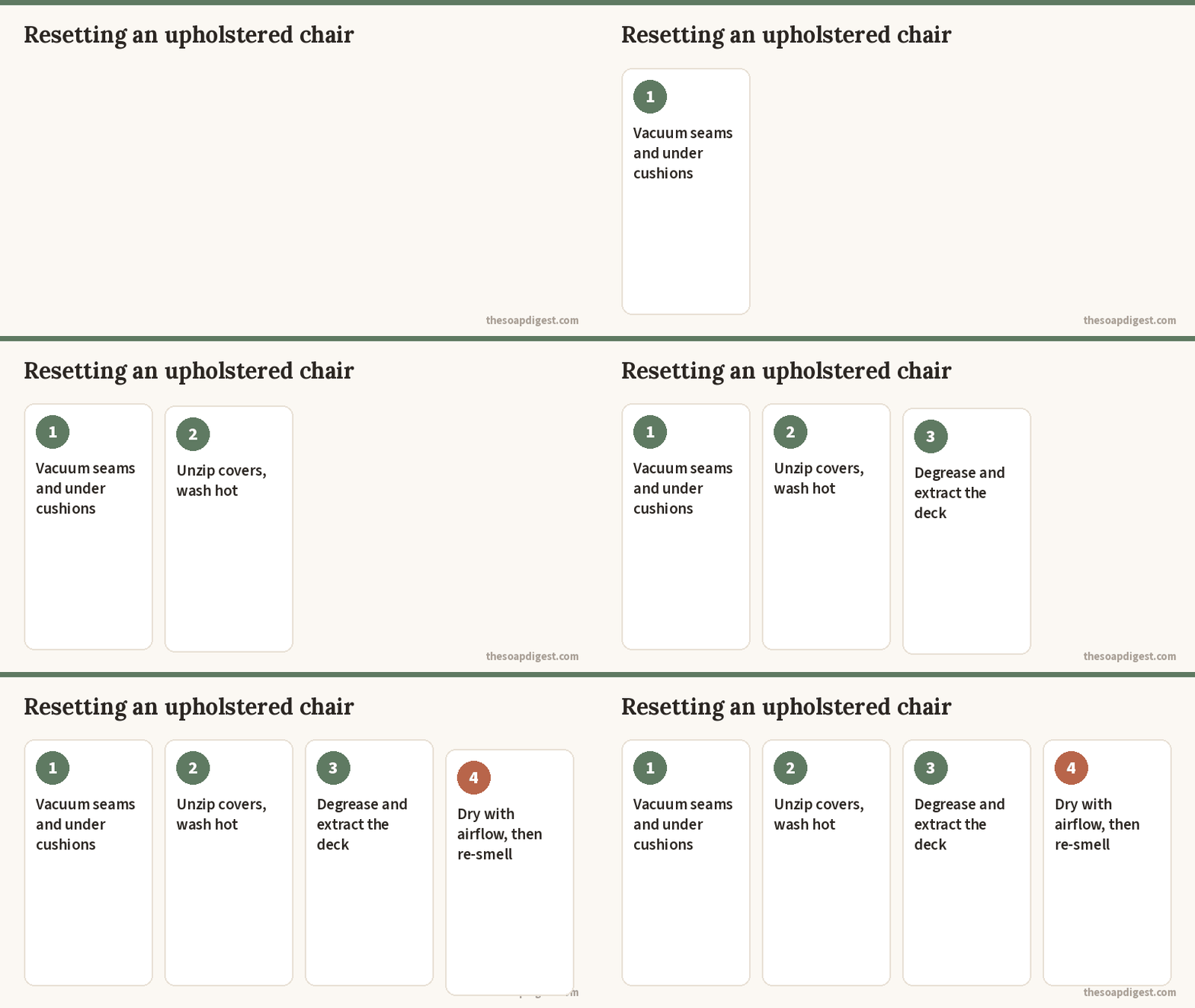
The foam itself. If you can get the cover off, take the foam out and smell it on its own. That single check answers the question the whole article turns on. Foam can be surface-washed and squeezed out, but a full-depth block will not dry reliably indoors, and half-dry foam is worse than what you started with. Which leads to the honest answer further down.
Leather and vinyl. The easy case, because they are not absorbent in the same way. The oil sits on the finish and in the seams and perforations. A damp cloth with a mild cleaner, working the seams with a soft brush, removes it properly. Recurring smell on leather usually means the foam underneath, reached through the perforations or the stitching.
Mattresses. Treat as fixed upholstery, but with a protector added afterwards — a washable barrier is the only thing that keeps the problem from rebuilding. Strip, vacuum, spot-treat, dry fully with a fan, and never wrap a damp mattress in plastic.

Wood furniture, dressers and drawers. A genuinely different problem, and the one people most often over-treat. Wood does not hold sebum the way foam does; a musty old dresser usually holds absorbed volatiles in a worn or unsealed interior finish, plus whatever was stored in it for thirty years. Empty it, pull the drawers right out and leave them apart in moving air for several days — that alone fixes a good proportion. Wash the interiors and dry them completely. If a faint smell persists, activated charcoal or bicarbonate shut in the empty drawer for a week works as an adsorbent. If it still persists, sealing the interior with shellac is the traditional answer: at that point you are containing what is left in the timber rather than washing it out.
When a piece is past saving
Sometimes the blunt answer in that office-chair thread is the right one.
“You're never getting the BO out of it”
If the foam is saturated, the covers do not come off, and the smell returns within weeks of a thorough clean, there is no realistic way to wash the inside of a sealed block. EPA’s home mould guidance makes the same structural point about a different contaminant: absorbent or porous materials such as ceiling tiles and carpet may have to be thrown away, because material can grow into and fill the spaces and crevices inside them, so it may be difficult or impossible to remove completely. Foam has the same geometry problem.
The useful part is that “past saving” rarely means the whole sofa. Replacing the cushion inserts is a cheap job on any frame worth keeping, and on a fixed-back sofa a reupholsterer can replace the seat foam without touching the frame. Trying that before buying a replacement sofa is nearly always the better order.
Some furniture smells are not body odour at all, and two of them matter. A sharp ammonia note points at urine rather than sebum, which is a different conversation and often a medical one. A damp, earthy, cellar-like smell points at moisture, and treating it as an odour problem rather than a water problem wastes both your time and your money — find the source of the damp first.
Where washing the person fits in
If a chair has been re-dosed every day for years, cleaning it once and changing nothing else is a slow-motion repeat. The reservoir and the source are two separate jobs, and doing only one of them is the most common reason people feel like nothing worked. This is the same failure we describe in why persimmon soap sometimes seems to do nothing.
We should be plain about the limits here, since we make one of these products. A soap acts on skin oil while someone is actually washing. It does nothing to a cushion, and it is irrelevant when the smell is coming out of furniture that nobody currently sits in. Where it is worth doing is the other half of the pair: reducing what goes back on afterwards.

TanniBar Persimmon Tannin Bar
Fragrance-free and built around persimmon tannin, so it addresses the skin-oil side without adding a scent you would then be smelling in the upholstery instead.
Check price →We own TanniBar and earn from sales. 30-day refund, no return needed.If you are weighing up which bar to try, our comparison of the best persimmon soap options puts five of them side by side on price, ingredients, scent and guarantee, including the ones we do not sell.
When to talk to a doctor
The NHS advice is to see a GP if you have body odour that has not improved after self-treatment and it is affecting your self-esteem, you notice a change in how it usually smells, or you suddenly begin to sweat much more than usual. A smell that has changed character, rather than simply persisted, is the one worth mentioning.
This is also not purely a cleaning question for the person at the centre of it. Zhao and colleagues looked at age-related odour in solo elderly housing and found it measurably affected whether visitors intended to come back. Furniture is often where that smell lives, which makes a cushion swap more socially useful than it sounds.
The bottom line
Work out which smell you have first, because sweaty bacterial BO and oxidised-sebum nonenal respond to different things and the internet’s default answer is aimed at the first one. Then find out whether you can physically reach the oil: covers off and washed hot if you can, degrease and extract if you cannot, and foam replacement rather than a new sofa when the block itself has gone. Give wood furniture air and time before anything else. And if the same person is re-dosing the same chair daily, treat the chair and the skin as one job rather than two, or you will be back here in a fortnight.
For the wider version of this — carpets, curtains, ducts and the rest of the house — start with our room-by-room guide to old person smell in a house.
Frequently asked questions
Why does the smell come back after I clean the chair?
Because cleaning usually removes odour molecules that have already formed, not the oil that forms them. 2-nonenal is produced when omega-7 unsaturated fatty acids from skin oil break down by oxidation, a chain reaction that needs no bacteria and keeps running as long as the oil is there. If the sebum is still in the foam, the chair carries on generating fresh nonenal after you have removed the old batch. That is why people report two good weeks and then a relapse.
Does hypochlorous acid spray get rid of it?
It is the most recommended answer in these threads, and it is aimed at the wrong target for this particular smell. EPA defines a disinfectant as a substance that destroys or inactivates bacteria, fungi and viruses on surfaces. 2-nonenal is not made by microbes; it is an oxidation product of skin oil. A disinfectant can genuinely help with the sweaty, bacterial kind of body odour, which is a different molecule with a different cause. It is also a surface spray, and the oil is usually several centimetres down.
Will an ozone generator work on furniture?
The US EPA states that at concentrations that do not exceed public health standards, ozone is not effective at removing many odour-causing chemicals, and reports experiments suggesting that body odour may be masked by the smell of ozone rather than removed by it. Inhaled ozone can also damage the lungs. On top of that it is a gas treatment, so it cannot reach oil held inside a foam block.
Is it the furniture or the person sitting in it?
Timing tells you apart. Odour coming off a person builds gradually through the day and is worst on pillows and collars. Odour coming out of furniture arrives the moment weight goes onto the cushion and warms it, and it is strongest at the headrest and armrests. If a chair smells when nobody has sat in it for a week and you press the cushion and get a puff of it, the chair is a source in its own right.
Can a sofa ever be beyond saving?
Yes, and it is worth knowing before you spend money. If the foam itself is saturated and the covers do not come off, there is no realistic way to wash the inside of a sealed block. Replacing the foam inserts is usually far cheaper than replacing the sofa, and on a decent frame it is the actual fix. EPA's guidance on porous materials makes the same point for a different contaminant: material can fill the spaces inside foam and fabric so that it is difficult or impossible to remove completely.
Sources
- Haze S. et al. (2001). 2-Nonenal newly found in human body odor tends to increase with aging. J Invest Dermatol 116(4):520–4. (2-nonenal is generated by oxidative degradation of omega-7 unsaturated fatty acids, using lipid peroxides as the initiator of an oxidative chain reaction)
- PubChem compound summary: (E)-2-nonenal (CID 5283335) — XLogP3 3.1.
- Møllebjerg A. et al. (2021). The bacterial life cycle in textiles is governed by fiber hydrophobicity. Microbiol Spectr 9(2):e0118521. (polyester adhered more bacteria and absorbed more sebum than cotton)
- Callewaert C. et al. (2014). Microbial odor profile of polyester and cotton clothes after a fitness session. Appl Environ Microbiol 80(21):6611–9.
- Minhas G.S. et al. (2018). Structural basis of malodour precursor transport in the human axilla. eLife 7:e34995. (the bacterial thioalcohol route, which is a different odour from 2-nonenal)
- Waqar S. et al. (2025). Unravelling the hidden side of laundry: malodour, microbiome and pathogenome. BMC Biol 23:39.
- US EPA: Selected EPA-Registered Disinfectants (definition of a disinfectant).
- US EPA: Ozone Generators that are Sold as Air Cleaners (effectiveness against odour and health effects).
- US EPA: Mold Cleanup in Your Home (absorbent or porous materials may have to be thrown away).
- US EPA: Guide to Air Cleaners in the Home (source control and ventilation first; activated carbon for gases).
- US EPA: Volatile Organic Compounds' Impact on Indoor Air Quality.
- Zhao S. et al. (2026). Age-related odor and design buffering in elderly solo housing: two-stage study of visitor behavioral intention. Sci Rep.
- NHS: Body odour (BO) — self-care and when to see a GP.
- TanniBar product page (brand's own claims: fragrance-free, ingredients, refund terms). (company information; we own TanniBar)
- r/CleaningTips: "Body odor on furniture!"
- r/CleaningTips: "body odor persists in office chair"
- r/CleaningTips: "Getting body odor out of a bedroom"