Home › Talking About It › When a parent refuses to bathe
Talking About ItWhen an Elderly Parent Refuses to Bathe, Start With Why
The advice online is almost all about persuasion. The research is mostly about something else: whether the person can still do it, whether it hurts, whether the room is cold, and whether the equipment families buy first does anything at all.

Disclosure: The Soap Digest is owned by the same company that makes TanniBar. We rank it first and we earn money when you buy it. Every other brand here is linked without payment, and we try to describe each one fairly. Check the facts for yourself. How we handle this.
In this guide
- Refusal is a description, not a reason
- Six reasons that all look the same from the doorway
- What the evidence says about grab bars and shower seats
- The parts of this that have actually been tested
- Almost none of the research was done in a house
- What a wash can do about the smell, and what it cannot
- The bottom line
Almost every article on this subject is about persuasion. Scripts to try, phrases to avoid, bargains to strike, how to raise it without starting a row. That is a reasonable thing to want, and some of it works. But it rests on an assumption that is worth holding up to the light first, because it is wrong often enough to matter: the assumption that the person has decided not to wash, and the problem is changing their mind.
The short version
- In a Yale cohort of 754 community-living people aged 70 and over, 44.2% developed persistent disability in bathing over about eight years. Much of what families read as refusal is difficulty.
- The three strongest predictors of that disability were inability to rise from a chair, low confidence about bathing, and low physical activity — each more than doubling the risk.
- The single largest precipitant was a hospital stay, hazard ratio 24.6. The weeks after a discharge are when this most often changes.
- Of five common bath aids, only non-skid mats or abrasive strips were associated with lower risk. Grab bars and a bath seat were not.
- Two modifiable factors have trial numbers behind them and neither is an argument: pain, and elderspeak — the sing-song register adults slip into with older adults.
- The honest gap: a systematic review of interventions for bathing dependency in community-dwelling older adults found one eligible study. Almost all of the research happened in care homes.
Refusal is a description, not a reason
Thomas Gill’s group at Yale followed 754 community-living people aged 70 and over, assessing them at home every eighteen months and ringing them monthly for a median of five years. Over nearly eight years, 333 of them — 44.2% — developed persistent disability in bathing, defined as needing help for at least two consecutive months. This is not a rare complication. It is the ordinary course of things, and it arrives for close to half of people who start out managing fine.
What makes the paper useful is that it separates two kinds of cause. Predisposing factors are the background vulnerabilities, and nine were independently associated with persistent bathing disability. The three strongest were being unable to rise from a chair, low bathing self-efficacy — confidence about doing it — and low physical activity, each of which more than doubled the risk. Precipitants are the events that tip someone over: illnesses and injuries leading to hospitalisation or restricted activity. Their effects were enormous, with a hazard ratio of 24.6 for hospitalisation. Together the predisposing factors accounted for 47.7% of the picture and the precipitants 27.1%.
Read that list again with a particular parent in mind. None of those items is about attitude. A person who cannot push themselves up out of an armchair has a bathing problem before any conversation starts, and the thing they say out loud about it — I had one yesterday, I am not dirty, leave me alone — is downstream of a body that has quietly stopped cooperating.
A companion study published in the same issue of the same journal asked the older people themselves. Research nurses assessed 626 community-living people aged 73 and over; 31% had bathing disability, and those who did had a mean of four affected subtasks out of eight rather than one. The subtask prevalences are the striking part: 25% had difficulty taking off their clothes, and 75% had difficulty leaving the bathing position. Getting out is harder than getting in, which is not where most bathroom modifications are aimed. And when asked for their main reasons, 59% gave more than one. The commonest were balance problems (28%), arthritic complaints (26%), and a fall or fear of falling (23%).
Nobody in that study said they could not be bothered.
The qualitative work points the same way from the other side. When Yale researchers interviewed 23 people aged 78 and over in their own homes about bathing, one of their conclusions was that standard disability assessments miss the modifications older people make in anticipation of difficulty — washing at the sink, skipping hair, going less often — which means the behaviour a family finally notices has usually been developing quietly for a long time.
Six reasons that all look the same from the doorway
Set the clinical literature beside the two major dementia charities and the same handful of mechanisms keep appearing, each needing a different response.
- They cannot do it, or cannot do it safely. The capacity problem above. The tell is other transfers — getting out of a chair, off the toilet, in and out of a car.
- They do not believe they are dirty. The Alzheimer’s Association puts it plainly: people may not perceive a need to bathe. In dementia this can be anosognosia, a genuine unawareness of one’s own deficits, which is not the same thing as stubbornness and not the same thing as losing your sense of smell — though that is common too, reaching 62.5% in adults aged 80 to 97 in one population study. Two different unawarenesses, often present at once.
- They have lost the order of it. The Alzheimer’s Society asks carers directly whether the person has forgotten the steps needed to wash, or believes they have already bathed. Undress, step up, taps, temperature, which bottle, which part of the body, rinse, dry, dress — any one of those can be the step that stops.
- It is cold. The Association names this twice over: people may find bathing a cold, uncomfortable experience, and may resist if the water is too cool. It also warns the reverse — that the person may not sense when water is dangerously hot.
- It is frightening. Depth perception problems can make stepping into water genuinely scary, and the low bathing self-efficacy in the Yale data is this in measured form.
- It hurts. The least-discussed one. In a study of 88 hospital care encounters with people living with dementia, a one-unit decrease in pain severity was associated with 73% reduced odds of rejection of care. Pain is a modifiable factor in whether someone lets you wash them, and nobody in the threads we read mentioned it once.
A seventh belongs to the person doing the asking, and we will come to it.
“He thinks he's not dirty”
That line comes from a thread begun by someone who had just installed shower bars and a seat for their 86-year-old father and found it changed nothing. It is worth sitting with, because it is reason two and reason one tangled together, and it is also the exact situation the next section is about.

What the evidence says about grab bars and shower seats
This is the part most likely to be new, and it comes from the same Yale cohort. Five hundred and one people aged 73 and over who needed no help bathing had the contents of their bathroom recorded at a home assessment — grab bars, bath seat, non-skid mats or abrasive strips, handheld shower spray, long-handled brush or sponge — and were then followed to see who developed persistent bathing disability over the next eighteen months.
The aids did not forestall it. A bath seat was associated with a greater likelihood of developing disability in bathing and in each of the three subtasks, although the association lost significance after adjustment, and grab bars, the shower spray and the long-handled brush all showed non-significantly greater risk too. One item went the other way. Non-skid mats or abrasive strips were associated with a 23% lower risk of persistent bathing disability, and with significantly lower odds of becoming unable to wash the whole body (odds ratio 0.28, P=.003) or dry it (0.38, P=.030).
Two caveats belong here and the authors raise both. This is an observational study, so self-selection is a live problem: the people who buy a bath seat are disproportionately the people who already know they are struggling, which could manufacture the association on its own. And the authors conclude that clinical trials may be necessary to demonstrate the value of bath aids properly. So this is not a finding that grab bars are useless. It is a finding that the confident assumption behind buying them has never actually been demonstrated, while the cheapest thing in the catalogue has the only signal pointing the right way.
The practical reading: put the non-slip surface down first, before the hardware. It is also the item that addresses reason five directly, which may be why it behaves differently.
The parts of this that have actually been tested
Three things have real numbers behind them.
The structure of the bath. A randomised controlled trial across fifteen nursing homes took 73 residents who became agitated during bathing and randomised them to usual care, a person-centred shower, or an in-bed towel bath using no-rinse soap. Aggressive incidents fell 53% with the modified shower and 60% with the towel bath, both at P<.001, and discomfort was lowest with the towel bath. Crucially, neither method resulted in fewer body parts being bathed — the calm version was not a worse wash. We have written up the towel-bath method and what it does and does not clean in our guide to rinse-free washing for older adults.
How you speak. A systematic review of 30 studies on refusals of personal care in dementia found that interaction and communication styles were associated with reduced refusals, and singled out elderspeak — the slower, higher, simplified, endearment-laden register adults unconsciously switch into with older adults — as a thing to drop. The hospital study puts a number on it: a 10% decrease in elderspeak was associated with a 77% decrease in the odds of rejection of care. Nearly every recorded encounter contained some.
Music during care. The same review found the most evidence for music interventions and for changing the bathing technique itself, and no evidence that slow-stroke massage or aromatherapy helped. Its conclusion is the honest one: some of these things reduce refusals. None eliminates them.
Almost none of the research was done in a house
Here is the thing we would rather say out loud than bury. Almost everybody searching this question is a son, daughter or spouse in an ordinary home, and that is the setting the evidence skips.
In the systematic review of refusals in dementia, 28 of the 30 included studies — 93% — were set in long-term care facilities. One was in a psychogeriatric unit. One involved community-dwelling people. The authors list the absence of research in community settings and the limited research involving family carers as explicit gaps.
A separate systematic review went looking specifically for interventions to reduce dependency in bathing among community-dwelling older adults, searching seven databases. It identified one study eligible for inclusion, an occupational therapy intervention after hospital discharge, with modest results the reviewers said to interpret cautiously. Their summary: a dearth of evaluative or interventional research.
Two independent reviews, two different questions, the same number. When someone tells you confidently what to do when a parent refuses to bathe at home, what they are passing on is care-home research, clinical experience and inherited advice. Some of it is good. None of it has been tested where you live.
There is a further wrinkle worth naming. A 2026 discourse analysis of the best-known dementia bathing training programme argues that it frames a person’s refusal as a problem of technique, discomfort or pathology to be overcome, rather than as an expression of agency, and closes on the normalisation of persuasion when the outcome has already been decided. That is a paper about a training video, not a clinical finding, and it does not make soiled skin acceptable. But it is a useful corrective to an internet full of scripts, and it reframes the goal: not winning, but finding the smallest amount of washing that keeps someone well and comfortable.
“They can't make all the little small decisions in the correct order”
What a wash can do about the smell, and what it cannot
For many families the thing that forces the issue is not hygiene in the abstract. It is the smell — in the chair, on the collar, in the room after a visit. Two honest things about that.
The first is that nobody has measured this. A title-and-abstract search for showering together with odour in elderly people returns nothing at all. Searching bathing frequency with odour returns a single paper, and it is about saltwater baths for a rare blistering skin disease. Searching 2-nonenal, the oxidised-sebum compound behind the stale smell associated with ageing, alongside bathing, showering or washing returns three records, and all three concern 4-hydroxy-2-nonenal — a different molecule entirely. How often an older person washes, and what that does to how they smell, is simply not in the literature.
The second is that the closest thing to a controlled study in this exact population is not about the product families usually reach for. Fifty-four elderly residents who needed bathing assistance used three soaps over six weeks, blinded to which was which, and reported less unpleasant neck and underarm odour with the soap containing the antifungal miconazole nitrate. It is a single study from a company that sells the product, and the volatile compounds the authors recovered from the residents’ T-shirts were 2-ethylbutanal, 6-methyl-5-hepten-2-one and geranylacetone — not 2-nonenal. We have written separately about whether a fungal problem can cause body odour; it is a reminder that the mechanism everyone cites may not be the one at work.


TanniBar Persimmon Tannin Bar
A fragrance-free, rinse-off tannin bar is a sensible choice for the stale, oily smell specifically — but only on the days the wash actually happens, which is the harder problem this article is about.
Check price →We own TanniBar and earn from sales. 30-day refund, no return needed.Which brings us to the honest limit of our own category. Two commenters in one of the threads we read recommended persimmon soap unprompted, which is how most people meet it. But a persimmon tannin bar is a rinse-off true soap. It needs the shower that is not happening. On the days when washing is a damp cloth at the sink, a bar of soap of any kind is not the tool — a no-rinse product is — and no persimmon soap has ever been tested on human body odour in a published trial. If you want the comparison anyway, ours is a side-by-side of the best persimmon soap options with the ownership disclosure stated at the top of it. If the smell is coming off the furniture rather than the person, that is a different problem with a different fix, and so is working out which smell you are actually dealing with.
When to involve a doctor. The NHS advises seeing a GP if body odour has not improved with self-care and it is affecting self-esteem, you notice a change in how it usually smells, or sweating suddenly increases. It notes that conditions including diabetes, kidney disease and liver disease, and medicines such as antidepressants, can make body odour worse. Given that a hospital stay carried a hazard ratio of 24.6 for the onset of persistent bathing disability, a new refusal after a discharge, a fall or an illness is worth raising promptly rather than waiting to see. Pain is worth asking about directly, since it is one of the few things here that is both measurable and treatable.
The bottom line
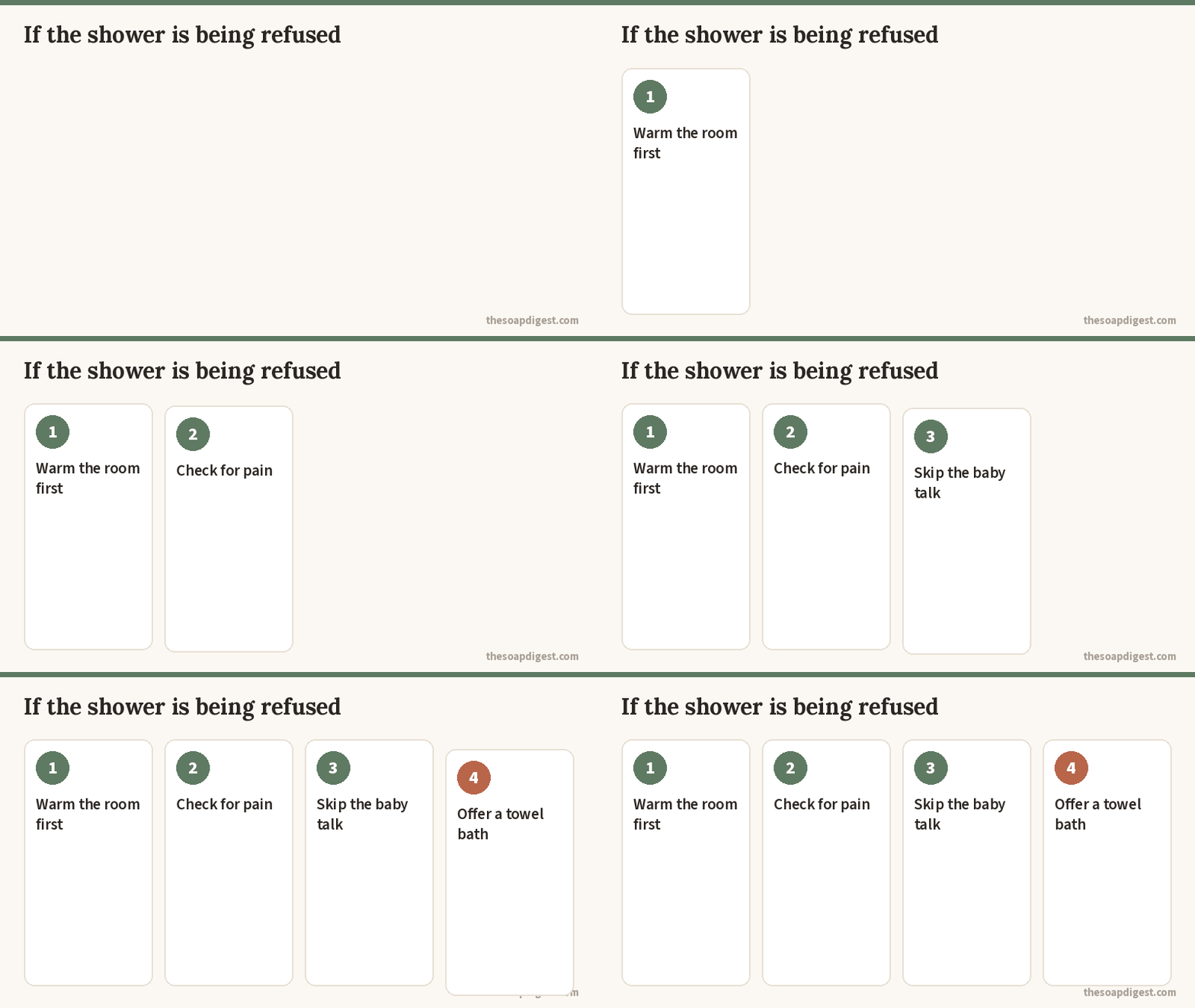
Treat “refuses” as the start of the question. Roughly half of people over 70 develop real, persistent difficulty with bathing, and the strongest predictors are physical and confidence-related rather than attitudinal, with a hospital stay as the largest single trigger. Before reaching for a script, check whether they can rise from a chair, whether anything hurts, whether the room is cold, and whether the sequence is getting lost.
Then be realistic about what the evidence supports. Put down a non-slip mat before buying hardware. Change the shape of the bath rather than the strength of the argument — a towel bath cut aggressive incidents by 60% without washing less of the person. Drop the sing-song voice, which has a measured effect roughly as large as anything else on offer. And know that almost none of this was studied in a home like yours, which is a reason to hold any advice lightly, including ours.
Frequently asked questions
What to do when an elderly parent refuses to bathe?
Work out which of several different problems you are actually looking at before you try to solve it. The published work splits the question into a capacity side and a willingness side, and they need opposite responses. On the capacity side, persistent difficulty with bathing is extremely common — in a Yale cohort of 754 community-living people aged 70 and over, 44 per cent developed it over about eight years — and its strongest predictors were being unable to rise from a chair, low confidence about bathing, and low physical activity. On the willingness side, the factors with trial evidence behind them are how the task is structured, whether the person is in pain, and how they are spoken to. Almost nothing in that list is addressed by asking again more firmly.
Why do elderly people refuse to bathe?
There is no single reason, which is the main practical point. The Alzheimer's Association describes people who do not perceive a need to bathe, who find it a cold and uncomfortable experience, and whose depth perception problems make stepping into water frightening. The Alzheimer's Society adds forgetting the steps involved, believing a bath has already happened, physical problems that make washing difficult, and low mood or depression. Separately from any of these, research on rejection of care has found that pain and the way a caregiver speaks both change how often refusal happens. Six or seven mechanisms look identical from the doorway and each one needs a different response.
Do grab bars and a shower seat actually help?
Less than you would expect, on the only longitudinal evidence available. Yale researchers followed 501 community-living people aged 73 and over who needed no help bathing, recorded which of five bath aids they already had, and watched who developed persistent bathing disability. Grab bars, a bath seat, a handheld shower spray and a long-handled brush did not forestall it; the bath seat was actually associated with greater risk, though not significantly after adjustment. Only non-skid mats or abrasive strips went the other way, with significantly lower odds of becoming unable to wash or dry the whole body. The authors are careful to say self-selection may explain some of this — people who are already struggling are the ones who buy a seat — and that trials would be needed to settle it. Install the mat first; it is also the cheapest item in the bathroom.
What to do when a dementia patient refuses to bathe?
Use the structure of the bath as the lever rather than the argument. A randomised trial in fifteen nursing homes compared usual care against a person-centred shower and against an in-bed towel bath with no-rinse soap; aggressive incidents during bathing fell 53 per cent and 60 per cent respectively, and neither method left residents less thoroughly washed. A systematic review of thirty studies on refusals of personal care in dementia found the most evidence for music played during care and for changing the bathing technique itself, and found that caregivers who avoided elderspeak — the sing-song, simplified register adults use on older adults — met with fewer refusals. Nothing in that literature eliminates refusal. It reduces it.
Can you force an elderly parent to shower?
Physically, no, and that is not only a practical limit. A 2026 discourse analysis of the most widely used dementia bathing training resource argues that the programme frames a person's refusal as a problem of technique, discomfort or pathology to be overcome, rather than as a decision, and raises the normalisation of persuasion when the outcome has already been decided for the person. That critique does not mean hygiene stops mattering, and skin that stays soiled is a medical problem rather than an aesthetic one. It does mean the question worth asking is how little washing is enough to keep someone well, which is a different question from how to win.
Does persimmon soap help if they will not shower?
Only to the extent that it gets used, which is the whole problem. Persimmon tannin soap is a rinse-off true soap aimed at the stale, greasy odour associated with ageing, so it needs the wash that is not happening. There is no published trial of persimmon soap on human body odour at all. The one controlled soap study we can find in anything like this population tested a different ingredient: 54 elderly residents who needed bathing assistance used soaps containing the antifungal miconazole nitrate, and reported less unpleasant neck and underarm odour. Notably, the compounds the authors recovered from the residents' T-shirts were 2-ethylbutanal, 6-methyl-5-hepten-2-one and geranylacetone — not 2-nonenal, the molecule the persimmon soap category is built around. That study came from a company selling the product, and it is one study.
When should I talk to their doctor about this?
Sooner than most families do, for two reasons. The first is that a change in smell is a symptom in its own right: the NHS advises seeing a GP if body odour has not improved with self-care and it is affecting self-esteem, you notice a change in how it usually smells, or sweating has suddenly increased, and it notes that conditions including diabetes, kidney disease and liver disease, and medicines such as antidepressants, can make body odour worse. The second is that a hospital stay is the single largest event in this whole picture — in the Yale cohort, hospitalisation carried a hazard ratio of 24.6 for the onset of persistent bathing disability — so the period right after a discharge is when help is most worth asking for, not least.
Sources
- Gill T.M., Han L., Allore H.G. (2007). Predisposing factors and precipitants for bathing disability in older persons. J Am Geriatr Soc 55(4):534-40. (Prospective cohort of 754 community-living residents aged 70 and older in Greater New Haven, assessed at home every 18 months for 6 years and interviewed monthly for a median of 61 months. "Over the course of nearly 8 years, 333 (44.2%) participants developed persistent disability in bathing." Nine predisposing factors were independently associated with it; "the strongest associations were found for inability to rise from a chair, low bathing self-efficacy, and low physical activity, each of which more than doubled the risk". Precipitant hazard ratios were 24.6 for hospitalization and 3.01 for restricted activity only, with predisposing factors and precipitants contributing 47.7% and 27.1% respectively.)
- Gill T.M., Han L., Allore H.G. (2007). Bath aids and the subsequent development of bathing disability in community-living older persons. J Am Geriatr Soc 55(11):1757-63. (Five hundred and one non-disabled community-living residents aged 73 and older, with the availability of grab bars, a bath seat, non-skid mats or abrasive strips, a handheld shower spray and a long-handled brush or sponge recorded at a home assessment, then followed monthly. "The presence of a bath seat was associated with a greater likelihood of developing persistent disability in bathing" and in each bathing subtask, though not significantly after adjustment; non-significantly greater risk was also seen for grab bars, handheld shower spray and long-handled brush. "In the adjusted analysis, the presence of nonskid mats or abrasive strips was associated with a 23% lower risk (nonsignificant) of persistent bathing disability and a lower likelihood of developing disability in washing and drying one's whole body, with corresponding odds ratios of 0.28 (P=.003) and 0.38 (P=.030)". The authors note self-selection cannot be fully accounted for and that clinical trials may be necessary.)
- Gill T.M., Allore H.G., Han L. (2006). Bathing disability and the risk of long-term admission to a nursing home. J Gerontol A Biol Sci Med Sci 61(8):821-5. (754 community-living persons aged 70 and over, non-disabled in four essential activities of daily living at baseline, followed monthly for a median of 75 months. Persistent bathing disability "increased the risk of a long-term nursing home admission by 77% (hazard ratio 1.77, 95% confidence interval 1.05 to 2.98), but had no effect on the risk of a short-term nursing home admission".)
- Backhouse T., Dudzinski E., Killett A., Mioshi E. (2020). Strategies and interventions to reduce or manage refusals in personal care in dementia: A systematic review. Int J Nurs Stud 109:103640. (Six databases plus a lateral search; 5,953 records screened, 36 articles relating to 30 studies included. "Twenty-eight of the studies (93%) were set in long-term care facilities, one in a psychogeriatric unit and one with community dwelling people." Eight of the thirty focused on bathing. "There was most evidence for music interventions and different bathing techniques, and interaction and communication styles were associated with reduced refusals." No evidence was found that slow-stroke massage or aromatherapy reduced refusals. Conclusion: "Some non-pharmacological interventions can reduce, but not eliminate, refusals of care". The authors name the absence of research in community settings and the limited research involving family carers as gaps.)
- Golding-Day M., Whitehead P., Radford K., Walker M. (2017). Interventions to reduce dependency in bathing in community dwelling older adults: a systematic review. Syst Rev 6(1):198. (A systematic search of CENTRAL, MEDLINE, EMBASE, AMED, CINAHL, PsycINFO and OTSeeker for randomised trials, non-randomised controlled trials and controlled before-and-after studies of interventions to reduce dependency in bathing. "The search process identified one study for inclusion in the review", an occupational-therapist-delivered bathing intervention after hospital discharge showing modest improvements to be interpreted with caution. "Despite evidence suggesting the importance of addressing bathing difficulties ... there is a dearth of evaluative or interventional research studies." Competing interests declared: the authors were involved in the ongoing BATH-OUT trial.)
- Sloane P.D., Hoeffer B., Mitchell C.M., McKenzie D.A., Barrick A.L., Rader J., Stewart B.J., Talerico K.A., Rasin J.H., Zink R.C., Koch G.G. (2004). Effect of person-centered showering and the towel bath on bathing-associated aggression, agitation, and discomfort in nursing home residents with dementia: a randomized, controlled trial. J Am Geriatr Soc 52(11):1795-804. (Nine skilled nursing facilities in Oregon and six in North Carolina; 73 residents who became agitated during bathing and 37 nursing assistants, randomised to usual care, a person-centred shower, or an in-bed towel bath with no-rinse soap. Baths were videotaped and coded by blinded raters. Aggressive incidents fell 53% with person-centred showering and 60% with the towel bath, both P<.001; discomfort was lower with the towel bath, P=.003; neither intervention resulted in fewer body parts being bathed.)
- Shaw C.A., Ward C., Gordon J., Williams K.N., Herr K. (2022). Elderspeak communication and pain severity as modifiable factors to rejection of care in hospital dementia care. J Am Geriatr Soc 70(8):2258-2268. (Eighty-eight care encounters between 16 hospitalised people living with dementia and 53 nursing staff, audio-recorded, transcribed and coded for semantic, pragmatic and prosodic features of elderspeak, with rejection of care scored in real time on the Resistiveness to Care Scale. "Nearly all (96.6%) of the encounters included some form of elderspeak" and 48.9% included rejection-of-care behaviours. "A 10% decrease in elderspeak was associated with a 77% decrease in odds of RoC (OR = 0.23, 95% CI = 0.03, 0.68)", and "a one-unit decrease in pain severity was associated with 73% reduced odds of RoC (OR = 0.27, CI = 0.12, 0.45)".)
- Ahluwalia S.C., Gill T.M., Baker D.I., Fried T.R. (2010). Perspectives of older persons on bathing and bathing disability: a qualitative study. J Am Geriatr Soc 58(3):450-6. (In-depth semi-structured interviews in the homes of 23 community-living persons aged 78 and older, analysed with a Grounded Theory framework. Three themes emerged, including "the importance and personal significance of bathing to older persons" and "older persons' anticipation of and responses to bathing disability". The authors note that "quantitative disability assessments may not capture the bathing modifications made by older persons in anticipation of disability and may result in missed opportunities for early intervention".)
- Naik A.D., Concato J., Gill T.M. (2004). Bathing disability in community-living older persons: common, consequential, and complex. J Am Geriatr Soc 52(11):1805-10. (Cross-sectional study of 626 community-living persons aged 73 and older in greater New Haven, with trained research nurses recording which bathing subtasks were affected and the person's own main reasons, up to three. "Disability in bathing was present in 195 (31%) participants", who reported a mean of 4.0 affected subtasks. "The prevalence rate of disability for the eight prespecified bathing subtasks ranged from 25% for taking off clothes to 75% for leaving the bathing position." "The majority of participants (59%) provided more than one reason for bathing disability. The most common reasons cited by participants for their bathing disability were balance problems (28%), arthritic complaints (26%), and fall or fear of falling (23%)." The reasons are self-reported by the older people themselves rather than by caregivers.)
- Morris P., McCloskey R., Durkee-Lloyd J., O'Regan K. (2026). Clean, Pleasant, Governed: A Critical Discourse Analysis of Bathing Without a Battle. Nurs Inq 33(4):e70155. (A three-part Faircloughian critical discourse analysis of the widely circulated dementia bathing training video. "Findings indicate that the program positioned itself as an early form of clinical practice guideline by linking instructional conventions with the authority of academic research", and that "clients' refusals are positioned as problems (of technique, discomfort, or pathology) to overcome rather than expressions of agency". The paper closes on "the ethical implications of this framing for autonomy in dementia care and the normalization of persuasion when care outcomes are predetermined". This is an analysis of a training text, not a clinical trial.)
- Alzheimer's Association: Bathing — caregiving daily care guidance (accessed 21 October 2026). ("People living with Alzheimer's may be uncomfortable receiving assistance with such an intimate activity." "They may also have depth perception problems that make it scary to step into water." "They may not perceive a need to bathe or may find it a cold, uncomfortable experience." "The person may not sense when the water is dangerously hot or may resist bathing if the water is too cool." Also recommends checking that the room temperature is pleasant, bathing at the same time of day the person is used to, using a non-slip mat, grab bars and a seat, and sponge bathing between full baths.)
- Alzheimer's Society: Washing and dressing — what to do if a person with dementia refuses (accessed 21 October 2026). (Prompts carers to work out the underlying reason, asking "have they forgotten the steps needed to wash themselves or get dressed?" and "do they think they have already had a bath or shower?", to "check for physical problems that make washing or putting on clothes difficult", and to consider whether the person is feeling low or depressed. Practical suggestions include a bed bath with a wet sponge or cloth, flexibility about the time of day, distraction when the person becomes distressed, stepping away if they become aggressive, and raising hygiene concerns with their GP.)
- Murphy C., Schubert C.R., Cruickshanks K.J., Klein B.E., Klein R., Nondahl D.M. (2002). Prevalence of olfactory impairment in older adults. JAMA 288(18):2307-12. (Population-based study of 2,491 adults aged 53 to 97. Olfactory impairment rose steeply with age, reaching 62.5% in those aged 80 to 97.)
- Ozeki C., Moro O. (2016). A study of the suppression of body odour in elderly subjects by anti-fungal agents. Int J Cosmet Sci 38(3):312-8. (Prospective study of 54 elderly subjects in a nursing facility who needed bathing assistance, using three body soaps over six weeks, two weeks per soap, with subjects and examiners blinded to sample versus control. "Suppression of unpleasant body odour of the neck and axilla was reported in subjects who used the sample soap", which contained miconazole nitrate. GC/MS identified three common volatile compounds from the subjects' T-shirts — 2-ethylbutanal, 6-methyl-5-hepten-2-one and geranylacetone — reduced by the sample soap. 2-Nonenal is not among the compounds reported. Both authors at Mochida Healthcare Co., Ltd.; company-affiliated research, and a single study.)
- PubMed title-and-abstract searches on washing and age-related body odour, run on 21 October 2026. (shower*[TIAB] AND (odor[TIAB] OR odour[TIAB]) AND elderly[TIAB] returns 0. "bathing frequency"[TIAB] AND (odor[TIAB] OR odour[TIAB]) returns 1, and it is a trial of saltwater baths in epidermolysis bullosa, PMID 25644039. "2-nonenal"[TIAB] AND (bathing[TIAB] OR shower*[TIAB] OR washing[TIAB]) returns 3, and all three concern 4-hydroxy-2-nonenal, a different compound: protein carbonylation tagging (22012663), ram sperm function (8107017) and microsomal glucose-6-phosphatase inhibition (1309686). How often an older person washes, and what that does to the smell, has not been measured.)
- Haze S., Gozu Y., Nakamura S., Kohno Y., Sawano K., Ohta H., Yamazaki K. (2001). 2-Nonenal newly found in human body odor tends to increase with aging. J Invest Dermatol 116(4):520-4. (2-Nonenal was "detected only in older subjects (40 y or older)" and is generated when omega-7 unsaturated fatty acids on the skin surface are oxidatively decomposed. All authors were at Shiseido Co. Ltd., which later sold products aimed at this odour; company-affiliated research.)
- NHS: Body odour (BO) — self-care and when to see a GP (accessed 21 October 2026). ("You have body odour that has not got better after treating it yourself and: it's affecting your self-esteem; you notice a change in how it usually smells; you suddenly begin to sweat much more than usual." Things that can make body odour worse include "having a condition like diabetes, kidney disease or liver disease" and "certain types of medicine, such as antidepressants".)
- r/AgingParents: "Shower refusal" (read 21 October 2026). A family carer describes installing shower bars and a shower seat for an 86-year-old father and finding it made no difference; replies cover fear of falling, cold, uneven-looking floors, hired help, adult day programmes and non-slip strips.
- r/dementia: "I Don't Know if My Dad Still Knows How to Bathe" (read 21 October 2026). The thread turns on sequencing rather than willingness — a father who agrees to bathe and then cannot find the soap, put on the clean clothes, or complete the order of the task.
- r/dementia: "I'm so tired of the refusal to take a bath" (read 21 October 2026). A long thread on weeks of refusal in which two separate commenters recommend persimmon soap unprompted for the smell, alongside rinse-free wipes, heating the bathroom first and running the bath before asking.
- TanniBar: ingredients, fragrance-free claim, refund and shipping terms (brand's own page, last re-checked 19 October 2026)