Home › Persimmon Soap › Does persimmon soap work?
Persimmon SoapDoes Persimmon Soap Actually Work? What the Science Says (and What Users Report)
The nonenal science is real. The proof that persimmon soap removes it is thinner than the labels suggest. Here's where the evidence stands, and why so many people still swear by it.

Disclosure: The Soap Digest is owned by the same company that makes TanniBar. We rank it first and we earn money when you buy it. Every other brand here is linked without payment, and we try to describe each one fairly. Check the facts for yourself. How we handle this.
In this guide
Type “is persimmon soap” into Google and the suggestions tell you how people feel about it: legit, a hoax, a gimmick, worth the hype. It’s a fair question. The bars aren’t cheap, the labels make big promises, and the smell they target is one most of us would rather not discuss.
So we went through the published research and hundreds of public comments from people who have used it. Here’s the short answer, followed by the detail.
The short answer
- The smell is real. Researchers have linked a compound called 2-nonenal to the “older person” body odor, and they found it only in people aged 40 and over.
- The mechanism is plausible. Persimmon tannins are big polyphenols that bind lots of small molecules. A Japanese cosmetics patent reports that persimmon tannin neutralized nonenal gas in lab tests.
- The human proof is thin. We found no peer-reviewed clinical trial showing that persimmon soap reduces body odor. A PubMed search for “nonenal AND persimmon” returns nothing.
- Users are mostly positive, especially for the neck, ears and scalp. The failures cluster around one thing: the odor wasn’t nonenal to begin with.
What is nonenal, and is “old person smell” real?
Yes. The best-known study came from Shiseido researchers in 2001. They analyzed body odor from people aged 26 to 75 and analyzed it with gas chromatography–mass spectrometry. 2-Nonenal, an unsaturated aldehyde with a greasy, grassy smell, turned up only in the participants aged 40 and over. It correlated with omega-7 fatty acids and lipid peroxides on the skin. The authors suggested it “may be involved in the age-related change of body odor.”
A 2016 study measured emissions from the nape of the neck and found that 2-nonenal rose with age in both men and women. More recent work has focused on building sensors to detect it. The science on what the smell is holds up well.

Why persimmon? The tannin theory
Kakishibu is fermented juice from unripe, astringent persimmons. Japan has used it for centuries as a dye, a wood and paper preservative, and a deodorizer. The active part is persimmon tannin, a condensed tannin with many binding sites.
The theory behind the soap works like this:
- Nonenal forms in the oily film on older skin.
- Regular soap lifts oil, but some odor molecules stay behind.
- Tannin in the lather binds the aldehyde, so it rinses off with the water instead of lingering.
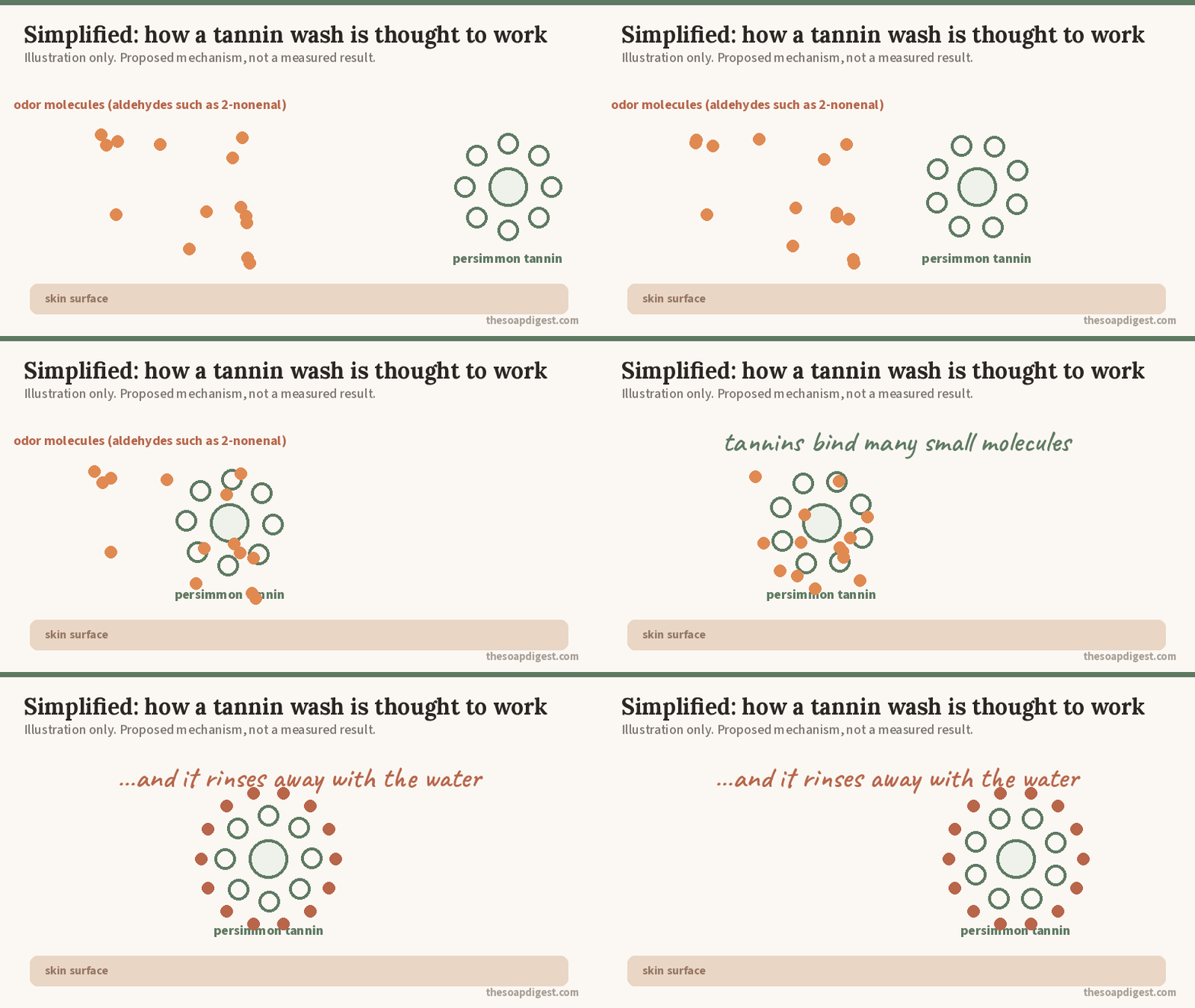
What supports this? A patent from the Japanese cosmetics company Menard reports that persimmon tannin removed nonenal gas in a lab test, plus a small 10-person, two-week product trial. We could only read it through a secondary summary, and it isn’t peer-reviewed. A separate 2011 Japanese dental study found that a 1% persimmon tannin rinse reduced sulfur compounds in bad breath in 100 people. That’s encouraging for tannin as a deodorizer, but breath isn’t skin, and sulfur compounds aren’t nonenal.
A note on “clinically proven.” Some persimmon brands use phrases like “clinically proven” or cite self-assessment surveys. We couldn’t find published, peer-reviewed trials behind those claims. That doesn’t mean the soaps don’t work. It means you should judge them on your own results and on a good refund policy.
What real users say
We read hundreds of comments across r/Menopause, r/Perimenopause, r/AskWomenOver60, r/bodyodor, r/hygiene and r/AusSkincare. The pattern was consistent.
When it works, people are surprised by how well. Menopause and perimenopause threads are full of posts titled “persimmon soap really works” and “thank God for persimmon soap”. Several people describe buying it for a father or husband and noticing the difference on his neck and pillow.
“I used some on my husband's neck this morning… completely took the smell away.”
When it doesn’t, the odor usually wasn’t nonenal. In r/bodyodor, where many posters are younger and dealing with sweat or bacterial odor, the replies are much cooler: “didn’t work for me,” “don’t waste your money.” One commenter summed it up:
“I think it only works for a very specific odor – old people smell.”
Skeptics raise fair points. In r/AusSkincare, one commenter noted that most of the data comes from the companies themselves. That’s a fair criticism, and it matches what we found.
So, should you try it?
Persimmon soap is a reasonable, low-risk experiment if:
- you’re over roughly 40 (or going through menopause) and notice a stale, oily or “dusty” smell,
- it’s strongest on the neck, scalp, pillowcases or collars rather than your armpits,
- ordinary washing and deodorant haven’t shifted it.
It’s probably not the right tool if your odor is sharp and sweaty, localized to the armpits or groin, sudden, or accompanied by other symptoms. A sudden change in body odor can have medical causes, including diabetes, kidney or liver problems, infections and some medications, so it’s worth mentioning to a doctor.
If you do try it, technique matters as much as the brand. Use it daily on the right areas, let the lather sit briefly, and wash your bedding at the same time. Our step-by-step guide covers it, and our comparison of five bars shows how they differ on scent, price and guarantee.
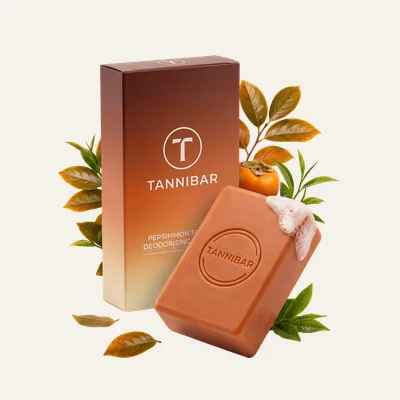
TanniBar Persimmon Tannin Bar
If you'd rather not add a new scent while you test it, TanniBar is fragrance-free and has a 30-day refund with no return needed.
Check price →We own TanniBar and earn from sales. 30-day refund, no return needed.The bottom line
The science clearly supports nonenal as a real, age-linked odor, and it gives a plausible reason tannins could help. It doesn’t yet include a proper trial of persimmon soap on people. User reports fill some of that gap, and for the specific smell it targets, they’re mostly positive. Go in with realistic expectations, a fair test period and a good refund policy.
Frequently asked questions
Is persimmon soap a gimmick?
Not entirely. The odor compound it targets, 2-nonenal, is well documented, and tannins are known to bind many small molecules. What's missing is a peer-reviewed human trial of persimmon soap on body odor. Treat brand claims like "clinically proven" with caution, but user experience is broadly positive.
Is persimmon soap antibacterial?
Persimmon tannin has shown antimicrobial activity in lab studies, but most persimmon soaps aren't sold or tested as antibacterial products. If your odor is sweat- or bacteria-driven (for example teenage armpit odor), a regular antibacterial wash may help more.
Why does persimmon soap work for some people and not others?
Mostly because not all body odor is nonenal. Hormonal, sweat-driven, bacterial, fungal and diet-related odors have different causes. Persimmon soap is aimed at one specific, oily, age-related smell.
Sources
- Haze S. et al. (2001). 2-Nonenal newly found in human body odor tends to increase with aging. J Invest Dermatol 116:520–4.
- Kimura K. et al. (2016). Measurement of 2-nonenal and diacetyl emanating from human skin surface. J Chromatogr B 1028:181–5.
- Ishino K. et al. (2010). Lipid peroxidation generates body odor component trans-2-nonenal covalently bound to protein in vivo. J Biol Chem.
- Iitani K. et al. (2023). Gas-phase biosensors (bio-sniffers) for measurement of 2-nonenal. Sensors.
- Persimmon tannin as a deodorant agent: summary of Menard patent JP2001-302483 (secondary source; patent data, not peer-reviewed)
- Kurata et al. (2011). Persimmon tannin and oral malodor. Japanese Journal of Conservative Dentistry. (breath odor, not skin)
- r/Menopause: "Persimmon soap really works! (Who knew!?)"
- r/bodyodor: "Has anyone tried persimmon soap?"
- r/AusSkincare: "Persimmon soap recommendations please"