Home › Nonenal & Body Odor › Nonenal research index
Nonenal & Body OdorThe Nonenal Research Index: Every Human Study on Age-Related Body Odor
2-Nonenal gets cited constantly and read rarely. This is every peer-reviewed human study we could find on it, what each one actually measured, and an honest account of the gaps — including the one directly under our own product.

Disclosure: The Soap Digest is owned by the same company that makes TanniBar. We rank it first and we earn money when you buy it. Every other brand here is linked without payment, and we try to describe each one fairly. Check the facts for yourself. How we handle this.
In this guide
The molecule 2-nonenal is cited far more often than it is read. It turns up in product copy, in news write-ups about “old person smell”, and in a great many blog posts that all seem to be paraphrasing the same single paper from 2001 without having opened it.
So we opened them. This page is an index of the peer-reviewed research on 2-nonenal as it relates to human age-related body odor: what each study measured, how many people were involved, and — the part usually left out — what it does not show. It includes the gap sitting directly underneath our own product.
The state of the evidence, in five lines
- The molecule is real and the age association is replicated. 2-Nonenal was identified in human body odor in 2001 and its emission from skin has since been measured with at least four independent methods.
- The mechanism is characterised. It is an oxidation product of ω7 unsaturated fatty acids in skin lipids, and it forms protein adducts in living tissue.
- The age link has been shown in both sexes, not just in men, and it rises with age rather than switching on at a threshold.
- Exactly one human intervention study has reported a reduction in 2-nonenal emission — a seven-day dietary crossover in 14 adults.
- There is no human trial of persimmon soap. Zero results, on the searches listed below, run the day this page was published.
How we built this index
Stating the method matters more than the conclusion, because it lets you check us.
On 20 September 2026 we queried PubMed via the NCBI E-utilities API with these searches, then read the abstract of every result:
"2-nonenal"[TIAB] AND (odor OR odour OR skin OR aging OR ageing)[TIAB]— 80 results"nonenal"[TIAB] AND "body odor"[TIAB]— 10 results"aging odor"[TIAB] OR "age odor"[TIAB] OR "old person smell"[TIAB]— 5 resultspersimmon AND tannin AND (odor OR deodor* OR malodor)[TIAB]— 0 results"persimmon soap"— 0 resultspersimmon AND "2-nonenal"— 0 results
Inclusion: studies measuring 2-nonenal in or from human skin, characterising its formation, developing a method to measure it, or testing something intended to reduce it. Exclusion: the large food-science literature where 2-nonenal appears as a flavour compound in beer, coffee, meat and cucumber, and the much larger literature on 4-hydroxy-2-nonenal, which is a different molecule (see below). After filtering, fourteen records were on topic.
We are not a systematic review, we did not search Embase, Scopus or the Japanese-language literature, and a company-funded study that was never published in a journal would not appear here at all. Treat this as a careful reading list, not a final word.
What is well established
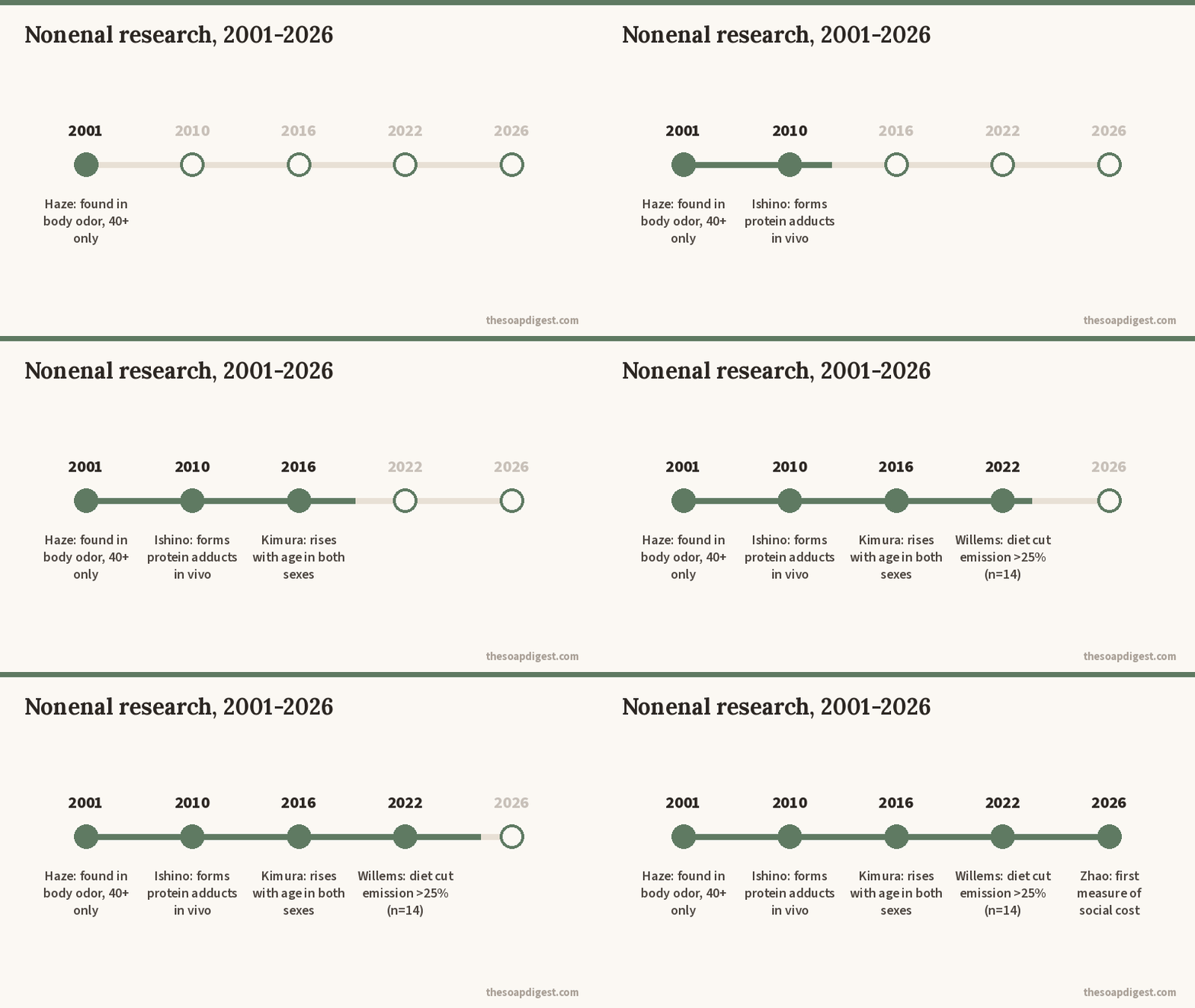
2-Nonenal is in human body odor and tracks with age. Haze and colleagues (2001) analysed the body odor of subjects aged 26 to 75 by headspace GC/MS. 2-Nonenal was detected only in subjects aged 40 or older. In the same work, ω7 unsaturated fatty acids and lipid peroxides in skin surface lipids also rose with age, and the amount of 2-nonenal correlated positively with both. Degradation tests confirmed 2-nonenal was generated when ω7 unsaturated fatty acids were oxidatively broken down.
This is the paper everything else cites, so two things are worth saying plainly. It is genuinely good work and its central finding has held up. It was also conducted by researchers at Shiseido, a cosmetics company — which does not make it wrong, but does mean the foundational paper in this field came from industry, and you should know that when you see it cited as neutral background.
It rises with age in women as well as men. Kimura and colleagues (2016) built a passive flux sampler that sits on the skin and traps emitted gases for GC/MS. Emission flux of 2-nonenal increased with age in both male and female volunteers. The same study found diacetyl — long described as a “middle-aged male odor” — peaked in the 30s and declined after 40, and was not male-specific either. They fixed the nape of the neck as the sampling site because emission varied sharply by body location and the nape has dense sebaceous and eccrine glands.
That last detail is the practical one, and it is why every sensible washing guide tells you to start at the neck and scalp rather than the armpits.
The formation mechanism is characterised. Ishino and colleagues (2010), in the Journal of Biological Chemistry, showed that trans-2-nonenal is generated endogenously during the peroxidation of polyunsaturated fatty acids, and that it covalently modifies proteins — reacting preferentially with lysine residues to form a specific adduct. They raised a monoclonal antibody against it and detected the adducts in living tissue. This is the study that moves 2-nonenal from “a smell people noticed” to “a documented product of lipid peroxidation in the body”.
The tension nobody mentions
Here is something that should be better known, because it complicates the tidy story.
Hayashi and colleagues (2003) measured skin surface lipids in an older group (mean age 83.7) against a younger group (mean age 22.2). Free fatty acids and squalene were significantly lower in the older group. Linoleic acid composition fell by 40%. And monounsaturated acids including palmitoleic acid — the ω7 precursor from which 2-nonenal is formed — also decreased significantly with age.
So the precursor goes down while the odor goes up. The authors flagged this as interesting rather than resolving it. The likely explanation is that what matters is not how much precursor is present but how much of it is being oxidised, which depends on antioxidant capacity rather than raw lipid quantity. But that is an inference, not a finding, and anyone telling you confidently that “as you age you produce more nonenal precursor” is going beyond the published data.
How it gets measured
Four independent approaches now exist, which is part of why the age association is credible.
- Passive flux sampler + GC/MS — Kimura 2016. A sampler creates a headspace on the skin; trapped gases are extracted and quantified.
- Headspace SPME + GC/MS from a gauze wipe — Saito and colleagues (2021). Limit of detection 22 picograms on gauze, linear from 1–50 ng. They applied it to lifestyle variables including cosmetics use, food intake, smoking and stress load.
- Enzyme biosensors (“bio-sniffers”) — Iitani and colleagues (2023) built fluorescence sensors using aldehyde dehydrogenase and enone reductase 1, quantifying 2-nonenal vapour over 0.4–7.5 ppm with a detection limit of 0.23 ppm. The enone reductase version was far more selective.
- Nanomechanical and sensor-array methods, which can discriminate 2-nonenal from chemically similar saturated aldehydes.
Nothing here is a consumer device. If you see a product claiming to measure your nonenal at home, it is not using any of these.
What has been shown to reduce it
This is the shortest section, and that is the point.
One human study. Willems and colleagues (2022) gave 14 middle-aged and older adults (nine male, mean age 55) New Zealand blackcurrant powder — 6 g/day providing 138.6 mg anthocyanins — for seven days in a crossover design, then sampled skin volatiles at the nape of the neck for one hour. Compared with control, emission of six skin VOCs including 2-nonenal was lower by more than 25%. Some other compounds rose.
Take it for what it is: fourteen people, one week, one sampling site, a commercially available supplement, and a measurement of emission rather than of whether anyone could smell a difference. It is the most interesting result in the field and it is nowhere near a recommendation.
Materials work exists but is not about people. Recent papers describe fabrics engineered to adsorb and catalytically break down 2-nonenal, and plant compounds that scavenge it in vitro. These are laboratory results on materials, not trials on human skin.
The gap under our own product
We sell a persimmon tannin soap, and we rank it first on our persimmon soap comparison. So this section needs to be unambiguous.
There is no published human trial of persimmon soap for 2-nonenal or age-related body odor. On the day this page was published, "persimmon soap" returned zero PubMed results and persimmon AND "2-nonenal" returned zero.
What does exist is adjacent and worth reading honestly:
- Persimmon polyphenols do have measurable deodorising activity — Li and colleagues (2026) characterised their cooperative removal of ammonia and hydrogen sulfide in solvent systems. But ammonia and H₂S are basic and sulfurous gases neutralised by acid-base chemistry. 2-Nonenal is an aldehyde. Activity against one does not transfer to the other.
- Kakishibu’s protein-binding is documented — Tokin and colleagues (2021) showed fermented persimmon juice inhibits microbial enzymes through non-specific tannin–protein interactions. That is a real mechanism, and it is the honest basis for the “tannins bind things” story. It was demonstrated on cellulose-degrading enzymes in the context of wood and paper protection, not on skin.
So the mechanism is plausible and the product evidence is absent. Both halves of that sentence are true, and we have written the whole site around saying so — see does persimmon soap actually work for the longer version.
Commonly confused with
Four mix-ups account for most of the bad citations we see, including in otherwise careful articles.
- 4-Hydroxy-2-nonenal (4-HNE) is a different molecule with a vast literature in Alzheimer’s, ferroptosis and oxidative-stress research. It is not the body-odor compound. A PubMed search that picks up 4-HNE papers will wildly overstate how much “nonenal research” exists — we caught one in our own search and excluded it.
- Diacetyl is a separate age-related skin volatile with a different age curve, peaking in the 30s (Kimura 2016).
- 3M3SH and thioalcohols are the bacterial underarm odor compounds, produced by Staphylococcus hominis acting on apocrine secretions (Minhas 2018). Different smell, different cause, different fix — the distinction we work through in perimenopause body odor.
- Cucumber aroma. (E)-2-nonenal is one of the dominant volatiles in cucumbers. Same molecule, which is exactly why the original paper described the smell as “greasy and grassy”.
The social evidence, for once measured
Most writing about this smell is about the person who has it. One 2026 paper looked at what it does to everyone else.
Zhao and colleagues (2026) combined field measurement in 35 elderly solo dwellings in Fuyang, China with an experiment exposing 75 participants to standardised (E)-2-nonenal under three conditions. Higher odor significantly reduced visitors’ stated intention to return, with the effect concentrated in the step from no odor to low odor — the first detectable trace did most of the damage. A combined design package of ventilation plus an entrance buffer plus enclosed storage sustained higher intention than ventilation alone.
The authors are careful that the design cannot isolate which component did the work, and the behavioural effect was not matched by the physiological measures. But it is the first study we found putting a number on the social cost, and it supports something the cleaning threads say constantly: a faint smell is not a small problem, and ventilation alone is not the whole answer. We go through the practical version in old person smell in a house.
When to see a doctor
Body odor that changes noticeably and recently, or comes with night sweats, weight change or a rash, is worth a GP appointment rather than a new soap — the NHS advises seeing a doctor when body odour changes and self-care hasn’t helped. A sudden change in how things smell to you, including smelling something nobody else can, should also be raised with a clinician. None of the research on this page is diagnostic, and none of it was conducted to guide individual treatment.
Corrections and reuse
This page exists to be cited and to be corrected. If you are writing about age-related body odor and want to quote it, please do. If we have missed a paper, misread a result, or a new study has landed, tell us through the contact page — we will correct it and say what changed and when.
We are not a neutral party. We sell one of the products in this category and the disclosure sits at the top of every page. The way we try to handle that is by being harder on the evidence for our own product than anyone else would be, which is why the shortest section on this page is the one about ours.
Last full re-check of the literature: 20 September 2026.
Frequently asked questions
Is 2-nonenal real, or is it marketing?
The molecule is real and well documented. It was identified in human body odor by Haze and colleagues in 2001, its formation from lipid peroxidation was characterised in the Journal of Biological Chemistry in 2010, and its emission from skin has been measured repeatedly since with independent methods. What is marketing is the leap from "this molecule exists and rises with age" to "this product removes it", which is a separate claim needing separate evidence.
Is there a clinical trial of persimmon soap?
We could not find one. On 20 September 2026, a PubMed search for "persimmon soap" returned zero results, and persimmon AND "2-nonenal" returned zero results. Persimmon tannin has documented deodorising activity against some odour gases in laboratory systems, but that is not the same as a trial of a soap on human skin odor. We state this on every page where it matters, including the ones selling our own bar.
Does anything have evidence for reducing 2-nonenal in people?
One small human study. Willems and colleagues (2022) gave 14 middle-aged and older adults New Zealand blackcurrant powder for seven days in a crossover design and measured skin volatiles at the nape of the neck; 2-nonenal emission was more than 25% lower than control. That is fourteen people, one week, one site on the body — interesting, not settled, and not a reason to buy anything.
Why is nonenal described as smelling greasy and grassy?
That phrasing comes from the chemistry literature and is used in the original 2001 paper. The same molecule, (E)-2-nonenal, is also one of the dominant aroma compounds in cucumbers, which is where the "green" note comes from. Descriptions people give in everyday language — musty, stale, like old books or a grandparent's house — are not in conflict with it; they're the same smell at different concentrations and mixed with everything else on skin.
Can I reuse this page?
Yes. It's here to be cited. Quote it, link to it, correct it. If you're a journalist or researcher and we've got something wrong or missed a paper, tell us through the contact page and we'll fix it and note the change.
Sources
- Haze S. et al. (2001). 2-Nonenal newly found in human body odor tends to increase with aging. J Invest Dermatol 116(4):520–4. (authors affiliated with Shiseido Co. Ltd.)
- Hayashi N. et al. (2003). Effect of sunlight exposure and aging on skin surface lipids and urate. Exp Dermatol 12(Suppl 2):13–7.
- Ishino K. et al. (2010). Lipid peroxidation generates body odor component trans-2-nonenal covalently bound to protein in vivo. J Biol Chem 285(20):15302–13.
- Kimura K. et al. (2016). Measurement of 2-nonenal and diacetyl emanating from human skin surface employing passive flux sampler-GCMS system. J Chromatogr B 1028:181–5.
- Saito K. et al. (2021). Headspace SPME/GC-MS for the determination of 2-nonenal and its application to body odor analysis. Molecules 26(19):5739.
- Willems M.E.T. et al. (2022). Intake of New Zealand blackcurrant powder affects skin-borne volatile organic compounds in middle-aged and older adults. J Diet Suppl 19(5):603–620.
- Iitani K. et al. (2023). Gas-phase biosensors (bio-sniffers) for measurement of 2-nonenal. Sensors 23(13):5857.
- Zhao S. et al. (2026). Age-related odor and design buffering in elderly solo housing: two-stage study of visitor behavioral intention. Sci Rep (online ahead of print).
- Tokin R. et al. (2021). Inhibition of LPMOs by fermented persimmon juice (kakishibu). Biomolecules 11(12):1890.
- Li B. et al. (2026). Cooperative removal of NH3 and H2S by persimmon polyphenols with natural deep eutectic solvent systems. Foods 15(5):939.
- PubChem compound summary: (E)-2-nonenal (CID 5283335).
- Minhas G.S. et al. (2018). Structural basis of malodour precursor transport in the human axilla. eLife 7:e34995.
- NHS: Body odour (BO) — self-care and when to see a GP.
- TanniBar product page (brand's own claims). (company information; we own TanniBar)