Home › Persimmon Soap › Persimmon soap vs Lume
Persimmon SoapPersimmon Soap vs Lume: Which One Does Your Smell Need?
In menopause and hygiene threads the two names arrive together, as if they were rival brands of the same thing. They aren't. One is a rinse-off soap aimed at an aldehyde in skin oil; the other is a leave-on acidic deodorant aimed at what bacteria do to sweat. Buying the wrong one is the most common reason people report that it 'did nothing'.

Disclosure: The Soap Digest is owned by the same company that makes TanniBar. We rank it first and we earn money when you buy it. Every other brand here is linked without payment, and we try to describe each one fairly. Check the facts for yourself. How we handle this.
In this guide
Ask in any perimenopause or hygiene thread what to do about a new smell and you will get the same two answers within minutes: persimmon soap, or Lume. They arrive together so consistently that most people assume they’re competitors — two brands solving one problem, pick the cheaper one.
One reader put the real question plainly in r/Perimenopause this year, asking what it is about the two of them that makes them good at washing away the funkiness. Nobody in the thread answered it. The comments went straight to substitutes — glycolic acid, witch hazel, hypochlorous spray, benzoyl peroxide — without anyone establishing what the original two were supposed to be doing.
“What is it about Lume and persimmon soap that makes them good”
That gap is worth closing, because the answer decides which one you should buy.
The short version
- They are not rival brands of the same product. Persimmon soap is a rinse-off soap; Lume is a leave-on deodorant. The FDA treats those as different kinds of product, and they work at different moments.
- They target different molecules. Persimmon tannin soap is used against 2-nonenal, an aldehyde formed when skin oils oxidize. A mandelic acid deodorant is aimed at odor that bacteria make out of sweat.
- Location is the fastest clue. Neck, ears, upper back, scalp and pillowcase point to the oil-borne odor. Armpits and groin point to the bacterial one.
- Many people have both, in which case the two products are complements rather than alternatives.
- Neither has a published head-to-head trial. What follows is what the evidence supports and what it doesn’t.
They aren’t the same category of product
Start with what each thing legally is.
A persimmon (kakishibu) soap bar is soap in the strict sense. TanniBar’s ingredient list, for example, is persimmon tannin, green tea leaf extract, vegetable glycerin, shea butter, saponified coconut and palm oil, vitamin E and water. “Saponified” is the operative word: the FDA’s definition of soap turns on whether the bulk of the non-volatile matter consists of alkali salts of fatty acids and whether the product is sold solely as soap. Most persimmon bars qualify. They are cleansers, used for a minute and rinsed away.
Lume is a deodorant — a leave-on cosmetic. The brand markets its deodorants as aluminium-free and sells a clinical-strength antiperspirant spray as a separate product, which is a meaningful distinction rather than marketing hair-splitting. The FDA classifies an antiperspirant as a drug, because reducing sweat is intended to affect a function of the body, while something that only addresses odor is a cosmetic. A deodorant does not reduce how much you sweat. It changes what happens to the sweat once it’s there.
So one product removes something and leaves; the other stays behind and interferes with a process. Already they are doing different jobs.
They are aimed at different molecules
This is the part the threads skip.
What persimmon soap is aimed at. Shiseido researchers reporting in the Journal of Investigative Dermatology in 2001 identified 2-nonenal in human body odor and found it tended to increase with age. Later work filled in the mechanism and the measurement: 2-nonenal is generated by lipid peroxidation of skin surface lipids and can be found covalently bound to protein in living skin, and a 2016 Japanese study sampling volatiles directly off the skin surface confirmed that emissions rise with age — in women as well as men, with the nape of the neck as a productive sampling site.
Crucially, 2-nonenal is oil-soluble and not water-soluble. PubChem lists it as soluble in most fixed oils and insoluble in water, with an XLogP of 3.1. It travels with sebum. That is why this odor concentrates where skin is oily and why it ends up embedded in pillowcases and collars rather than rinsing out of them.
What a whole-body deodorant is aimed at. Underarm odor has a different origin entirely. Apocrine sweat is odorless when it leaves the gland; skin bacteria convert precursor molecules in it into the compounds you can actually smell. A 2018 eLife paper described the transporter that lets Staphylococcus hominis take up the precursor of 3-methyl-3-sulfanylhexan-1-ol, one of the sulphurous thioalcohols responsible for that sharp smell. Earlier chemistry had already identified the other family: (E)-3-methyl-2-hexenoic acid and related medium-chain acids, again bacterial products rather than oxidation products.
Lume’s own explanation of its formula fits that picture. The brand says odor-causing bacteria thrive in a higher-pH environment, that fluids such as sweat raise skin pH, and that mandelic acid is acidic enough to bring it back down. The underlying premise is well supported — a much-cited 2006 review concluded that natural skin surface pH is on average below 5 and that this acidity benefits the resident flora. That is a reason the approach is plausible. It is not a trial of the product, and we didn’t find one.

The mechanical difference: rinse-off versus leave-on
Even if both products addressed the same molecule, they would behave differently, because one of them goes down the drain.
A bar of soap is in contact with your skin for perhaps a minute. Its job is removal — lifting oxidized oil off the skin along with everything else. Nothing is left behind to keep working. A deodorant is designed to persist on the skin and keep acting for hours.
That difference is why the same product can honestly earn contradictory reviews. Against an odor that sits in accumulated skin oil, removal is exactly the right move, and people describe the effect as immediate. Against a bacterial process that restarts the moment you sweat again, removal buys you a few hours at most.
It’s also a quiet awkwardness in the persimmon story. When we read the original Japanese cosmetic patent behind the persimmon-tannin-for-nonenal idea in full, the formulations it tested were leave-on — mists, gels, lotions and emulsions — not soap. We wrote that up in our guide to whether persimmon soap actually works. Nobody has published a study of contact time for a rinse-off bar.
Which smell do you actually have?
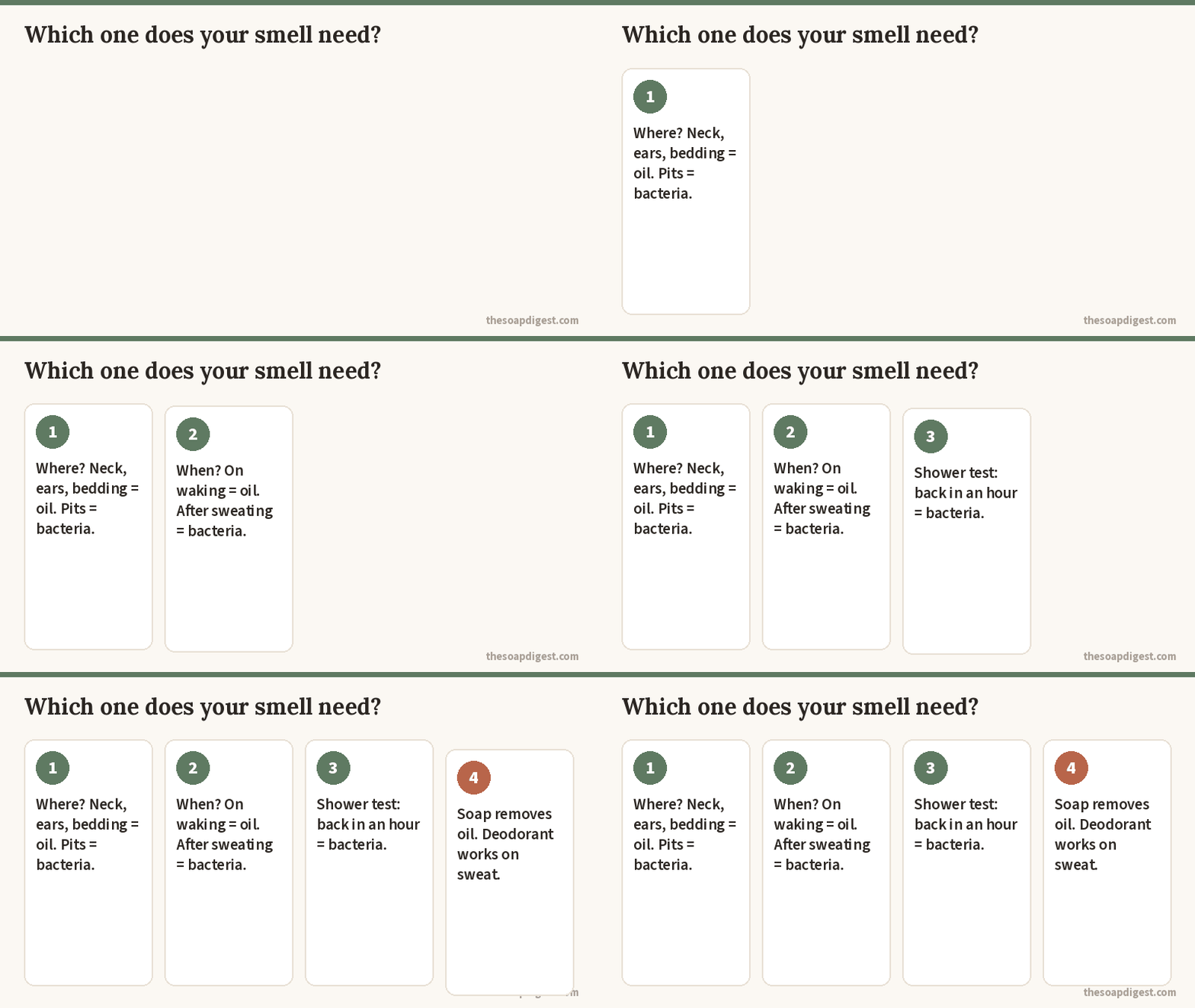
Four questions usually settle it.
Where is it? Behind the ears, the back of the neck, the upper back and chest, the scalp — these are sebum-rich sites and they point to the oil-borne odor. Armpits and groin point to the bacterial one. If you have both, you have both; that is extremely common from the forties onward and we’ve covered it in detail in perimenopause body odor.
When does it appear? Odor that builds through the day, especially after heat or exertion, is tracking sweat. Odor that is present when you wake up, on a pillowcase, or on clothing that has been sitting clean in a drawer, is tracking oil.
What happens right after a shower? If the smell is gone and back within an hour or two, you are watching bacteria repopulate. If it is still faintly there on demonstrably clean skin, or if freshly laundered clothes still carry it, you are dealing with residue rather than live production.
Does a deodorant change it? This is the cheapest test of all. If you already use an antiperspirant or deodorant on your underarms and the smell you’re worried about is unaffected, that smell isn’t coming from your underarms — and no deodorant, whole-body or not, will fix it.
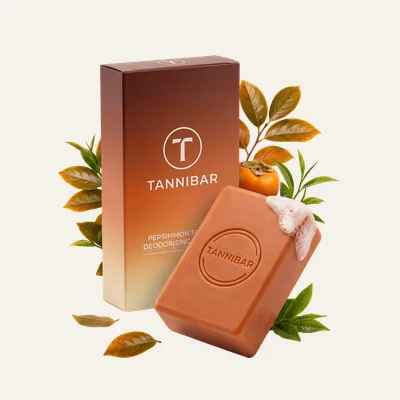
TanniBar Persimmon Tannin Bar
Fragrance-free, triple-milled and built around persimmon tannin rather than perfume — the bar we'd start with if the odor you're chasing is the oily, stale kind.
Check price →We own TanniBar and earn from sales. 30-day refund, no return needed.Where the tidy story breaks down
Two honest complications, because a comparison that only flatters one side isn’t worth reading.
Persimmon tannin is not purely an anti-aldehyde story. A 2025 study in the Journal of Pharmacological Sciences found persimmon tannin bactericidal in vitro against Porphyromonas gulae, and in a one-month clinical study in dogs, a 0.1% persimmon tannin gel significantly reduced hydrogen sulfide and methyl mercaptan — sulfur gases, the same chemical family as underarm thioalcohols. Note what that study is: dogs, mouths, a leave-on gel, and gingivitis and plaque scores that did not significantly improve. It’s a reason to stop saying tannins only work on aldehydes. It is not evidence that a persimmon bar deodorizes armpits.
Nobody has tested either product properly for this. Searching PubMed for “persimmon soap” returns zero results — we documented the exact queries in our nonenal research index. We found no published trial of a mandelic acid whole-body deodorant either. The single human intervention that has been shown to move 2-nonenal emissions wasn’t a product at all: a 2022 crossover study gave 14 middle-aged and older adults 6 g a day of New Zealand blackcurrant powder for seven days and measured changes in skin-borne volatiles. One commenter in that Australian thread suggested blackcurrant supplements on a half-remembered hunch, which is closer to the published record than most of the advice in it.
Can you use both?
Yes, and for a lot of people that’s the right answer.
They don’t compete for the same moment. Wash with the bar, rinse thoroughly, dry properly — particularly skin folds — and then apply the deodorant to dry skin. A fragrance-free bar won’t fight a scented deodorant, which matters if you are sensitive to fragrance.
The real caution is irritation, not interaction. A soap can leave mature skin tight and dry, and putting an acidic leave-on product on top of skin that is already stinging is how people end up posting rash photos. One reader in r/Menopause described using persimmon soap without trouble one year and developing a rash within a day of restarting it the next summer. Introduce one product at a time, patch-test, and read our notes on persimmon soap side effects before you layer anything.
If the bar disappoints you, work through why persimmon soap stops working before concluding the category is a scam — frequency, contact time and the site you’re washing all matter, as our guide on how to use it sets out.
What readers actually report
The pattern in the threads is consistent with the chemistry, once you know to look for it.
One perimenopause poster whose complaint was a whole-body stench after a short walk reported the opposite of the usual recommendation:
“persimmon soap didn't work for me but Dove full body deodorant does”
That reader’s description — odor arriving with heat and exertion, across the body, unrelated to her pillowcase — is sweat-driven. In the same thread, others describing a smell that was present even when clean said persimmon soap was what finally worked. Both groups are telling the truth about different problems.
The other recurring theme is cost and availability. Readers outside the US repeatedly report that whole-body deodorant subscriptions add up and that persimmon bars are hard to find locally, which is part of why “which one do I actually need” is a question with money attached to it. If you decide the oil-borne odor is your problem, our best persimmon soap comparison sets the bars side by side on ingredients, format and what each brand does and doesn’t claim.
When to see a doctor
The NHS advises seeing a GP if body odor hasn’t improved with self-care and it’s affecting your self-esteem, if you notice a change in how your body odor usually smells, or if you suddenly start sweating much more than usual. It notes that body odor can be affected by conditions including diabetes, kidney disease and liver disease, and by some medicines including antidepressants.
If a product leaves you with a rash, burning or broken skin, stop using it. TanniBar’s own page advises checking with a doctor first if you have an active skin condition; that’s sensible advice for any of these products, including acidic leave-on ones.
The bottom line
Persimmon soap versus Lume is the wrong comparison, because it assumes one problem. There are at least two.
If the smell you’re chasing is stale, faintly greasy, worst on your neck, ears and bedding, and stubbornly present on clean skin, you want the bar. If it’s sharp, arrives with sweat, is concentrated in your armpits and groin, and comes back a few hours after a shower, you want the deodorant — and a rinse-off soap will keep disappointing you no matter how many times the internet recommends it.
If both descriptions sound familiar, buy both, introduce them a week apart, and judge each one on the smell it was meant for.
Frequently asked questions
Is persimmon soap better than Lume?
Neither is better in general, because they are not aimed at the same smell. Persimmon tannin soap is used against 2-nonenal, the stale, greasy odor that forms when skin surface oils oxidize and that studies have measured rising with age. A whole-body deodorant like Lume is aimed at odor that bacteria create from sweat, and the brand's own explanation is that its mandelic acid lowers skin pH so those bacteria are less able to work. If you pick the one that matches the wrong process, it will appear to fail.
Can I use persimmon soap and Lume together?
There is no chemical reason you cannot. They act at different moments: the soap is a rinse-off cleanser, the deodorant is left on afterwards. Wash, dry thoroughly, then apply the deodorant to dry skin. The practical caution is irritation rather than interaction — an acidic leave-on product on skin that a soap has already left tight or stinging is how people end up with a rash. Introduce one at a time and stop if anything burns.
Is Lume an antiperspirant?
No. Lume's deodorants are marketed as deodorants and as aluminium-free; the brand sells a separate clinical-strength antiperspirant spray as its own product. The distinction matters legally as well as practically. The FDA treats an antiperspirant as a drug, because reducing sweating is intended to affect a function of the body, while a product that only addresses odor is a cosmetic. A deodorant does not reduce how much you sweat.
Why does persimmon soap work for some people and not others?
Usually because 'body odor' covers at least two unrelated processes. Readers who describe a stale, greasy smell on the neck, ears, upper back and pillowcase are describing the odor persimmon soap is aimed at. Readers whose complaint is sharp underarm smell that returns hours after a shower are describing bacterial odor, which a rinse-off bar cannot prevent because the process restarts as soon as you sweat again. Our guide to why persimmon soap stops working covers the other reasons.
Is there a study comparing them?
We could not find one. A PubMed search for "persimmon soap" returns no results at all, and we found no published trial of a mandelic acid whole-body deodorant either. What exists is good evidence for the odor molecules themselves and for the general principles each product relies on, plus brand statements about formulation. Anyone telling you one is clinically proven to beat the other is going beyond the published record.
Sources
- Haze S. et al. (2001). 2-Nonenal newly found in human body odor tends to increase with aging. J Invest Dermatol 116(4):520–4.
- Kimura K. et al. (2016). Measurement of 2-nonenal and diacetyl emanating from human skin surface employing passive flux sampler-GCMS system. J Chromatogr B 1028:181–5.
- Ishino K. et al. (2010). Lipid peroxidation generates body odor component trans-2-nonenal covalently bound to protein in vivo. J Biol Chem 285(20):15302–13.
- Minhas G.S. et al. (2018). Structural basis of malodour precursor transport in the human axilla. eLife 7:e34995.
- Zeng X.N. et al. (1991). Analysis of characteristic odors from human male axillae. J Chem Ecol 17(7):1469–92.
- Lambers H. et al. (2006). Natural skin surface pH is on average below 5, which is beneficial for its resident flora. Int J Cosmet Sci 28(5):359–70.
- Willems M.E.T. et al. (2022). Intake of New Zealand Blackcurrant Powder Affects Skin-Borne Volatile Organic Compounds in Middle-Aged and Older Adults. J Diet Suppl 19(5):603–20.
- Toyooka M. et al. (2025). Intraoral treatment of persimmon tannin significantly ameliorates gingivitis, plaque and halitosis via directly influencing the periodontal bacteria Porphyromonas gulae. J Pharmacol Sci 157(4):203–11.
- PubChem compound summary: (E)-2-nonenal (CID 5283335) — XLogP 3.1; "soluble in most fixed oils; insoluble in water"
- FDA: Is It a Cosmetic, a Drug, or Both? (Or Is It Soap?) — antiperspirants as drugs; the regulatory definition of soap
- NHS: Body odour (BO) — causes, self-care and when to see a GP
- Lume: "Why mandelic acid is such a powerhouse for your skin" (brand's own explanation of its mechanism and pH reasoning) (company information; unpaid, not affiliated with us)
- Lume: official site (whole-body deodorant positioning, aluminium-free, 72-hour claim) (company information; unpaid, not affiliated with us)
- TanniBar product page (brand's own claims: ingredients, fragrance-free, triple-milled, refund terms) (company information; we own TanniBar)
- r/Perimenopause: "Australian alternatives to Lume and persimmon for funky armpit smells?"
- r/Menopause: "Persimmon soap alternative"
- r/Perimenopause: "Body odor" (update: persimmon soap didn't work, whole-body deodorant did)