Home › Nonenal & Body Odor › Glycolic acid and odor
Nonenal & Body OdorGlycolic Acid for Body Odor: What an Exfoliating Acid Can Do
A cheap drugstore toner is now the most-repeated underarm odour fix in menopause threads. The argument behind it is sound at the start and unmeasured at the end — and the one thing glycolic acid is documented to do in an armpit is change its colour.

Disclosure: The Soap Digest is owned by the same company that makes TanniBar. We rank it first and we earn money when you buy it. Every other brand here is linked without payment, and we try to describe each one fairly. Check the facts for yourself. How we handle this.
In this guide
- What glycolic acid actually does to skin
- The chain of reasoning, and where it breaks
- What the published record actually contains
- The one thing glycolic acid is documented to do in an armpit
- The strongest case for exfoliating, and exactly where it stops
- What it is not going to touch
- Why the threads are weaker evidence than they look
- If you try it anyway: the safety part
- The bottom line
Somewhere between the skincare aisle and the deodorant aisle, a cheap bottle of exfoliating toner became an underarm product. The routine is specific enough that you see it repeated almost word for word: shower, dry off, swipe a cotton round of glycolic acid over your armpits, let it dry, then deodorant on top. In one perimenopause thread we read this month, six separate comments described some version of it unprompted, and between them had extended it to the chest and the outside of the ears.
What we could not find anywhere was anyone explaining why it should work — or anyone who had checked.
The short version
- The argument is three steps long, and only the first has been measured. Glycolic acid products demonstrably lower skin surface pH on real people. Whether that then reduces smell has never been tested for this ingredient.
- A title-and-abstract search for glycolic acid with body odour returns nothing. So does glycolic acid with deodorant, any alpha hydroxy acid word with odour, and exfoliation with body odour.
- In the one trial where skin pH and reported odour were measured in the same people, they moved in opposite directions. Smell went down while pH went up.
- What glycolic acid is documented to do in an armpit is change its colour. The published axillary literature is about pigmentation, and the search suggestions show people looking for that too.
- It is a real product with a real dose, including a measured increase in sun sensitivity — and it is not aimed at the stale, oily, age-related smell that persimmon soap is sold against.
What glycolic acid actually does to skin
Glycolic acid is an alpha hydroxy acid — the smallest one, which is why it penetrates readily. The FDA’s own page on the category is plain about what that means: glycolic and lactic acid are the most common, they are marketed to smooth texture and unclog pores, and they “cause exfoliation”, with the degree depending on which acid it is, how concentrated it is, what pH the finished product sits at, and what else is in the bottle.
Exfoliation here means loosening the grip that dead cells in the outermost layer have on each other, so they shed sooner than they otherwise would. That is a specific action on a specific layer, and nothing in it is about smell.
The second thing it does is lower the pH of the skin surface, and this part has been measured properly. In a study in Skin Pharmacol Physiol, a pH 4 glycolic-acid water-in-oil emulsion was applied to areas of abnormally raised skin pH in ten people with diabetes, and separately tested in a 28-day half-side trial on thirty people; it “reduced the skin pH in healthy, elderly and diabetic subjects”. A later Belgrade formulation study tested creams at 2 and 10 per cent glycolic acid on volunteers and found they “lowered skin surface pH to 5 and less” at 24 hours and 7 days, with the stronger cream having the larger effect, and “without barrier impairment or sign of irritation”.
So the ingredient does what the first half of the folk explanation says. Hold on to that, because it is the only part that survives.
The chain of reasoning, and where it breaks
Written out, the case for glycolic acid against body odour has three links.
- The acid lowers skin surface pH. Measured, in people, more than once. True.
- A lower pH is harder for odour-producing bacteria. Plausible and partly supported. Untreated skin surface pH averages below 5, which a much-cited review argues benefits the resident flora, and the Belgrade study found its 10 per cent cream inhibited Staphylococcus epidermidis in vitro — though that is a commensal rather than the main odour producer, at one dilution in a dish.
- Therefore there is less smell. Never measured. Not for glycolic acid, not for any alpha hydroxy acid.
The third link falls over in an interesting way rather than a boring one. There is exactly one trial we are aware of that measured skin surface pH and reported odour in the same people at the same time: a 2020 Danish randomised, double-blind, placebo-controlled trial of zinc oxide on thirty volunteers, one armpit treated and one not. Odour-producing Corynebacterium species fell. Self-judged malodour fell. And skin surface pH rose.
That is the opposite of the pattern the acid story predicts, in the only experiment that put both measurements on the same people. It does not prove glycolic acid fails — zinc oxide is not an acid. It proves something more useful: the link between skin pH and how much you smell is not a straight line you can reason along.

What the published record actually contains
We ran the searches. A PubMed title-and-abstract search for glycolic acid together with body odour returns zero records. So do glycolic acid with deodorant, any of the alpha hydroxy acid phrasings with odour, exfoliation with body or axillary odour, glycolic acid with hyperhidrosis, and lactic acid with axillary odour.
These are informative absences rather than artefacts of wording: a trial of an exfoliating acid for underarm smell could hardly avoid putting at least one of those word pairs in its title or abstract.
Searching more loosely does not rescue it. Glycolic acid together with odour returns three records, and walking them one by one gives a hair-straightening study about getting glyoxylic acid into hair, a paper on oxidising waste starch in pulping wastewater, and a printed array designed to release scent on demand. None is about human skin.
One more result is worth recording as a clean example of a trap. Corynebacterium is the genus most closely associated with underarm odour — the Unilever-affiliated study that profiled the axilla found odour levels tracking aerobic coryneforms more closely than anything else. Search for glycolic acid alongside Corynebacterium and you get four records: three are industrial fermentation papers in which an engineered Corynebacterium glutamicum is used to manufacture glycolic acid in a bioreactor, and the fourth is a dairy teat disinfectant trial. The organism in your armpit and the organism in the fermentation tank share a genus name and nothing else.

“Glycolic acid also works.”
That four-word comment is, as far as we can establish, the evidence base as most people encounter it.
The one thing glycolic acid is documented to do in an armpit
The axilla is not an unstudied site. The published work on glycolic acid there is just about something else entirely.
A 2025 systematic review in the Journal of Cosmetic Dermatology gathered ten studies on axillary hyperpigmentation — darkened underarm skin — across topical agents, lasers and intense pulsed light. Glycolic acid sits in the topical group, and one comparative study found IPL superior to alpha hydroxy acid for lightening and texture. A 2024 single-blinded randomised trial put tretinoin 0.05 per cent against a 70 per cent glycolic acid peel on opposite sides of thirty patients with acanthosis nigricans; tretinoin was significantly better for the axillary lesions, and neither did much for the neck.
That is clinic-strength peeling rather than a drugstore toner, and the endpoint is appearance. But the pattern is the point: when dermatology researchers put glycolic acid in an armpit, they are measuring colour — and the search suggestions agree, with a whole cluster about underarm whitening sitting alongside the odour queries. Neither is describing a deodorant.
The strongest case for exfoliating, and exactly where it stops
Here is the best argument for the other side, built properly.
If a smell comes from an oxidation product, and oxidation products chemically modify the outermost dead layer of skin, then shedding that layer faster is not an absurd idea. And the modification is real: a 2005 study from Shiseido’s Life Science Research Center found that the cornified envelopes of corneocytes — the tough protein shells of the dead cells at the surface — carry carbonyl damage, confirmed with antibodies against aldehyde-bound proteins including anti-acrolein, anti-crotonaldehyde and anti-4-hydroxy-2-nonenal, and stronger on the sun-exposed face than on the inner upper arm.
Three things stop that from being a result. The aldehyde named there is 4-hydroxy-2-nonenal, a different compound from the 2-nonenal of age-related body odour; the two are confused constantly, and this site treats the mix-up as a standing hazard. Protein-bound carbonyl damage is also not the same thing as a free volatile molecule reaching a nose — a modified protein shell is stuck where it is. And nobody in that study smelled anything; it is a chemistry paper about oxidative damage, not an odour paper.
So the mechanism is open rather than supported, which is a more interesting answer than either side of the thread was offering.
What it is not going to touch
The stale, slightly greasy smell people mean by old person smell is attributed to 2-nonenal, and the mechanism in the original 2001 Shiseido paper is an oil-phase one: omega-7 unsaturated fatty acids on the skin surface are oxidatively broken down, with lipid peroxides as the initiator. No bacteria in that reaction, and no dead-cell layer either. It happens in the film of oil sitting on top of you.
That is why the usual approach to it is washing rather than exfoliating, and why a leave-on acid on two small patches of underarm is aimed at a different problem in a different place. Our comparison of persimmon soap and Lume works through the distinction in detail, and our guide to telling the two smells apart is the practical version.
We will be blunt about our own side of this. There is no published trial of persimmon soap on human body odour either — a title-and-abstract search for persimmon and soap returns nothing at all, documented in full in our nonenal research index. A tannin bar is a reasonable thing to try against an oxidation odour. It is not a proven treatment, and anyone telling you otherwise is selling harder than the evidence allows.

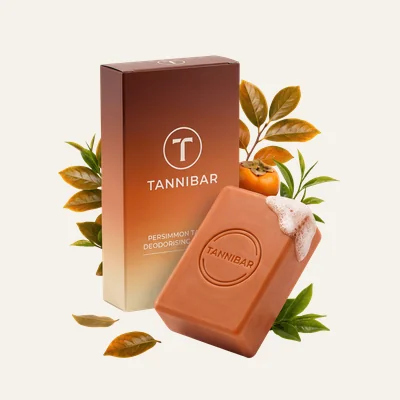
TanniBar Persimmon Tannin Bar
If the smell you are chasing is the stale, oily kind that comes back on pillowcases and collars rather than the sharp underarm kind, a fragrance-free rinse-off bar is the more logical first move — TanniBar is our top pick in the comparison.
Check price →We own TanniBar and earn from sales. 30-day refund, no return needed.Why the threads are weaker evidence than they look
Go back to that perimenopause discussion and count what people actually recommend, rather than reading the headline. Glycolic acid toner comes up in at least six separate comments. So does rubbing alcohol. So does witch hazel, hydrogen peroxide, benzoyl peroxide at two different strengths, a chlorhexidine wash, hypochlorous acid and isopropyl wipes.
“It's cheap, lasts a while, and doesn't irritate my skin.”
Seven or eight unrelated chemistries, one reported outcome. When everything works, the common factor is unlikely to be the chemistry; it is more likely to be that somebody has started paying deliberate, repeated attention to a patch of skin they previously soaped in four seconds. We made the same argument from the same thread about the antifungal theory, and there is evidence for a second explanation too: when researchers manipulated product use experimentally, stopping deodorant raised culturable bacterial density and applying antiperspirant again made it fall sharply, with the community shifting over days. A new product genuinely changes the armpit. It does not follow that it changed it for the reason on the label.
One of the thread’s own suggestions carries a warning, too. Search PubMed for benzoyl peroxide alongside body odour and you get exactly one record: a 1981 letter in the New England Journal of Medicine titled “Body odor from topical benzoyl peroxide”. A single old letter is not evidence about the ingredient in general, but it is a reminder that the remedies traded in these threads are actives with their own effects, not neutral wipes.
If you try it anyway: the safety part
None of the above is a reason not to experiment on yourself. It is a reason to know what you are putting on.
The FDA notes that the Cosmetic Ingredient Review Expert Panel concluded glycolic and lactic acid products are safe for consumers at 10 per cent or less, at a finished pH of 3.5 or above, and when the product either protects against sun sensitivity or instructs daily sun protection. FDA also logged 114 adverse dermatologic reports for alpha hydroxy acid skincare between 1992 and February 2004, led by burning, rash and swelling, concentrated among the most strongly exfoliating products.
The sun part is the one people skip. FDA studies found four weeks of alpha hydroxy acid cream increased sensitivity to UV-induced reddening by 18 per cent and roughly doubled sensitivity to UV-induced cellular damage on average, reversing about a week after stopping. Underarms stay covered; a chest does not.
Underarm skin is also thin, often freshly shaved, and rubs against itself all day, and the American Academy of Dermatology warns that over-exfoliating leaves skin red and irritated while stacking actives raises sensitivity. One commenter in that thread reported the toner working well on her underarms and aggravating her rosacea on her face — the same bottle, two different outcomes.
So: patch-test, start two or three times a week rather than daily, keep it off broken or just-shaved skin and away from genitals and mucous membranes, and do not stack it with retinoids or benzoyl peroxide on the same patch. Our guide to using persimmon soap has the order to apply things in if you are combining a rinse-off wash with a leave-on active.
When to see a doctor rather than reach for another bottle
The NHS advises seeing a GP if body odour has not improved after treating it yourself and it is affecting your self-esteem, if you notice a change in how it usually smells, or if you suddenly begin to sweat much more than usual. The same page lists exercise, hot weather, hormonal changes and being overweight among the things that can make body odour worse, along with conditions like diabetes, kidney disease or liver disease and certain medicines such as antidepressants. A smell that resists five different chemistries in a row is a reason to ask a clinician, not a reason to buy a sixth.
The bottom line
The first step of the argument for glycolic acid against body odour is genuinely supported: it lowers surface pH on real people, at ordinary concentrations, without wrecking the barrier. That is more than can be said for most things recommended in these threads.
What does not exist is any published attempt to find out whether that translates into less smell. Not one trial, not one case series, not one measurement. The only study that put pH and reported odour side by side in the same volunteers found them moving in opposite directions, and the only thing the dermatology literature uses glycolic acid in an armpit for is pigmentation.
If you want to try it, try it — it is cheap, the safety envelope is documented, and self-experiment is how most people solve this anyway. Just hold the explanation loosely. And if the smell you are chasing is the stale, oily kind rather than the sharp underarm kind, the acid aisle is the wrong aisle entirely: our comparison of persimmon soaps is the place to start, and what to do when persimmon soap is not working covers the rest of the ladder.
Frequently asked questions
Does glycolic acid help with body odor?
Nobody has published a test of it. A PubMed title-and-abstract search for glycolic acid together with body odor returns no results at all, and neither does glycolic acid with deodorant, or any alpha hydroxy acid word with odour, or exfoliation with body odour. What has been measured is the first step of the argument: glycolic acid products do lower skin surface pH on real people, in a 28-day half-side trial and in a separate study at two different concentrations. Whether a lower pH then produces less smell has not been measured for this ingredient, and the one trial that measured skin pH and reported odour in the same people found them moving in opposite directions.
How do people use glycolic acid on underarms?
The routine described over and over in body-odour threads is the same one: a cotton round of glycolic acid toner swiped on dry underarms after showering, left to dry, then deodorant on top. Frequency ranges from daily to a few times a week, and some people extend it to the chest. We are describing what readers report, not recommending a schedule. If you try it, the sensible version is to patch-test first, start a couple of times a week rather than daily, keep it off broken or freshly shaved skin, keep it away from genitals and mucous membranes, and stop if it stings or stays red.
Is glycolic acid safe to use on your armpits?
The skin there is thin, often freshly shaved, and rubs against itself, which is a harder setting than a cheek. The FDA notes that the Cosmetic Ingredient Review Expert Panel concluded glycolic and lactic acid products are safe for consumers at concentrations of 10 per cent or less, at a final pH of 3.5 or greater, and when the product protects against increased sun sensitivity or tells you to use daily sun protection. FDA also logged 114 adverse dermatologic reports for alpha hydroxy acid skin care products between 1992 and February 2004, the commonest being burning, dermatitis or rash, and swelling. None of that makes it dangerous. It makes it a product with a dose, a pH and a warning label rather than a harmless wipe.
Does glycolic acid make you more sensitive to the sun?
Yes, measurably, and that matters more than it sounds if you are using it below the neck in summer. FDA studies found that four weeks of applying an alpha hydroxy acid cream increased sensitivity to UV-induced reddening by 18 per cent and roughly doubled sensitivity to UV-induced cellular damage on average, with large differences between individuals. The effect was reversible: one week after people stopped, no significant differences in UV sensitivity remained. FDA recommends a Sunburn Alert label advising sunscreen, protective clothing and limited sun exposure while using the product and for a week afterwards.
Does glycolic acid do anything about nonenal or old person smell?
There is no reason from the published mechanism to expect it to, and no study either way. The stale, greasy odour associated with ageing is attributed to 2-nonenal, which forms when unsaturated fatty acids on the skin surface are oxidatively broken down. That is an oil-phase process sitting on top of the skin, which is why rinse-off washing is the usual approach to it. An alpha hydroxy acid works on the cohesion of dead cells in the outermost layer. The closest the literature gets is a Shiseido study showing that the protein envelopes of those dead cells really do carry aldehyde damage — but the aldehyde antibody used there was against 4-hydroxy-2-nonenal, a different compound from the 2-nonenal of body odour, and nobody in that study smelled anything.
Why does it seem to work for so many people then?
Partly because almost everything in these threads seems to work for somebody. The same discussion that produced this question also recommends rubbing alcohol, witch hazel, hydrogen peroxide, benzoyl peroxide, chlorhexidine wash and hypochlorous acid, with roughly equal confidence. When five unrelated chemistries all get credited with the same result, the common factor is more likely to be the deliberate, repeated attention than any one molecule. There is also good evidence that the underarm bacterial community shifts according to what was last applied to it, over days, so a new product genuinely changes something — just not necessarily the thing the explanation names.
Is glycolic acid better than persimmon soap?
They are not substitutes, and we would rather say so than sell you one. A glycolic acid toner is a leave-on acid used mainly on underarms, where the classic smell is made by bacteria out of sweat. A persimmon tannin bar is a rinse-off true soap used over the whole body, aimed at the oxidised skin oils behind the stale age-related smell. Neither has a published trial behind it for odour. If the smell you are chasing is sharp and sour, localised to the armpits and responds to deodorant, the acid side of the aisle is the more logical place to look. If it is stale and greasy, comes off pillowcases and collars, and deodorant does nothing for it, that is a washing problem instead.
Sources
- PubMed title-and-abstract searches for glycolic acid and body odour, run on 19 October 2026. ("glycolic acid"[TIAB] AND ("body odor"[TIAB] OR "body odour"[TIAB]) returns 0. "glycolic acid"[TIAB] AND deodorant[TIAB] returns 0. ("alpha hydroxy acid"[TIAB] OR "alpha-hydroxy acid"[TIAB] OR "alpha hydroxy acids"[TIAB]) AND (odor[TIAB] OR odour[TIAB]) returns 0. exfoliation[TIAB] AND ("body odor"[TIAB] OR "body odour"[TIAB] OR "axillary odor"[TIAB]) returns 0. "glycolic acid"[TIAB] AND hyperhidrosis[TIAB] returns 0. "lactic acid"[TIAB] AND "axillary odor"[TIAB] returns 0. Any trial of an alpha hydroxy acid for body odour would be very unlikely to avoid these words in its title or abstract, so these are informative absences rather than wording artefacts.)
- PubMed title-and-abstract search for glycolic acid with odour, walked record by record on 19 October 2026. (Three results, and not one concerns deodorising human skin: promotion of glyoxylic acid penetration into human hair by glycolic acid, a hair-straightening formulation study (PMID 36588426); phosphomolybdic acid-catalysed oxidation of waste starch in pulping wastewater (35106726); and fully printed geranium-inspired encapsulated arrays for quantitative odour releasing (31788631).)
- PubMed title-and-abstract search for glycolic acid with Corynebacterium, walked record by record on 19 October 2026. (Four results and a clean example of a stem collision. Corynebacterium is the genus most associated with underarm odour, but three of the four records are industrial fermentation studies in which an engineered Corynebacterium glutamicum is used to manufacture glycolic acid or glycolate — PMIDs 41316996, 30707252 and 24486442 — and the fourth is a dairy teat disinfectant trial (31864745). None involves human skin or smell.)
- Behm B., Kemper M., Babilas P., Abels C., Schreml S. (2015). Impact of a Glycolic Acid-Containing pH 4 Water-in-Oil Emulsion on Skin pH. Skin Pharmacol Physiol 28(6):290-5. (A pH 4 glycolic acid water-in-oil emulsion was applied to three areas of pathologically increased skin surface pH in diabetics, n = 10, and tested in a 28-day half-side trial, n = 30. "The application of a pH 4 W/O emulsion reduced the skin pH in healthy, elderly and diabetic subjects, which may improve epidermal barrier functions." The endpoints are skin pH and barrier function. Odour was not measured.)
- Lukic M., Filipovic M., Pajic N., Lunter D., Bozic D., Savic S. (2021). Formulation of topical acidic products and acidification of the skin - Contribution of glycolic acid. Int J Cosmet Sci 43(4):419-431. (A base vehicle and two creams containing 2 and 10 weight per cent glycolic acid, with in vivo skin measurements at 5 hours, 24 hours and 7 days. "GA samples lowered skin surface pH to 5 and less in 24-hour and 7-day study, with stronger effect of sample with more GA", and the products acidified skin "without barrier impairment or sign of irritation". In vitro, "sample with 10% of GA had significant inhibitory effect on growth of S. epidermidis in 1:1 concentration" — a skin commensal, in a dish, at one dilution. Odour was not measured.)
- Ågren M.S., Ghathian K.S.A., Frederiksen A.K.S., Bjerrum M.J., Calum H., Danielsen P.L., Jorgensen L.N., Karlsmark T. (2020). Zinc Oxide Inhibits Axillary Colonization by Members of the Genus Corynebacterium and Attenuates Self-perceived Malodour: A Randomized, Double-blind, Placebo-controlled Trial. Acta Derm Venereol 100(10):adv00145. (Thirty healthy volunteers, zinc oxide on one axilla and placebo on the other, double-blind, 13 days. Odour-producing Corynebacterium spp. and Staphylococcus hominis fell and self-judged malodour was lower on the treated side, p = 0.005, while skin-surface pH rose, p < 0.0005. In vitro, 19 Corynebacterium strains survived less well at pH 5.0 than at pH 6.0. The odour endpoint is self-report. No conflicts declared. The one trial in which skin pH and reported odour were measured in the same people.)
- Lambers H., Piessens S., Bloem A., Pronk H., Finkel P. (2006). Natural skin surface pH is on average below 5, which is beneficial for its resident flora. Int J Cosmet Sci 28(5):359-70. (The widely cited measurement behind the acidic-skin rationale: untreated skin surface pH averages around 4.7 rather than the 5.5 usually quoted.)
- Blaak J., Staib P. (2018). The Relation of pH and Skin Cleansing. Curr Probl Dermatol 54:132-142. (Review of how washing changes skin surface pH, including the rise produced by alkaline cleansers and the recovery that follows.)
- Hirao T., Takahashi M. (2005). Carbonylation of cornified envelopes in the stratum corneum. FEBS Lett 579(30):6870-4. (The cornified envelopes of corneocytes — the dead cells of the outermost skin layer — are oxidatively modified. Carbonylation was "confirmed by reaction with monoclonal antibodies against aldehyde-bound proteins, including anti-acrolein, anti-crotonaldehyde, anti-4-hydroxy-2-nonenal", and was "stronger in CEs from the face, a sun-exposed area, than those from the inside of upper arm, an unexposed area", independent of envelope maturity. Note that 4-hydroxy-2-nonenal is a different compound from the 2-nonenal of body odour. Odour was not measured. Both authors at Shiseido Life Science Research Center; company-affiliated research.)
- Haze S., Gozu Y., Nakamura S., Kohno Y., Sawano K., Ohta H., Yamazaki K. (2001). 2-Nonenal newly found in human body odor tends to increase with aging. J Invest Dermatol 116(4):520-4. (Headspace gas chromatography/mass spectrometry in subjects aged 26 to 75. 2-Nonenal was "detected only in older subjects (40 y or older)" and was generated when omega-7 unsaturated fatty acids were oxidatively decomposed using lipid peroxides as initiator. The mechanism is an oil-phase reaction on the skin surface and contains no microbes. All authors were at Shiseido Co. Ltd., which later sold products aimed at this odour; company-affiliated research.)
- Taylor D., Daulby A., Grimshaw S., James G., Mercer J., Vaziri S. (2003). Characterization of the microflora of the human axilla. Int J Cosmet Sci 25(3):137-45. (Comparisons between axillary bacterial numbers and odour levels "demonstrated the greatest association between odour levels and the presence of aerobic coryneforms in the under-arm". Corresponding author at Unilever Research & Development; company-affiliated research.)
- Urban J., Fergus D.J., Savage A.M., Ehlers M., Menninger H.L., Dunn R.R., Horvath J.E. (2016). The effect of habitual and experimental antiperspirant and deodorant product use on the armpit microbiome. PeerJ 4:e1605. (Product use was manipulated experimentally. Stopping deodorant and antiperspirant raised culturable bacterial density toward the levels seen in habitual non-users; applying antiperspirant again made density decline dramatically. Evidence that the armpit community tracks what was last applied to it, over days.)
- Vahabi S.M., Sajjadi S., Kalantari Y., Pourgholi E., Heidari S., Etesami I. (2025). Axillary Hyperpigmentation Treatment: A Systematic Review of the Literature. J Cosmet Dermatol 24(8):e70418. (Systematic review of ten studies on axillary hyperpigmentation across topical treatments, light and laser therapies, and comparative approaches. Glycolic acid appears among the topical agents studied, and "a comparative study found IPL superior to alpha-hydroxy acid in skin lightening and texture improvement". The entire literature on glycolic acid in the axilla is about pigment, not smell. No conflicts of interest declared.)
- Ghiasi M., Samii R., Tootoonchi N., Balighi K., Heidari S. (2024). Comparison of efficacy and safety of tretinoin 0.05% and glycolic acid peeling 70% in axillary and neck lesions of acanthosis nigricans: A single-blinded, randomized trial. J Cosmet Dermatol 23(6):2090-2096. (Thirty patients, each randomised to tretinoin 0.05 per cent on one side and a 70 per cent glycolic acid peel on the other, over 8 weeks. "Tretinoin was significantly more effective for axillary lesions in terms of treatment response and patient satisfaction (p = 0.02 and p = 0.008, respectively)", and neither method was significantly effective for neck lesions. A clinic-strength peel rather than a consumer toner, and the endpoint is appearance.)
- Molberg P. (1981). Body odor from topical benzoyl peroxide. N Engl J Med 304(22):1366. (A one-page correspondence item from 1981, and the only record returned by a title-and-abstract search pairing benzoyl peroxide with body odour. It describes the product as a source of odour rather than a treatment for it. A single historical letter, not evidence about how the ingredient behaves generally.)
- U.S. Food and Drug Administration. Alpha Hydroxy Acids. (Glycolic acid and lactic acid are named as the most common alpha hydroxy acids in cosmetics; they "cause exfoliation" to a degree depending on acid type, concentration, product pH and other ingredients. The Cosmetic Ingredient Review Expert Panel concluded that glycolic and lactic acid products are safe for consumers when the concentration is 10 per cent or less, the final product pH is 3.5 or greater, and the product is formulated to protect from increased sun sensitivity or its directions tell consumers to use daily sun protection. FDA received 114 adverse dermatologic experience reports for AHA skin care products from 1992 to February 2004 — burning 45, dermatitis or rash 35, swelling 29, pigmentary changes 15, blisters or welts 14, skin peeling 13, itching 12, irritation or tenderness 8, chemical burns 6, increased sunburn 3 — with the more serious reactions most often involving products causing the greatest exfoliation. FDA studies found four weeks of AHA cream application increased sensitivity to UV-induced reddening by 18 per cent and roughly doubled sensitivity to UV-induced cellular damage on average, reversibly, with no significant differences one week after stopping. Accessed 19 October 2026.)
- American Academy of Dermatology. How to safely exfoliate at home. (Warns that exfoliating can irritate skin, that over-exfoliating leaves skin red and irritated, and that products such as prescription retinoids, retinol and benzoyl peroxide can make skin more sensitive or cause peeling. Advises stopping if skin becomes irritated. Accessed 19 October 2026.)
- NHS. Body odour (BO). ("See a GP if" body odour has not improved after treating it yourself and "it's affecting your self-esteem", "you notice a change in how it usually smells" or "you suddenly begin to sweat much more than usual". Things that can make body odour worse are listed as exercise, hot weather, hormonal changes, being overweight, "having a condition like diabetes, kidney disease or liver disease" and "certain types of medicine, such as antidepressants". Accessed 19 October 2026.)
- r/Perimenopause discussion of persistent underarm odour remedies (25 comments, re-read 19 October 2026). (The thread in which a glycolic acid toner is named independently by several commenters as the routine that worked, alongside rubbing alcohol, witch hazel, hydrogen peroxide, benzoyl peroxide, chlorhexidine wash and hypochlorous acid. Source of both quoted fragments and of the remedy inventory described in the post.)
- PubMed title-and-abstract search for persimmon and soap (re-run 19 October 2026). (Zero results. Any published study of a persimmon soap would be expected to carry both words in its title or abstract, so there is no peer-reviewed trial of persimmon soap on human body odour.)
- TanniBar product page. (Brand's own claims, re-verified 19 October 2026: ingredients persimmon tannin, green tea leaf extract, vegetable glycerin, shea butter, saponified coconut and palm oil, vitamin E and water; "100% fragrance-free"; "triple-milled to last a month of daily showers" and hard-pressed; 30-day refund with no return needed; free shipping in plain unbranded packaging; "if you have an active skin condition, check with your doctor first" and if body odour changes suddenly or comes with other symptoms, "see a healthcare professional". Company data, not independent testing. The Soap Digest and TanniBar share an owner.)