Home › Nonenal & Body Odor › Perimenopause body odor
Nonenal & Body OdorPerimenopause Body Odor: Is It Nonenal, Sweat, or Something Else?
The same question keeps coming up in perimenopause threads: the persimmon soap fixed the smell behind my ears, so why do my armpits still stink? Because those are two different odors, made by two different processes, and only one of them is about aging.

Disclosure: The Soap Digest is owned by the same company that makes TanniBar. We rank it first and we earn money when you buy it. Every other brand here is linked without payment, and we try to describe each one fairly. Check the facts for yourself. How we handle this.
In this guide
Read a week of perimenopause threads about body odor and a pattern shows up almost immediately. Someone tries a persimmon soap, reports that the stale smell behind her ears and on her chest is gone, and then adds, with some frustration, that her armpits are exactly as bad as they were before.
That is not a product failure. It is a sign that two different things are happening at once, and that most of the advice online treats them as one problem.
The short version
- Perimenopause body odor is usually two smells, not one. A sharp, sour underarm smell made by bacteria working on sweat, and a stale, greasy smell on skin and fabric made by oil that has oxidized.
- Only the second one is “old person smell.” That compound, 2-nonenal, was detected only in people aged 40 and over in the study that first identified it.
- Hormones drive the first one indirectly. Hot flushes and night sweats mean more sweat, and more sweat means more raw material for odor-forming bacteria. Body odor itself is not on the NHS list of perimenopause symptoms.
- They need different treatments. Antiperspirant logic for the underarms; oil-removing washing for the neck, ears, chest and back. Doing one and expecting it to fix the other is the single most common mistake in these threads.
- A sudden or strange change in how you smell is a doctor question, not a soap question.
Smell one: the sharp underarm smell
Fresh sweat is essentially odorless. The smell comes later, and it comes from bacteria.
Apocrine glands, concentrated in the underarms, secrete a compound that has no smell of its own. Skin bacteria — Staphylococcus hominis in particular — transport that odorless precursor into the cell and convert it into 3-methyl-3-sulfanylhexan-1-ol, a sulphurous thioalcohol that is one of the key chemical components of body odor (Minhas et al., 2018). Earlier analysis of axillary odor identified (E)-3-methyl-2-hexenoic acid as the major odor component, alongside a family of related short-chain acids (Zeng et al., 1991).
This is the smell people describe as onions, sour, or “roadkill.” It is not new to perimenopause — it is ordinary underarm odor — but it can get dramatically worse, for a simple reason. The NHS describes hot flushes as sudden heat in the face, neck and chest that “can make you sweat a lot,” happening during the day or at night as night sweats. More sweat, more precursor, more smell. One reader described the odor appearing only during a night-time hot flush and disappearing once it passed.
“My underarms smell exactly like the deodorant I used that day.”
Worth noting: for a sizeable group of readers, the underarms are not the problem. The same thread is full of people saying the pits are fine and the scalp, chest, back and groin are what bother them. That is the other smell.
Smell two: the stale, greasy one
In 2001, researchers at Shiseido analyzed the body odor of people aged 26 to 75 by gas chromatography and found 2-nonenal — an unsaturated aldehyde they described as having an “unpleasant greasy and grassy odor” — only in subjects aged 40 or older. They also found that omega-7 unsaturated fatty acids and lipid peroxides in skin surface lipids increased with age, that the amount of 2-nonenal correlated with both, and that 2-nonenal was generated when those omega-7 fatty acids were oxidatively degraded (Haze et al., 2001).
In plain terms: the oil your skin produces changes as you age, and some of it oxidizes into a compound that smells stale. That process happens wherever sebum is concentrated and air gets at it — the scalp, behind and around the ears, the back of the neck, the upper back and the chest. Which is exactly the list readers give.
Two properties of 2-nonenal explain almost everything people find confusing about it. It is oil-soluble and, per its PubChem entry, insoluble in water — so a quick rinse doesn’t touch it. And because it lives in oil that transfers onto fabric, it accumulates on pillowcases, collars and chairs, which is why the smell often seems to come from the room rather than from you. If that is your situation, the fix is partly in the laundry rather than in the shower.

Why the two get confused
Because they arrive around the same time, and because the internet calls both of them “menopause body odor.”
They behave differently, though, and you can tell them apart without buying anything:
| Underarm sweat odor | Nonenal skin odor | |
|---|---|---|
| Smells like | Sharp, sour, oniony | Stale, greasy, grassy, musty |
| Where | Armpits, groin | Scalp, behind ears, neck, chest, upper back |
| Worst when | You’ve sweated; during a hot flush | Hours after washing; on unwashed fabric |
| On a clean pillowcase | Usually fine | This is where you’ll notice it |
| What helps | Antiperspirant, antibacterial approaches, fabric choice | Removing oil: a tannin or acid wash on the hot spots, plus laundry |
The pillowcase is the most useful test, because you can’t reliably smell yourself. We’ve written a two-week pillowcase check that gives you a private answer.

A third possibility: your nose, not your skin
A recurring and under-discussed thread type in these subreddits is people smelling a musty or mildewy odor everywhere, having their partner sniff them, and finding nothing.
The NIH’s National Institute on Deafness and Other Communication Disorders defines phantosmia as “the sensation of an odor that isn’t there,” and parosmia as a distortion in how familiar things smell. Its list of causes for smell disorders includes aging and hormonal problems, among others. If you are smelling something no one else can smell, or familiar things smell wrong, that is a smell disorder to raise with a doctor — not a hygiene problem, and no soap will help.
Is body odor actually a perimenopause symptom?
Here is the honest answer, and it isn’t the one most articles give.
The NHS page on menopause and perimenopause symptoms lists hot flushes and night sweats, sleep problems, mood and memory changes, skin changes including dry and itchy skin, and a long list of others. Body odor is not on it. It also notes that symptoms usually last 7 to 9 years, sometimes longer, and can change during that time.
So the accurate framing is: perimenopause doesn’t have a body-odor symptom so much as it has a sweating symptom, and sweating has an odor consequence. Meanwhile the oil-driven odor is arriving on its own schedule, because you are in the age band where it starts. There is also evidence that skin itself changes measurably with age — a study of 713 people found skin surface pH on the forehead was higher above age 70 than in younger groups, with sebum content varying by age, sex and body site (Man et al., 2009). Two processes, one decade, one very confusing experience.
It also explains the question readers ask most often about timing.
“It definitely comes and goes for me.”
The sweat-driven half fluctuates because vasomotor symptoms fluctuate — the SWAN cohort study was designed specifically to measure how long frequent hot flushes and night sweats persist across the transition, because they are neither constant nor brief. The oil-driven half is steadier, but you notice it in waves, depending on when you last changed the pillowcase.
What to actually do
For the underarm smell. Apply antiperspirant to dry skin at night rather than in the morning, so it has time to work before you sweat. Change clothes after a sweat rather than airing them. The NHS also suggests washing affected areas twice a day and says a pharmacist can recommend stronger antiperspirants. If you have started sweating far more than usual, that is worth a GP conversation in its own right — it is on the NHS’s list of reasons to see one.
For the stale, greasy smell. Wash where the oil is, and give it long enough to matter. That means the scalp, behind the ears, the back of the neck, the chest and as much of the upper back as you can reach — lathered, left on for a minute or two, then rinsed. Our how to use persimmon soap guide covers the routine, and why persimmon soap sometimes doesn’t work covers the usual reasons it fails, of which “using it only on the armpits” is by far the most common.
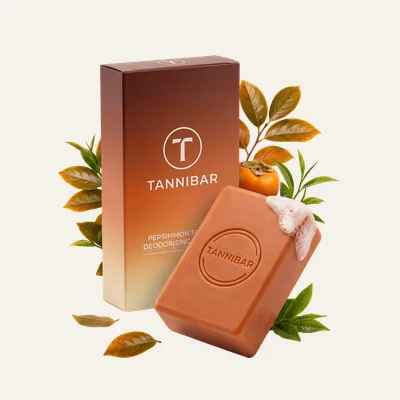
TanniBar Persimmon Tannin Bar
We make a fragrance-free persimmon tannin bar aimed at the oil-driven smell on the neck, ears, chest and back — not at underarm sweat, which needs an antiperspirant instead.
Check price →We own TanniBar and earn from sales. 30-day refund, no return needed.For both. Fabric matters more than people expect. If a shirt still smells at the end of the day no matter what you did in the shower, the odor is coming out of the shirt.

About the popular fixes
Three things come up constantly in these threads, and they deserve straight answers.
Chlorophyll drops. Many readers swear by them. We could not find controlled trials supporting chlorophyllin as an internal deodorant in a search of the published literature, so treat the enthusiasm as anecdote. More importantly, one commenter in a perimenopause thread described being told by her doctor to stop chlorophyll and spirulina because of her other conditions and medications — and that caution is well founded in general terms. The NIH’s Office of Dietary Supplements notes that supplements “can also interact with some medicines in ways that might cause problems,” that the FDA “does not determine whether dietary supplements are effective before they are marketed,” and that you should tell your health care providers about any supplement you take. Check before you start, particularly on blood thinners or immunosuppressants.
Glycolic acid on the skin. Widely reported to help with underarm odor. We are not aware of clinical trials testing it for that use, and it can irritate — especially the thinner, drier skin described in our guide to persimmon soap side effects. Patch-test, don’t apply it after shaving, and stop if it stings.
Persimmon (kakishibu) soap. There is good evidence for the compound it targets — 2-nonenal is well characterized — but no peer-reviewed human trial of persimmon soap itself that we have been able to find. So the honest claim is narrow: it is a plausible tool aimed at a real, well-documented odor, in the specific places that odor comes from. If you want the full picture of how the bars differ on ingredients and price, our best persimmon soap comparison lays them out side by side.
When to see a doctor
The NHS advises seeing a GP if body odor hasn’t improved with self-care, if it’s affecting your self-esteem, if you notice a change in how it usually smells, or if you suddenly begin to sweat much more than usual. It lists hormonal changes as something that can make body odor worse — but also diabetes, kidney disease, liver disease and certain medicines including antidepressants.
Unusual descriptions in particular — fishy, ammonia-like, sweet or fruity, or the mothballs-and-gasoline one reader was told about — belong in a consulting room rather than a shopping cart. So do vaginal odor changes, which are a separate issue with their own causes and treatments.
The bottom line
If you are in perimenopause and something has changed about how you smell, the useful first step isn’t buying anything. It’s working out which of the two smells you have — sharp and sweaty, or stale and greasy — because they respond to completely different things, and because you may well have both.
Then treat them separately. An antiperspirant will not fix your pillowcase, and no soap will out-compete a hot flush.
Frequently asked questions
Is body odor a symptom of perimenopause?
Not directly, and it isn't on the NHS list of menopause and perimenopause symptoms. The link is indirect: hot flushes and night sweats make you sweat far more, and sweat is what odor-forming bacteria feed on. Separately, the greasy 'stale' skin odor that shows up from the forties onward comes from age-related changes in skin oil rather than from hormones as such. Most people in perimenopause are dealing with both at once.
Why does persimmon soap help behind my ears but not my armpits?
Because it is aimed at the wrong smell for that spot. Persimmon tannin soap is used against 2-nonenal, the greasy, grassy odor generated when skin surface oils oxidize. Underarm odor is made by bacteria breaking down an odorless compound in apocrine sweat into sulphurous thioalcohols. Washing away oil does very little to a process that restarts as soon as you sweat again.
Why does the smell come and go?
Readers describe it arriving alongside other symptoms and then receding. That fits the mechanism: the sweat-driven part of the odor tracks how much you are sweating, which tracks hot flushes and night sweats, which fluctuate. The oil-driven part is steadier but is more noticeable on unwashed fabric, so it seems to come and go with your laundry cycle.
My body odor smells like onions, mothballs or ammonia. Is that normal?
Unusual odor descriptions are worth taking to a doctor rather than to a shower. The NHS advises seeing a GP if you notice a change in how your body odor usually smells or if you suddenly begin to sweat much more than usual, because body odor can be affected by conditions such as diabetes, kidney disease and liver disease, and by some medicines.
Will HRT stop it?
We found no trial testing hormone therapy against body odor as an outcome, so we can't tell you it will. What hormone therapy is established for is vasomotor symptoms. If it reduces how much you sweat, it may reduce the sweat-driven half of the problem as a side effect. That is a conversation for your doctor, not a reason to buy a soap.
Sources
- Haze S. et al. (2001). 2-Nonenal newly found in human body odor tends to increase with aging. J Invest Dermatol 116(4):520–4.
- Minhas G.S. et al. (2018). Structural basis of malodour precursor transport in the human axilla. eLife 7:e34995.
- Zeng X.N. et al. (1991). Analysis of characteristic odors from human male axillae. J Chem Ecol 17(7):1469–92.
- Man M.Q. et al. (2009). Variation of skin surface pH, sebum content and stratum corneum hydration with age and gender in a large Chinese population. Skin Pharmacol Physiol 22(4):190–9.
- Avis N.E. et al. (2015). Duration of menopausal vasomotor symptoms over the menopause transition. JAMA Intern Med 175(4):531–9.
- PubChem compound summary: (E)-2-nonenal (CID 5283335) — "soluble in most fixed oils; insoluble in water"
- NHS: Menopause and perimenopause — symptoms
- NHS: Body odour (BO) — causes, self-care and when to see a GP
- NIDCD (NIH): Smell disorders — phantosmia, parosmia and their causes
- NIH Office of Dietary Supplements: Dietary Supplements — What You Need to Know
- TanniBar product page (brand's own claims: fragrance-free, ingredients, refund terms) (company information; we own TanniBar)
- r/Perimenopause: "Body odor - constant or shifting?"
- r/Perimenopause: "Perimenopause Body Odour"
- r/Perimenopause: "Body Odor help!"
- r/Perimenopause: "Body odor but only with hot flash while sleeping"
- r/Perimenopause: "Phantom musty/mildew odors are a perimenopause symptom??"