Home › Nonenal & Body Odor › Does HRT cause body odor
Nonenal & Body OdorDoes HRT Cause Body Odor? Following the Chain
Hormone therapy demonstrably changes how much oil your skin makes, and the direction depends on which hormone. Whether that changes how you smell has never been measured in anyone.

Disclosure: The Soap Digest is owned by the same company that makes TanniBar. We rank it first and we earn money when you buy it. Every other brand here is linked without payment, and we try to describe each one fairly. Check the facts for yourself. How we handle this.
In this guide
- The question is being asked in both directions at once
- There is no such thing as HRT
- What hormone therapy has actually been measured to do to skin oil
- The link nobody has measured
- Whether your nose changed is a separate question, and somebody did measure that
- The only people who were asked are not the people searching this
- What a bar of soap can do here, and ours is no exception
- What to do with this
- The bottom line
Few questions on this site arrive in two opposite forms at once, but this one does. Type the first half of it into a search box and the suggestions split down the middle: does HRT reduce body odour, does HRT increase body odour, can low estrogen cause body odour, can too much estrogen cause body odour. The same split shows up wherever people actually discuss it. In two perimenopause threads read for this article, readers described hormone therapy abolishing a smell nothing else had touched, and readers described a smell arriving within weeks of starting it.
That looks like noise. It is not. The contradiction is a clue, and following it gets to a far more useful answer than picking a side would: hormone therapy demonstrably changes how much oil your skin produces, the direction depends on which hormone you are taking, and everything after that step is unmeasured.
The short version
- No study has ever measured hormone therapy against body odour, in either direction. Three title-and-abstract searches pairing HRT, estrogen or menopause with body odour each return zero records.
- The step before that has been measured, twice. Estrogens with antiandrogens reduce sebum production; testosterone increases it. One study followed 38 people for a year with the oil measured directly.
- “HRT” is not one drug. The NHS lists six preparations under that name, and testosterone is prescribed on top for some women. Two people reporting opposite effects may be taking different hormones.
- Your sense of smell is a separate question, and it was measured. In 131 people, gender-affirming hormone treatment produced no change in odour perception.
- A soap cannot resolve any of this, including ours. If a smell changed when a prescription changed, that belongs in front of a prescriber.
The question is being asked in both directions at once
Search suggestions are a crude instrument, but they are a direct readout of what large numbers of people have typed — and here the completions contradict each other within a single stem. Whatever is happening, it is not that everybody observed the same thing.
Reddit says the same. In a perimenopause thread from mid-October about underarm smell, one commenter wrote that hormone therapy was the one thing that had worked after a long list of acids, antibacterial washes and deodorant changes had not.
“HRT was the only real thing that helped with the smell”
Four comments further down the same thread, somebody else described a smell arriving when they started hormone therapy. In a second thread two days earlier, another reader reported having to shower several times a day and switch to a stronger deodorant after starting, with the problem settling after a few months. A third said the smell went away once the estrogen dose was right, and came back a little in the second half of her cycle.
These are reader reports, not evidence, and we are not offering them as evidence. They serve a narrower purpose: they show the contradiction is real rather than an artefact of how search suggestions are generated.
There is no such thing as HRT
The most likely explanation is the least interesting-sounding one, which is why it gets skipped: the three letters do not name a drug.
The NHS medicines pages list six separate things under hormone replacement therapy — oestrogen as tablets, patches, gel or spray; vaginal oestrogen; micronised progesterone; continuous combined preparations; sequential combined preparations; and tibolone. Those are not variations on a theme. They contain different hormones in different ratios by different routes, and a sequential regimen deliberately changes its composition across the month.
Then there is a seventh thing, not on the NHS list at all. Testosterone is prescribed to some women alongside menopausal hormone therapy, enough so that sixteen authors representing the International Menopause Society, the American College of Obstetricians and Gynecologists, the North American Menopause Society, the Endocrine Society and the Royal College of Obstetricians and Gynaecologists issued a joint global consensus position statement about it in 2019. So “I started HRT” does not tell you whether an androgen is in the regimen.
“Progesterone cured my horrendously smelly armpits within a week of taking it”
We quote that one for which hormone it names, not because a week is a meaningful observation period. In a third thread, a reader reported that progesterone alone did little and adding estradiol was what changed things. Three readers, three regimens, three answers — which is what you would expect if the composition is doing the work.
What hormone therapy has actually been measured to do to skin oil
This is the one link in the chain with real human measurement behind it, and it is better than you might expect.
Giltay and Gooren (2000), at the Vrije Universiteit in Amsterdam, followed 38 people through the first year of cross-sex hormone treatment: 21 on estrogens with antiandrogens, 17 on testosterone. Sebum production was measured directly, by Sebutape, at baseline and at four, eight and twelve months. In the estrogen-and-antiandrogen group, with plasma testosterone driven below 1.0 nmol/L, all parameters of sebum production declined. In the testosterone group, sebum production increased.

A separate group reached the same conclusion from the other direction. Analysing the lipid composition of skin surface oil across differing sex hormone levels, Chen and colleagues (2021) concluded that androgen induces sebocytes to synthesise and secrete more fatty acids and triglycerides, and that estrogen inhibits this.
So the direction is established, and it is opposite for the two hormone families. That alone explains most of the contradiction above without anyone having to be mistaken.
One caution against over-reading it: the Giltay participants were on high-dose cross-sex hormones, not a menopausal dose. In postmenopausal women specifically, Piérard-Franchimont and Piérard (2002) measured sebum in 100 women, half on hormone therapy, and concluded that it did not significantly control seborrhoea — what it mitigated was the widening of the follicular openings. The menopausal-dose answer is smaller than the cross-sex-dose answer.
The link nobody has measured
Now the part this site exists to be honest about.
The stale, greasy odour persimmon soap is sold against comes from 2-nonenal, produced when omega-7 unsaturated fatty acids in skin surface lipids are oxidatively degraded (Haze et al., 2001). It is made in your own oil, in place, and partly ends up chemically bound to protein (Ishino et al., 2010); the whole evidence base is at what the research on nonenal actually shows. So if hormone therapy changes how much of that oil you make, it is reasonable to wonder whether it changes how much 2-nonenal comes off you. Nobody has checked.

Searching titles and abstracts, hormone replacement therapy paired with body odour returns zero records. Estrogen paired with body odour or axillary odour returns zero. Menopause paired with body odour returns zero. 2-Nonenal paired with menopause returns exactly one record, and it is a case report about clear cell carcinoma in which the aldehyde discussed is 4-hydroxy-2-nonenal, an oxidative stress marker that shares most of a name with the odour molecule and nothing else.
One honest footnote on our own searching, because the tidy version would overstate things. Sebum paired with nonenal also returns zero — but swap “sebum” for “skin surface lipids” and you get three records, including Haze’s original paper. That zero is a difference of vocabulary, not an absence of work. The real absence is narrower: nobody has measured this molecule against anyone’s hormone status.
One place is less bad, and it concerns the other smell. Underarm odour is largely bacterial — skin bacteria take an odourless precursor from apocrine sweat and release volatile thioalcohols (Minhas et al., 2018), separated from the oil pathway in persimmon soap vs Lume. The NHS describes hot flushes as making you “sweat a lot”, and hormone therapy is established for relieving menopause symptoms; less sweating means less substrate for that pathway. Two inferences rather than a finding, since nobody has run a trial with odour as an outcome — but it is the only part of this subject pointing somewhere definite. Even there, body odour appears nowhere on the NHS list of menopause symptoms, which runs to seventeen entries including skin changes.
Whether your nose changed is a separate question, and somebody did measure that
A persistent alternative explanation on this site is that the smell did not change, the nose did — a possibility readers raise themselves, and one we take seriously in can you smell your own body odor.

This one has been tested properly. Kranz and colleagues (2020) gave the Sniffin’ Sticks battery to 131 participants — trans men and trans women across their first four months of gender-affirming treatment, plus male and female controls — measuring odour detection, discrimination and identification at baseline and at one and four months, with plasma estradiol, testosterone and sex hormone-binding globulin at each point. There was no significant change in olfactory performance in either treatment group, no difference between groups at any time point, and no significant correlation between sex hormones and odour perception.
The authors are careful about what that covers, and so are we: their concluding caveat is that the result “do[es] not preclude hormonal effects on odors not included in the Sniffin’ Sticks test battery, such as body odors”. The battery uses standard odorants, not human smell. Still, it is a real measurement with real hormone levels attached, and it makes “my nose got sharper on HRT” a less likely explanation than it was before.
The only people who were asked are not the people searching this
Here is the finding that struck us most, and it is the kind this site exists to report.
There is exactly one published study anywhere about hormone therapy and how a person’s body smells, and it is not a clinical trial. It is an interview study of 11 transgender and nonbinary people who had accessed gender-affirming hormone therapy, conducted by a humanities researcher and analysed as discourse (Easterbrook-Smith, 2025). Participants did notice changes in how they smelled, often experiencing them as affirming rather than as a problem.
What makes it worth citing is a sentence in its own abstract, which states the condition of this field more plainly than any null search: although it is well documented that hormone therapy changes skin oiliness, changes in smell “are inconsistently documented, and within the medical literature are often commented on only in passing”.
A researcher in a different discipline, from a different direction, arrives where we did: the oil is documented, the smell is not. And the only people systematically asked are not the people typing this question into search engines — which says less about trans healthcare than about how little attention the question has had anywhere.
What a bar of soap can do here, and ours is no exception
We sell a persimmon tannin bar, so this is where we have to be straight about what it is for.
A soap is a wash. It removes what is on your skin at the moment you use it. It cannot change how much oil your skin produces — the only part of this subject with measurements behind it — and it certainly cannot change your hormone status. If what altered your smell was a change in a prescription, the mechanism is systemic and a cleanser sits entirely outside it. Nothing in our comparison of the best persimmon soaps changes that, and a reader who arrived hoping a bar would substitute for a conversation with a prescriber should leave with the opposite impression.
The narrower claim we would defend: if your smell is the oxidised-oil kind, washing is a removal event, and removal is worth something even when the supply rebuilds — the argument, and its limits, in why persimmon soap might not be working. If it is the bacterial kind, a rinse-off bar is the wrong tool, and the acids readers in those threads swore by have their own incomplete evidence base — see glycolic acid for body odor.
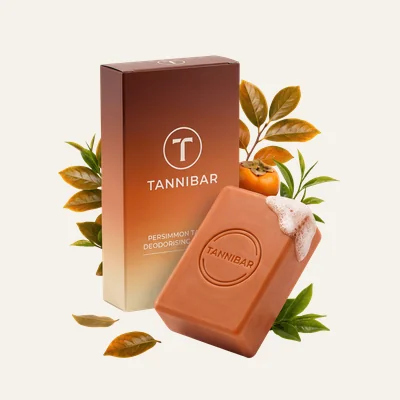
TanniBar Persimmon Tannin Bar
If you want the oxidised-oil half handled by a wash while you sort the rest out with a doctor, a fragrance-free true soap is the simplest version of that — but it is a wash, not a treatment.
Check price →We own TanniBar and earn from sales. 30-day refund, no return needed.What to do with this
Three things are actionable.
-
Use fabric, not your own nose, as the instrument. Smell a pillowcase after a night, or a collar at the end of a day. Underarm-only and worse through the day points bacterial; neck, chest and pillowcase, worse on waking, points oxidised oil. Perimenopause body odor walks through telling them apart.
-
Track timing against dose changes, not against days. The measured sebum changes ran over four to twelve months. Write down what changed and when, so the prescriber has something concrete rather than an impression.
-
Do not start or stop hormone therapy over a smell. There is no evidence base to lean on either way, and the indications and risks that do govern that decision are untouched by anything here.
When to see a doctor
The NHS advises seeing a GP, though not urgently, if you have body odour that has not got better after treating it yourself and it is affecting your self-esteem, you notice a change in how it usually smells, or you suddenly begin to sweat much more than usual. Things that can make body odour worse include having a condition like diabetes, kidney disease or liver disease, and certain types of medicine such as antidepressants. A sudden change in how you smell is worth a conversation rather than a product.
The bottom line
This question returns contradictory answers because it is phrased as though HRT were one thing acting on one smell, and it is neither. Six preparations sit under that name on the NHS pages alone, testosterone sits beside them for some women, and the two hormone families move skin oil in opposite directions — measured in people, prospectively, with the oil itself as the readout.
What has never been measured is whether any of that changes how you smell. Not in menopausal women, not in anyone. The nearest thing to a study is eleven interviews, whose author says in her own abstract that the medical literature mentions the question only in passing. Your observation is probably real, the mechanism that would explain it is partly measured, and the step connecting them is empty — a better place to leave it than either confident answer the search box offers.
Frequently asked questions
Does HRT cause body odor?
No study has ever measured it, in either direction. A title-and-abstract search pairing hormone replacement therapy with body odour returns zero records, and so do estrogen with body odour and menopause with body odour. What is measured is the step before that. In 21 trans women and 17 trans men followed for twelve months with sebum measured directly by Sebutape, estrogens with antiandrogens reduced sebum production and testosterone increased it. Since the stale, greasy odour the category is built around is made by oxidation of skin oil, a treatment that changes oil output is plausibly upstream of it. Plausibly is the operative word: nobody has gone on to smell anyone.
Why do some people say HRT fixed their body odor and others say it caused it?
Partly because HRT is not one drug. The NHS lists six separate preparations under that heading — oestrogen tablets, patches, gel and spray; vaginal oestrogen; micronised progesterone; continuous combined; sequential combined; and tibolone — and testosterone is prescribed to some women on top of those. Estrogen and androgens push sebum production in opposite directions, which is measured. So two people saying opposite things about HRT may be describing two different hormone regimens, two different doses, and two different smells. Neither of them is necessarily wrong.
Does estrogen reduce sebum?
In the clearest human measurement available, yes. Giltay and Gooren followed 21 male-to-female transsexuals receiving estrogens plus antiandrogens, with sebum production measured by Sebutape at baseline and at 4, 8 and 12 months. All parameters of sebum production declined. In the same study, 17 female-to-male transsexuals receiving testosterone showed increased sebum production. A separate lipidomics analysis reached the same conclusion from the other end, finding that androgen induces sebocytes to synthesise and secrete more fatty acids and triglycerides, and that estrogen inhibits this.
Can HRT make you smell worse at first and better later?
Nothing published can answer that, and the reader reports that describe it are reader reports. What can be said is that dose and composition are adjusted over months in ordinary practice, that the measured sebum changes in the one long study ran over 4 to 12 months rather than days, and that the two mechanisms in play — oil output and sweating — need not move together or at the same speed. If a smell change tracks a dose change for you, that is information worth taking to the prescriber rather than to a soap.
Is body odour a symptom of menopause?
Not according to the NHS. Its symptoms page for menopause and perimenopause lists hot flushes and night sweats, sleep problems, mood changes, memory and concentration problems, weight gain, vaginal and urinary symptoms, palpitations, bone density loss, headaches, joint pain, hair thinning, skin changes including dry and itchy skin, reduced sex drive and mouth problems. Smell is not on that list, and sweating appears only inside the description of a hot flush. That absence does not mean nothing changed for you; it means the link is indirect enough that the health service does not list it.
Does HRT change your sense of smell?
For ordinary test odours, the one study that measured it found no effect. Kranz and colleagues gave the Sniffin' Sticks battery to 131 people — trans men and trans women over their first four months of gender-affirming treatment, plus male and female controls — and measured plasma estradiol, testosterone and sex hormone-binding globulin at each point. There was no significant change in odour detection, discrimination or identification, and no correlation between sex hormones and odour perception. The authors add their own caveat: this does not rule out effects on odours the test battery does not include, such as body odours.
Should I start or stop HRT because of body odour?
That is a decision for you and a prescriber, and there is no evidence base here to lean on in either direction. Hormone therapy is prescribed for defined indications with defined risks and benefits; body odour is not one of them, and no trial has used it as an outcome. If your body odour has changed suddenly, the NHS advises seeing a GP, because a changed smell can accompany conditions such as diabetes, kidney disease and liver disease, and some medicines including antidepressants can make it worse.
Sources
- Giltay E.J., Gooren L.J. (2000). Effects of sex steroid deprivation/administration on hair growth and skin sebum production in transsexual males and females. J Clin Endocrinol Metab 85(8):2913-21. (21 male-to-female and 17 female-to-male transsexuals receiving cross-sex hormones, assessed at baseline and after 4, 8 and 12 months, with sebum production measured by Sebutape. "In males, estrogens and antiandrogens reduced plasma testosterone to below 1.0 nmol/L. Though all parameters of hair growth and sebum production declined, facial hair growth continued." "In females, testosterone increased hair growth rate and sebum production." This is the clearest prospective human measurement available of what administered sex steroids do to skin oil output, and it was not a study of odour.)
- Chen F., Hu X., He Y., Huang D. (2021). Lipidomics demonstrates the association of sex hormones with sebum. J Cosmet Dermatol 20(7):2015-2019. (Lipidomic analysis of skin surface lipids across differing sex hormone levels. "We found that androgen can induce sebocytes to synthesis and secrete more fatty acids (FAs) and triglycerides (TGs) through comprehensive analysis of sebum content and composition, which is inhibited by estrogen." Reaches the same directional conclusion as Giltay and Gooren from molecular composition rather than from output.)
- Easterbrook-Smith G. (2025). 'Boy smell': transgender and nonbinary people's experiences of bodily smell. Cult Health Sex 27(4):421-435. (Interviews with 11 transgender and nonbinary people who have accessed gender-affirming hormone therapy, analysed as discourse. "Although it is well documented that GAHT causes changes in skin oiliness, changes in smell are inconsistently documented, and within the medical literature are often commented on only in passing." Participants noticed changes in their own smell during hormonal transition and often experienced the change as affirming. A qualitative humanities study of 11 people, not a clinical measurement, and the author does not present it as one.)
- Kranz G.S., Kaufmann U., Lanzenberger R. (2020). Probing the Impact of Gender-Affirming Hormone Treatment on Odor Perception. Chem Senses 45(1):37-44. (131 participants including female and male controls, transmen and transwomen, tested with the Sniffin' Sticks battery for odour detection, discrimination and identification at baseline and at 1 and 4 months after starting treatment, with plasma estradiol, testosterone and sex hormone-binding globulin measured at each point. "Results revealed no significant change of olfactory performance in the two transgender groups compared with female and male controls." "Moreover, there was no significant correlation between sex hormones and odor perception." The authors add: "our results do not preclude hormonal effects on odors not included in the Sniffin' Sticks test battery, such as body odors or odors associated with sex.")
- Piérard-Franchimont C., Piérard G.E. (2002). Postmenopausal aging of the sebaceous follicle: a comparison between women receiving hormone replacement therapy or not. Dermatology 204(1):17-22. (100 postmenopausal women, 50 on hormone therapy and 50 not, age-matched, measured four times at three-week intervals with a Sebumeter on the forehead. Untreated women showed a significant decline in sebum excretion rate across the first post-menopausal decade, with longer sebum replacement time and larger follicular openings. The authors concluded that hormone therapy does not significantly control seborrhoea; what it mitigated was the progressive widening of the follicular openings.)
- Haze S., Gozu Y., Nakamura S., Kohno Y., Sawano K., Ohta H., Yamazaki K. (2001). 2-Nonenal newly found in human body odor tends to increase with aging. J Invest Dermatol 116(4):520-4. (2-Nonenal, "an unsaturated aldehyde with an unpleasant greasy and grassy odor, was detected only in older subjects (40 y or older)". Omega-7 unsaturated fatty acids and lipid peroxides in skin surface lipids both increased with age, and correlated positively with the amount of 2-nonenal in body odour. 2-Nonenal was generated only when omega-7 unsaturated fatty acids were oxidatively degraded. The authors were affiliated with Shiseido, a cosmetics company.)
- Ishino K., Wakita C., Shibata T., Toyokuni S., Machida S., et al. (2010). Lipid peroxidation generates body odor component trans-2-nonenal covalently bound to protein in vivo. J Biol Chem 285(20):15302-13. (Trans-2-nonenal is generated endogenously during peroxidation of polyunsaturated fatty acids and reacts preferentially with lysine residues to form a protein adduct detected in vivo. The molecule is made in skin oil, where the oil already is.)
- Minhas G.S., Bawdon D., Herman R., Rudden M., Stone A.P., et al. (2018). Structural basis of malodour precursor transport in the human axilla. Elife 7:e34995. (Underarm malodour is produced when specific skin bacteria, principally Staphylococcus hominis, take up an odourless precursor secreted in apocrine sweat and release the volatile thioalcohol 3-methyl-3-sulfanylhexan-1-ol. A bacterial pathway acting on sweat, distinct from the oxidative pathway that produces 2-nonenal from skin lipids.)
- Davis S.R., Baber R., Panay N., Bitzer J., Cerdas Perez S., Islam R.M., Kaunitz A.M., Kingsberg S.A., Lambrinoudaki I., Liu J., Parish S.J., Pinkerton J., Rymer J., Simon J.A., Vignozzi L., Wierman M.E. (2019). Global Consensus Position Statement on the Use of Testosterone Therapy for Women. Climacteric 22(5):429-434. (Published simultaneously in several journals. Cited here only to establish that testosterone therapy for women is a recognised prescribing question addressed by a joint statement whose authors represent the International Menopause Society, the American College of Obstetricians and Gynecologists, the North American Menopause Society, the Endocrine Society, the Royal College of Obstetricians and Gynaecologists and others — that is, that "HRT" in practice can include a hormone the standard menopause preparations do not contain.)
- PubMed title-and-abstract searches on hormone therapy and body odour, run on 28 October 2026. ("hormone replacement therapy"[TIAB] AND ("body odor"[TIAB] OR "body odour"[TIAB]) returns 0. estrogen[TIAB] AND ("body odor"[TIAB] OR "body odour"[TIAB] OR "axillary odor"[TIAB]) returns 0. menopause[TIAB] AND ("axillary odor"[TIAB] OR "body odor"[TIAB] OR "body odour"[TIAB]) returns 0. "2-nonenal"[TIAB] AND menopause[TIAB] returns 1, and it is a case report of clear cell carcinoma arising in cystic adenomyosis, where the aldehyde discussed is 4-hydroxy-2-nonenal, a marker of oxidative stress and not the odour molecule. "hormone therapy"[TIAB] AND (odor[TIAB] OR odour[TIAB]) returns 5, walked in full: a laser hair removal review, a hidradenitis suppurativa monograph, an EEG study of fragrance in menopausal women, a urological case report, and the Easterbrook-Smith interview study above. Only the last is about how a body smells.)
- PubMed vocabulary check on sebum and 2-nonenal, run on 28 October 2026. (sebum[TIAB] AND ("2-nonenal"[TIAB] OR nonenal[TIAB]) returns 0, but "skin surface lipid*"[TIAB] AND ("2-nonenal"[TIAB] OR nonenal[TIAB]) returns 3, including Haze 2001 and Hayashi 2003. The zero is a difference of vocabulary rather than an absence of work: the literature on this molecule says "skin surface lipids" where a reader would say "sebum". Recorded here because a bare zero would overstate the case.)
- NHS: Hormone replacement therapy (HRT) (accessed 28 October 2026). The types of HRT listed on the NHS medicines pages are "Oestrogen tablets, patches, gel and spray", "Vaginal oestrogen", "Utrogestan (micronised progesterone)", "Continuous combined HRT tablets, capsules and patches", "Sequential combined HRT tablets and patches" and "Tibolone". Benefits named include "relieving menopause symptoms and preventing osteoporosis". Testosterone is not among the preparations listed.
- NHS: Symptoms of menopause and perimenopause (accessed 28 October 2026). "Hot flushes are when your face, neck and chest suddenly feel very hot or cold. It can make you sweat a lot, cause palpitations or anxiety, or make you feel dizzy." "It can happen during the day or night (night sweats) and last for several minutes." The symptom list includes "skin changes, including dry and itchy skin". Body odour and changes in smell are not listed, and sweating appears only within the description of a hot flush.
- NHS: Body odour (BO) (accessed 28 October 2026). Advises seeing a GP, though not urgently, if body odour has not got better after treating it yourself and "it's affecting your self-esteem", "you notice a change in how it usually smells", or "you suddenly begin to sweat much more than usual". Names "having a condition like diabetes, kidney disease or liver disease" and "certain types of medicine, such as antidepressants" among things that can make body odour worse.
- PubChem Compound Summary for CID 5283335, 2-Nonenal (accessed 28 October 2026). Molecular weight 140.22, XLogP3 3.1 — a fat-soluble molecule.
- TanniBar product page (accessed 28 October 2026). States "100% fragrance-free", "Triple-milled and hard-pressed for a full month of daily showers", an ingredient list of persimmon tannin, green tea leaf extract, vegetable glycerin, shea butter, saponified coconut and palm oil, vitamin E and water, and a 30-day refund with no return required. Also states "It is a cosmetic product, not a medicine, and is not a substitute for medical advice" and "If body odour changes suddenly or is accompanied by other symptoms, see a healthcare professional." The Soap Digest and TanniBar share an owner.