Home › Nonenal & Body Odor › Phantom smells
Nonenal & Body OdorPhantom Smells in Perimenopause: What the Evidence Says
A phantom smell is a fact about your nose, not about your body. Everything useful follows from that one sentence, including why washing more does nothing.

Disclosure: The Soap Digest is owned by the same company that makes TanniBar. We rank it first and we earn money when you buy it. Every other brand here is linked without payment, and we try to describe each one fairly. Check the facts for yourself. How we handle this.
In this guide
- Phantom and distorted are two different things
- How common it is depends entirely on who was asked
- The smell nearly everybody names is the same smell
- Nobody has measured it in the menopause transition
- The only test that separates a phantom smell from a real one
- Why it is not imaginary
- The headache question, from the other side
- What a bar of soap can do here, which is nothing
- What to do instead
- The bottom line
Somewhere in the middle of an ordinary week, you start smelling cigarette smoke in a house where nobody smokes. Or burning, faintly, from no appliance you can find. Or cat urine, in a flat with no cat. You check the sockets, open the windows, sniff your own clothes, and ask whoever is nearest whether they can smell it. They cannot.
That experience has a name, a measured prevalence and a reasonable first step. It also has one sentence underneath it that makes everything else fall into place: a phantom smell is a fact about your nose, not about your body. Once that is clear, most of what people do about it — washing more, changing deodorant, buying a different soap — stops making sense, and a much shorter list takes its place.
The short version
- Phantosmia means an odour with no source — distinct from parosmia, where a real smell arrives wrong. The two are treated differently.
- The commonest phantom smell is smoke or burning, and references to tobacco are more frequent among people who have never smoked.
- Prevalence depends on who was asked: 4.9% in a population sample of older adults, 25.6% in a smell clinic, 37% after COVID-related smell loss.
- It has never been studied in the menopause transition. The nearest measured hormonal state is pregnancy, where 14% reported phantom smells.
- No wash touches it. If nobody else can smell it, there is nothing on your skin to remove.
Phantom and distorted are two different things
The NIH’s National Institute on Deafness and Other Communication Disorders names four smell disorders. Two are about quantity: hyposmia, “a reduced ability to detect odors”, and anosmia, “the complete inability to detect odors”. Two are about quality: parosmia, “a change in the normal perception of odors”, such as when something familiar is distorted; and phantosmia, “the sensation of an odor that isn’t there.”
The difference matters more than it sounds. Parosmia needs a real odour to distort; phantosmia does not need anything at all. A 2023 review of both puts it plainly: parosmia “should not be confused with phantosmia, in which the distortion of smells occurs in the absence of olfactory stimuli” (Altundag, 2023). The distinction is practical rather than academic: modified olfactory training has evidence behind it for post-infectious smell loss and for COVID-related parosmia, while for phantosmia “the treatment of phantosmia is less straightforward, with an emphasis on determining the etiology and providing symptomatic relief.”
“Is our closet actually stinky or am I menopausal?”
That question, asked half as a joke in a thread of fifty-three replies, is the whole diagnostic problem in nine words. From the inside, there is no way to tell which kind of smell it is.
How common it is depends entirely on who was asked
Four numbers circulate, and they disagree by a factor of seven — because they were collected from four different groups of people.
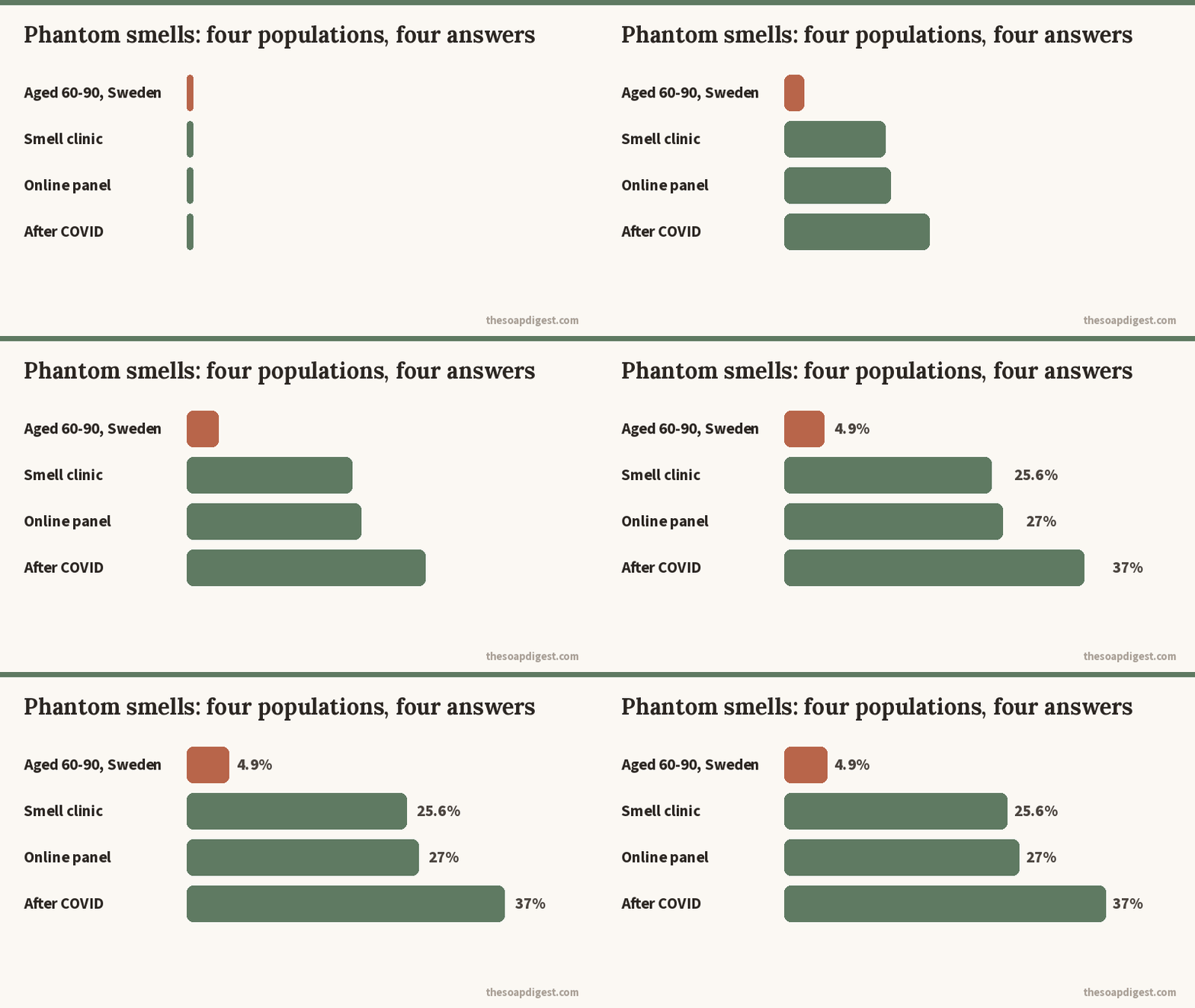
The figure to trust for a general question is the first. In the Swedish National Study on Aging and Care, 2,569 adults aged 60 to 90 were interviewed, and phantosmia was defined carefully as “an odor percept in the absence of any stimuli in the surrounding environment that could emit the odor.” The prevalence was 4.9% (Sjölund et al., 2017). About one person in twenty.
The other three are narrower groups: 363 patients at a smell clinic, who had already sought help (Nordin et al., 1996); 2,340 adults on an online research panel, whose authors say voluntary participation “is likely to favour selection bias, probably overrepresenting individuals with more persistent or severe symptoms” (Rehman et al., 2026); and 4,691 people who already had COVID-related smell loss (Bousquet et al., 2023).
One finding from the Swedish study contradicts the obvious assumption. Phantom smells were associated with female gender, with vascular risk burden and with also reporting parosmia — but measured olfactory dysfunction was not related to phantosmia at all. A phantom smell is not a sign that your nose is failing. It is something else happening in a nose that may be working perfectly well.
The smell nearly everybody names is the same smell
Three independent sources, asked in three completely different ways, return the same answer.
The Swedish population study reports that “the most frequently reported phantom smell was smoky/burnt.” The NHS, listing changes to the sense of smell, gives its example as “smelling things that are not there (phantosmia), like smoke or burnt toast.” And Google’s own suggestions, queried across seven stems today, run heavily to smoke, burning and burnt toast.
The threads match. In the fifty-three-reply thread read for this article, cigarette smoke and burning dominate, and several people say they have never smoked and have spent months suspecting a neighbour. There is a published counterpart to that detail: in the analysis of 1,723 phantosmia descriptions from people with COVID-related smell loss, “reference to ‘tobacco’ was more frequent in non-smokers.”
Which is worth knowing mainly because it removes a particular worry. Smelling cigarettes in a non-smoking house is not something strange happening specifically to you; it is the single most reported phantom smell there is.
Nobody has measured it in the menopause transition
Here is the gap, stated precisely. A title-and-abstract search for phantosmia returns 169 records: a real literature, not an empty field. Pairing that same term with menopause, perimenopause, estrogen or oestrogen returns nothing at all. Not a small study, not a weak study. Zero.
That is a specific absence rather than a general one, and it sits oddly beside the NIDCD’s own list of causes of smell disorders, which includes both “aging” and “hormonal disturbances.” The category is acknowledged; the particular question has not been asked.
What has been asked is the same question in a different hormonal state. A longitudinal study followed women through pregnancy and after it, asking about sensitivity, distortions and phantom sensations. Abnormal smell or taste perception was reported by 76% of the pregnant women. Increased smell sensitivity was very common early on — 67% — and was “occasionally accompanied by qualitative smell distortions (17%) and phantom smells (14%).” The abnormalities were less common late in pregnancy and “almost absent post partum” (Nordin et al., 2004).
Pregnancy is not menopause. But it establishes that phantom smells can rise and fall with a hormonal state in a way that has actually been measured in people, which is more than can be said for most of what is asserted on this subject. It makes the experience plausible. It does not make it proven, and nobody should tell you otherwise.
The only test that separates a phantom smell from a real one
There is exactly one, and it is not clever: somebody else’s nose.
This is what people in the threads do without being told to. They ask a partner. They ask three people. They take a black light to the carpet looking for the cat urine. One commenter describes blaming new neighbours for cooking smells — until the neighbours went on holiday and the smell carried on.
The threads also contain the control case. A reader describes smelling burning and assuming it was phantom, like the cigarette smoke she also gets. Three days later other people could smell it too, and a failing fan had to be replaced. That smell was real; it had simply been faint, and she had detected it first.
“It wasn't me, it was my nose.”
So one failed confirmation settles nothing. A repeated pattern — the same smell, many times, in different rooms and different company, and nobody has ever once smelled it with you — points at your nose. A smell other people eventually find points at a source. Establish which you have before you spend anything, because the two lead to completely different next steps.
One exception, and treat it as the rule. If you smell gas, or burning, do not reason about phantosmia first. Treat it as real until something rules it out — check appliances, check sockets, get out and call the emergency number if you smell gas. The cost of being wrong in that direction is small; the cost of being wrong in the other direction is not.
Why it is not imaginary
People with phantosmia are routinely told, gently or otherwise, that it is in their heads. There is a small, old and striking piece of evidence against the dismissive version of that.

Between 1988 and 1999, one surgeon saw a series of patients with unremitting phantosmia lasting longer than four years. Eight had olfactory mucosa surgically removed; seven had “complete and permanent resolution” of the phantom smell on follow-up averaging 5.4 years. The removed tissue showed “a decreased number of neurons, a greater ratio of immature to mature neurons, and disordered growth of axons with some intraepithelial neuromas” (Leopold et al., 2002).
The caveats are large and the authors state them themselves: eight patients, one centre, retrospective, and surgery that is “extremely difficult with significant risks, and therefore should be limited to specialized centers.” This is not a treatment to ask for. It is cited here for one narrow reason — in the people examined, there was something physically abnormal to find. The phantom smell had a place.
The headache question, from the other side
A reader in one thread reports that her phantom smells arrived as her migraine aura changed from visual to olfactory. It is worth raising with a doctor, but the published numbers point the opposite way from the assumption.
In 113 patients meeting formal criteria for migraine, given a sixty-five-item questionnaire about smell, phantosmia was reported by 4.4% and olfactory hallucinations by 6.2% — while migraine triggered by an odour occurred in 90.2%, with perfume, cleaning products, cigarette smoke and vehicle exhaust the four commonest triggers in that order (Fornazieri et al., 2016). In migraine, the usual relationship between smells and headaches runs from the smell to the headache, not the other way round. The sensitivity side of that is covered separately in our piece on a heightened sense of smell in menopause.
What a bar of soap can do here, which is nothing
This site is about persimmon soap, so it should say where its own subject stops.
A persimmon tannin bar is a rinse-off wash. The case for it rests on 2-nonenal, an aldehyde described as greasy and grassy that is generated when skin-surface lipids oxidise and that was “detected only in older subjects (40 y or older)” (Haze et al., 2001). Everything a wash can do, it does to something sitting on skin.
A phantom smell is not sitting on your skin. Pairing phantosmia with body odour or hygiene in the published literature returns no records at all — not a thin evidence base, an absent one. And the threads make the stakes concrete: people describe washing repeatedly, changing products and interrogating their own clothes for months before anyone tells them the smell has no source to wash off. That is money and self-esteem spent in the wrong direction.

TanniBar Persimmon Tannin Bar
If you have established the smell is real and other people can smell it, our comparison is the place to start; if nobody else can, no bar on that page will help you.
Check price →We own TanniBar and earn from sales. 30-day refund, no return needed.There is one narrow product point worth making, and it argues for buying less rather than more: while smells are bothering you, fragrance-free is the sensible default, because an added scent is one more variable in a situation you are trying to simplify. If the smell is real and age-related, that is a different question, and we have compared the options in our guide to the best persimmon soap.
What to do instead
A short list, in order.
- Rule out a real source once, properly. Gas, appliances, the fridge, the drains, the bins, the car. Then stop re-checking, because the re-checking becomes its own problem.
- Get one other person to be your instrument. Not three people every time — one person you trust to answer honestly, as a standing arrangement.
- Keep a short note for a fortnight. The smell, the time, how long it lasted, where you were, who else was there and whether they smelled it. That page is far more useful to a GP than a description from memory.
- See a GP if it is not settling. The NHS advises a non-urgent appointment if your sense of smell has not gone back to normal in a few weeks; the GP will look for obvious causes such as sinusitis or nasal polyps and may refer on.
- Do not buy anything for it. There is no product for phantosmia, and the absence of one is not a gap in the market.
When to see a doctor. The NHS advises seeing a GP if your sense of smell does not return to normal in a few weeks (NHS, lost or changed sense of smell). Separately, for body odour that is real rather than phantom, it advises a GP visit if self-care has not helped and you notice a change in how it usually smells, you suddenly sweat much more than usual, or it is affecting your self-esteem; it also names conditions such as diabetes, kidney disease and liver disease, and medicines including antidepressants, among things that can make body odour worse (NHS, body odour). The causes of smell disorders listed by the NIDCD run from sinus infections and head injury to medications and neurological conditions, which is a list worth a clinician rather than a search box.
The bottom line
A phantom smell is a fact about your nose. It is common enough to have a population prevalence of about one in twenty in older adults, it is most often smoke or burning, it is not evidence that your sense of smell is failing, and in the few people whose olfactory tissue has been examined there was something physically abnormal there to find.
What it has not got is a menopause literature, so anyone who tells you confidently that perimenopause causes phantom smells is going beyond what has been measured — the nearest evidence is from pregnancy, and it is suggestive rather than settled. What it also has not got is a product. If you are smelling something nobody else can, the useful next steps are one other person’s nose, a two-week note and a GP appointment. The things sold on this website will not help you, and we would rather say so than sell you one.
If other people can smell it, that is a different article: start with what changes about body odour in perimenopause, or with why you may not be able to smell yourself.
Frequently asked questions
Are phantom smells a perimenopause symptom?
Nobody has measured that. A title-and-abstract search pairing phantosmia with menopause, perimenopause, estrogen or oestrogen returns no records at all, and that is against a phantosmia literature of 169 records, so it is a specific gap rather than a small field. What has been measured is a neighbouring hormonal state: in a longitudinal study of pregnant women, 14% reported phantom smells, against 67% reporting increased smell sensitivity, and the smell abnormalities were almost absent by nine to twelve weeks post partum. That makes the experience plausible. It does not make it established, and the honest position is that the question has not been asked.
How common are phantom smells?
It depends entirely on who was asked, which is the most useful thing to know about the numbers. In a population-based interview study of 2,569 Swedish adults aged 60 to 90, 4.9% reported phantom smells. Among 363 patients attending a chemosensory and nasal or sinus clinic, 25.6% had phantosmia. A self-selected online panel survey of 2,340 adults in Austria, Germany and Switzerland put it at 27%, with the authors noting that voluntary participation probably overrepresents people with persistent symptoms. Among 4,691 people with COVID-related smell problems, 37%. The population figure is the one to reason from.
Why is it always cigarette smoke or burning?
Because that is genuinely the commonest phantom smell, and three independent sources agree on it. In the Swedish population study, the most frequently reported phantom smell was smoky or burnt. The NHS gives smoke and burnt toast as its examples. And in a study of 4,691 people with COVID-related smell problems, reference to tobacco in the descriptions was more frequent among people who had never smoked. It is not a coincidence in your house; it is the single most reported category of phantom smell there is.
Does it mean something is wrong with my sense of smell?
Not necessarily, and that is one of the more surprising findings. In the Swedish population study, phantom smells were associated with female gender, with vascular risk burden and with also reporting distorted smells — but measured olfactory dysfunction was not related to phantosmia at all. People reporting phantom smells did not, as a group, have worse noses. Phantosmia and smell loss are separate things that can occur separately.
Is it all in my head?
Not in the sense people usually mean. In a long-term follow-up of eight patients with phantosmia that had lasted more than four years, surgeons removed olfactory tissue and examined it; seven had complete and permanent resolution, and the excised tissue showed fewer neurons, a higher ratio of immature to mature neurons and disordered axon growth. Eight people is a very small series and the authors describe the operation as extremely difficult, with significant risks, and suitable only for specialised centres. But there was something there to find, which is worth knowing if you are being told you are imagining it.
Will persimmon soap help with phantom smells?
No, and this is the clearest case on this site of a product being the wrong shelf entirely. A persimmon tannin bar is a rinse-off wash aimed at 2-nonenal, an aldehyde on the skin surface. If nobody else can smell what you are smelling, there is nothing on your skin for a wash to remove. Pairing phantosmia with body odour or hygiene in the published literature returns no records at all. The useful move here is a doctor, not a soap, and if smells are bothering you then fragrance-free products are the sensible choice while you work out what is going on.
When should I see a doctor about it?
The NHS advises seeing a GP, non-urgently, if your sense of smell does not go back to normal in a few weeks; the GP will check for obvious causes such as sinusitis or nasal polyps and may refer on. Phantosmia has a long list of possible causes including infections, head injury, nasal growths, medications and neurological conditions, so it is worth a proper look rather than a search engine. And if you smell gas or burning, treat it as real until something has ruled it out.
Sources
- Sjölund S., Larsson M., Olofsson J.K., Seubert J., Laukka E.J. (2017). Phantom Smells: Prevalence and Correlates in a Population-Based Sample of Older Adults. Chem Senses 42(4):309-318. (Swedish National Study on Aging and Care in Kungsholmen; n = 2,569 adults aged 60 to 90. Phantosmia assessed by standardised interview and "defined as reporting having experienced an odor percept in the absence of any stimuli in the surrounding environment that could emit the odor". "The overall prevalence of phantom smells was 4.9%, and was associated with female gender, carrying the met allele of the BDNF gene, higher vascular risk burden, and reporting distorted smell sensations (parosmia). Olfactory dysfunction was, however, not related to phantosmia. The most frequently reported phantom smell was smoky/burnt." The authors also report that some individuals described phantom smells with an autobiographical connotation.)
- Nordin S., Murphy C., Davidson T.M., Quiñonez C., Jalowayski A.A., Ellison D.W. (1996). Prevalence and assessment of qualitative olfactory dysfunction in different age groups. Laryngoscope 106(6):739-44. (363 chemosensory and nasal or sinus patients. "More than 40% of the study group evidenced either parosmia (18.7%) and/or phantosmia (25.6%), a finding that suggests that more attention should be paid by the medical practitioner in addressing qualitative olfactory dysfunction." A clinic population, not a general one, which is why its figures sit so far above the population estimate.)
- Rehman U., Philpott C., Hsieh J., Mueller C.A., Landis B.N., Welge-Luessen A., Huber A., Otte M.S., Klussmann J.P., Lechner M., Hummel T. (2026). Self-Reported Smell and Taste Disorders in the General Population: A Cross-Sectional Survey in Austria, Germany and Switzerland. Eur Arch Otorhinolaryngol 283(7):4395-4404. (Online survey, January 2025, of 2,340 non-institutionalised adults recruited via a research panel. "Overall, 40% (n = 945) of respondents reported at least one symptom, with olfactory intolerance (29%, n = 686), phantosmia (27%, n = 622), and parosmia (19%, n = 451) being the most common." Phantosmia and parosmia were the strongest independent predictors of reduced quality of life. The authors' own caveat: "the voluntary nature of survey participation is likely to favour selection bias, probably overrepresenting individuals with more persistent or severe symptoms".)
- Bousquet C., Bouchoucha K., Bensafi M., Ferdenzi C. (2023). Phantom smells: a prevalent COVID-19 symptom that progressively sets in. Eur Arch Otorhinolaryngol 280(3):1219-1229. (4,691 patients with COVID-19 responded to an online questionnaire on COVID-related olfactory disorder; 1,723 reported phantosmia and their free-text descriptions were analysed. "The prevalence of phantosmia was of 37%. Women were more likely to report phantosmia than men." Prevalence rose over the first two months and then plateaued with no decrease over 15 months. Descriptions were negatively valenced for 78% of respondents, and "reference to 'tobacco' was more frequent in non-smokers".)
- Altundag A. (2023). Parosmia and Phantosmia: Managing Quality Disorders. Curr Otorhinolaryngol Rep 11(1):19-26. (Review. "Parosmia, the distortion of smells, is a symptom in qualitative olfactory disorders that severely affects patients' mental well-being and enjoyment of their everyday lives. The condition was first documented in 1895 and can affect up to 5% of the general population." On the distinction: "Parosmia should not be confused with phantosmia, in which the distortion of smells occurs in the absence of olfactory stimuli." Etiologies of phantosmia given as infections, traumatic brain injury and psychiatric disorders; "unlike parosmia, the treatment of phantosmia is less straightforward, with an emphasis on determining the etiology and providing symptomatic relief". Modified olfactory training is described for post-infectious loss and for COVID-related parosmia, not for phantosmia.)
- Nordin S., Broman D.A., Olofsson J.K., Wulff M. (2004). A longitudinal descriptive study of self-reported abnormal smell and taste perception in pregnant women. Chem Senses 29(5):391-402. (Self-reported abnormal sensitivity, qualitative distortions and phantom sensations assessed for gestational weeks 13-16 and 31-34, compared with 9-12 weeks post partum and with non-pregnant women over matched intervals. "Abnormal smell and/or taste perception was reported by 76% of the pregnant women, typically believed to be caused by their pregnancy. Increased smell sensitivity was found to be very common at the early stage of pregnancy (67% of all pregnant respondents) and occasionally accompanied by qualitative smell distortions (17%) and phantom smells (14%). The smell abnormalities were less common at the late pregnancy stage and almost absent post partum." Cited here as the nearest hormonal state in which this question has actually been asked; it is not a study of menopause.)
- Leopold D.A., Loehrl T.A., Schwob J.E. (2002). Long-term follow-up of surgically treated phantosmia. Arch Otolaryngol Head Neck Surg 128(6):642-7. (Retrospective record review and telephone survey of all patients presenting to one surgeon from 1988 to 1999 with unremitting phantosmia lasting longer than four years; follow-up 1 to 11 years, average 5.4. "Of 8 patients, 7 have complete and permanent resolution of their phantosmia." "The excised olfactory mucosa generally shows a decreased number of neurons, a greater ratio of immature to mature neurons, and disordered growth of axons with some intraepithelial neuromas." The authors' own caveat: the surgery "is also extremely difficult with significant risks, and therefore should be limited to specialized centers". Eight patients, one centre: cited here for the histology, not as a treatment recommendation.)
- Fornazieri M.A., Neto A.R., de Rezende Pinna F., Gobbi Porto F.H., de Lima Navarro P., Voegels R.L., Doty R.L. (2016). Olfactory symptoms reported by migraineurs with and without auras. Headache 56(10):1608-1616. (113 patients meeting ICHD-II criteria for migraine, given a 65-item questionnaire on olfaction-related experience. "While osmophobia was present in 95.5% of the patients, the prevalence of other olfaction-related symptoms was much lower (interictal olfactory hypersensitivity [IOH], 14.1%; olfactory hallucinations, 6.2%; phantosmia, 4.4%; cacosmia/euosmia, 2.6%). Migraine was commonly triggered by odors (90.2%), with perfume being the most common trigger (95.1%), followed by cleaning products (81.3%), cigarette smoke (71.5%), and motor vehicle exhaust (70.5%)." No significant differences were found between migraineurs with and without auras.)
- PubMed title-and-abstract searches on phantom smells, run on 4 November 2026. (phantosmia[TIAB] returns 169 records, so this is a real literature rather than an empty field. phantosmia[TIAB] AND (menopause[TIAB] OR perimenopause[TIAB] OR estrogen[TIAB] OR oestrogen[TIAB]) returns 0. phantosmia[TIAB] AND ("body odor"[TIAB] OR "body odour"[TIAB] OR hygiene[TIAB]) returns 0. phantosmia[TIAB] AND migraine[TIAB] returns 7. The phrase searches "phantom smell"[TIAB] OR "phantom smells"[TIAB] OR "phantom odor"[TIAB] OR "phantom odour"[TIAB] return 17 between them, which is why the clinical word is the one to search on.)
- NIDCD (National Institute on Deafness and Other Communication Disorders, NIH): Smell disorders (accessed 4 November 2026). Defines hyposmia as "a reduced ability to detect odors", anosmia as "the complete inability to detect odors", parosmia as "a change in the normal perception of odors", "such as when the smell of something familiar is distorted", and phantosmia as "the sensation of an odor that isn't there". The causes listed are aging, sinus and other upper respiratory infections, smoking, growths in the nasal cavities, head injury, hormonal disturbances, dental problems, exposure to certain chemicals such as insecticides and solvents, numerous medications including some common antibiotics and antihistamines, radiation for treatment of head and neck cancers, and conditions that affect the nervous system such as Parkinson's disease or Alzheimer's disease.
- NHS: Lost or changed sense of smell (accessed 4 November 2026). Lists "smelling things that are not there (phantosmia), like smoke or burnt toast" alongside loss of smell (anosmia), reduced sense of smell (hyposmia) and changes to how things smell (parosmia). Advises seeing a GP, non-urgently, if "your sense of smell does not go back to normal in a few weeks"; the GP will check for obvious causes such as sinusitis or nasal polyps and may refer on. Causes listed include colds, flu or COVID-19, sinusitis, allergies such as hay fever, nasal polyps, some medicines, ageing, and rarely more serious conditions such as Parkinson's disease or epilepsy.
- NHS: Body odour (BO) (accessed 4 November 2026). Advises seeing a GP, though not urgently, if body odour has not got better after treating it yourself and "it's affecting your self-esteem", "you notice a change in how it usually smells", or "you suddenly begin to sweat much more than usual". Names "having a condition like diabetes, kidney disease or liver disease" and "certain types of medicine, such as antidepressants" among things that can make body odour worse.
- Haze S., Gozu Y., Nakamura S., Kohno Y., Sawano K., Ohta H., Yamazaki K. (2001). 2-Nonenal newly found in human body odor tends to increase with aging. J Invest Dermatol 116(4):520-4. (2-Nonenal, "an unsaturated aldehyde with an unpleasant greasy and grassy odor, was detected only in older subjects (40 y or older)". The molecule was generated when omega-7 unsaturated fatty acids in skin surface lipids were oxidatively degraded. The authors were affiliated with Shiseido, a cosmetics company.)
- r/Perimenopause, "Phantom smells", posted 2 October 2026. (A 53-entry thread read in full for this article on 4 November 2026. Readers name cigarette smoke, burning or electrical-fire smells, burnt toast, coffee, cat urine, musty odours and cooking meat; several say they have never smoked. Read as evidence of how the experience is described and of what people do about it, which is overwhelmingly to ask somebody else to verify the smell. One commenter distinguishes a smell that turned out to be real, because three days later other people could smell it too, from the phantom ones that nobody ever confirmed.)
- r/Perimenopause, "Phantom blue cheese smells", posted 5 May 2026. (A short thread read in full for this article on 4 November 2026, in which the original poster describes attributing a smell first to her husband and then to herself before concluding it had no external source, and commenters describe blaming neighbours whose absence did not stop the smell. Read as evidence of the misattribution sequence, not for any claim about causes.)
- r/Perimenopause: subreddit search for "phantom", sorted by new over one year, run on 4 November 2026. (Returned 25 threads, of which eight are specifically about smelling things that are not there, posted across twelve months: two titled simply "Phantom smells", plus threads on exhaust fumes, musty or mildew odours, blue cheese, phantom smells and noises, and two general "is anyone else" and "any tricks to stop" threads. Cited as evidence that the question recurs rather than for any claim made in the threads.)
- Google autocomplete, queried 4 November 2026 on seven stems. ("phantom smells" returns causes, menopause, perimenopause, pregnancy, migraines, anxiety, cigarette smoke, of smoke and after covid. "phantom smells menopause" returns phantom smells perimenopause, phantom smells perimenopause reddit, phantom smells perimenopause treatment, phantom smells post menopause, phantom smells of smoke menopause and can menopause cause phantom smells. "perimenopause phantom" returns phantom smells first, then phantom cigarette smell and phantom smoke smell. "phantosmia" returns phantosmia and perimenopause and phantosmia and menopause. "why do i keep smelling" returns cigarette smoke, smoke, burning, ammonia, burnt toast and onions. "smelling cigarette smoke" returns when there is none, perimenopause and menopause. "menopause smelling" returns smoke, cigarette smoke, burning and things that aren't there. Recorded as a dated observation of what is being searched, not as a measure of volume.)