Home › Nonenal & Body Odor › Hypochlorous acid for body odor
Nonenal & Body OdorHypochlorous Acid for Body Odor: What It Can and Can't Fix
It has become the default answer in every cleaning and body-odour thread on Reddit. It is a genuinely useful antimicrobial — which is exactly why it matters that one of the two smells people call body odour is not made by microbes at all.

Disclosure: The Soap Digest is owned by the same company that makes TanniBar. We rank it first and we earn money when you buy it. Every other brand here is linked without payment, and we try to describe each one fairly. Check the facts for yourself. How we handle this.
In this guide
- What hypochlorous acid actually is
- The two smells it has to choose between
- What happens when hypochlorous acid meets skin oil
- The spray gets used up before it finishes the job
- Does spraying it into the air do anything?
- The one place HOCl has been measured against a smell
- Is it safe? On skin, and on fabric
- Why your bottle stopped working
- So which smell have you got, and what fits it?
- The bottom line
Search almost any cleaning or body-odour thread from the past year and one answer turns up more than any other: hypochlorous acid. It is cheap, it leaves little smell of its own, and the people recommending it are sincerely enthusiastic. What almost nobody in those threads does is say what it is for. That matters here, because “body odour” is doing double duty — it covers two unrelated smells with two unrelated causes — and hypochlorous acid is a sensible tool for one of them and close to beside the point for the other.
The short version
- Hypochlorous acid (HOCl) is an antimicrobial. EPA defines a disinfectant as a product used on nonliving surfaces to destroy or irreversibly inactivate infectious fungi and bacteria.
- The sharp, sweaty underarm smell is made by bacteria, so that is the odour HOCl is aimed at.
- The greasy, musty smell people call “old person smell” is 2-nonenal, an oxidation product of skin oil. Its published mechanism contains no microbes at all.
- No study has measured hypochlorous acid against 2-nonenal or human body odour. A PubMed title-and-abstract search returns nothing.
- Where HOCl has met skin oil in the lab, it added chlorine across the oil’s double bonds without breaking the carbon backbone. The oil was still there afterwards.
- Organic matter consumes HOCl fast, and the bottle itself degrades in light, air and warmth.
What hypochlorous acid actually is
HOCl is the active species in ordinary chlorination, and hypochlorite salts that release the hypochlorite ion have been in use for more than two centuries as disinfecting, cleaning, deodorizing and decolorizing agents. Fukuzaki’s 2023 review makes the key distinction plainly: the antimicrobial activity of a dilute hypochlorite solution is attributed largely to HOCl, because HOCl can cross bacterial cell membranes, while the hypochlorite ion is non-volatile and stays in the solution.
That dissolves the idea that the spray in the cupboard and the bleach under the sink are unrelated chemistries. They are different balances of the same pair of species: the sprays sit near neutral or mildly acidic, which keeps the balance on the HOCl side, while bottled bleach is strongly alkaline and far more concentrated.
Our own immune cells make HOCl too — it is part of the innate immune system — which is where the “it’s natural” framing in the threads comes from. The framing is accurate, and it tells you nothing about what the compound does to a particular smell.
Notice what EPA’s categories have in common. Sterilizer, disinfectant and sanitizer are each defined by what the product does to organisms — eliminating, inactivating or reducing fungi, spores, viruses and bacteria. None of them is defined by what it does to a molecule.
“it's not a magical odor destroyer”
The two smells it has to choose between
The first is the one everybody means by body odour. Apocrine glands in the armpit secrete compounds that have no smell on their own; skin bacteria then cleave them, releasing thioalcohols — and Minhas and colleagues worked out the structural basis of how those precursors are transported into the bacteria in the first place. Bacteria are load-bearing there. Reduce them and you change the smell, so an antimicrobial is genuinely on target.
The second is the one this site mostly exists to write about. Haze and colleagues analysed the body odour of people aged 26 to 75 by headspace gas chromatography–mass spectrometry and found 2-nonenal only in subjects of 40 and over. Omega-7 unsaturated fatty acids and lipid peroxides in skin-surface lipids both rose with age, and both correlated with how much 2-nonenal was present. When the researchers deliberately broke down the main components of skin-surface lipid using lipid peroxides as the initiator of an oxidative chain reaction, 2-nonenal appeared.
Read that mechanism again and look for the microbe. There isn’t one. It is a chain reaction in oil, running on oxygen. Our index of the peer-reviewed nonenal literature covers it in detail, and it is the most useful thing to have straight before buying anything: an antimicrobial cannot inactivate an oxidation reaction, because nothing in it is alive.
What happens when hypochlorous acid meets skin oil
Here the literature is more specific than either side of the argument usually is. Schwartz-Narbonne and colleagues at Toronto did something close to the relevant experiment, for a different reason. They put gaseous HOCl — the kind that fills a room when you clean with bleach — over thin films of squalene and oleic acid. Squalene is one of the major lipids on human skin. At 600 parts per billion, HOCl formed chlorohydrins by adding across the carbon–carbon double bonds without breaking the carbon backbone. The first molecule was taken up within minutes; all six of squalene’s double bonds were chlorinated within one to two hours. Their conclusion was that chlorination of skin oil is likely to happen rapidly under common cleaning conditions, and may account for the irritation people associate with chlorine bleach.
What was measured: HOCl reacts fast with this kind of oil, and the reaction adds onto the molecule rather than demolishing it. What was not measured: anything about odour. Nobody in that study smelled anything.
Even so, the direction is informative. Haze’s 2-nonenal comes from breaking fatty-acid chains apart. A reaction that saturates the double bonds and leaves the backbone intact is not the same event as clearing the reservoir — and the omega-7 double bond is the very feature the nonenal story turns on. Chlorinating the oil is a real chemical change with genuinely unknown consequences for how it smells, in either direction. Nor is HOCl on lipid a clean subtraction anywhere else: in tissue, immune-cell HOCl attacking plasmalogens liberates 2-chlorofatty aldehydes of its own — not 2-nonenal, not known to smell of anything, and not a spray on a cushion, but a reminder that an oxidant meeting unsaturated lipid is a reaction with products.
The spray gets used up before it finishes the job
This is the most practical finding of the lot, and it explains a lot of disappointed reports. Ishihara and colleagues tested a 200 ppm solution at pH 6 and found that excess organic compounds containing amine or carbonyl groups — proteins and carbohydrates — or common inorganic ions including nitrite, sulphite, phosphite, iron and copper caused HOCl to be consumed rapidly by oxidation, significantly reducing its activity against bacteria.
So the thing you are spraying is also the thing that eats the spray. A cushion or mattress that has absorbed skin oil for years is a very large organic load, and the HOCl is spent on its outermost layer.
There is direct evidence for that on HOCl’s home ground. Kumaran and Ramirez-Arcos grew Cutibacterium acnes biofilms with and without sebum-like components, then treated them with chlorhexidine and isopropyl alcohol, with a hypochlorous-acid-based disinfectant, and with both. Sebum significantly reduced the efficacy of every strategy tested, and none eradicated the bacteria. Even where killing bacteria is the whole point, skin oil blunts the tool.
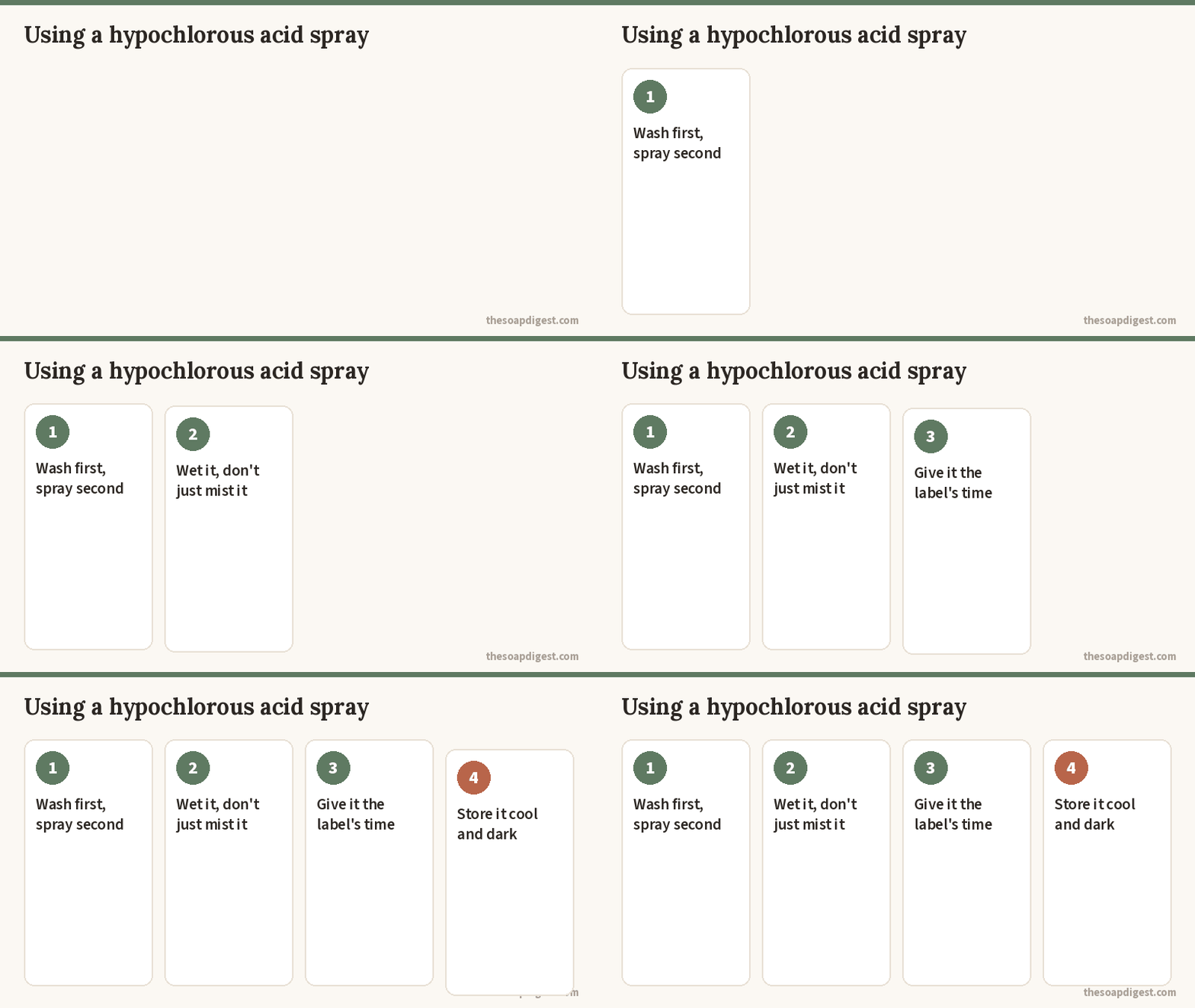
Then there is contact time, which almost nobody observes at home. EPA’s guidance is that a surface should stay visibly wet for the entire contact time on the label — ten minutes means ten minutes of visible wetness. A light mist across a three-seater sofa is dry in a minute or two, and if the oil is centimetres down inside the foam, as it usually is with smell that has soaked into furniture, a surface spray was never reaching it anyway.
Does spraying it into the air do anything?
People ask this directly, and it deserves a straight answer. Gaseous hypochlorous acid indoors has been studied seriously: HOCl is volatile and readily driven out of solution by stirring, bubbling, atomising or forced-air vaporisation, and Fukuzaki’s review gathers the evidence for its safety and effectiveness in indoor spaces.
But look at the endpoint in that literature. It is controlling microorganisms. Even the work supporting fogging a room is not about removing odour molecules from air — and a fog cannot reach oil inside a foam block or a mattress, which is where the household version of this smell almost always lives. If a whole room smells, find the reservoir rather than treating the air, which is the logic running through our guide to old person smell in a house.
The one place HOCl has been measured against a smell
To be fair to it, there is a study and the result is positive. Kim and colleagues applied HOCl to food waste being vermicomposted and measured what came off it. Ammonia fell by about 40% and amines by about 80% against untreated waste, and the earthworms did better too.
That is a real deodorising result, and also a precise illustration of the boundary. Ammonia and amines are nitrogen compounds generated by active microbial decay — exactly the odour an antimicrobial oxidant should reduce. 2-nonenal is neither. It is an aldehyde produced by oxygen attacking a fatty acid, with no microbe required at any step.
The negative finding is as informative as the positive one. A PubMed search of titles and abstracts for hypochlorous acid together with body odour returns nothing; nothing links it to 2-nonenal, and nothing links it to persimmon. Every confident claim in circulation about hypochlorous acid and body odour — including the careful version on this page — is inference from what the compound does elsewhere, not a measurement of the smell.
Is it safe? On skin, and on fabric
On skin, the dermatology literature is broadly favourable. A 2025 review across dermatology, surgery, dentistry, ophthalmology and rhinology describes topical HOCl as useful in wound care, leg and diabetic ulcers, atopic dermatitis, seborrhoeic dermatitis, pruritus and acne, and notes its high safety profile as a compound the body already produces. The same review is candid that results are not entirely consistent and that future work needs to minimise tissue irritation. That is a reasonable basis for using it on skin if a clinician has suggested it — not a basis for expecting it to change age-related odour.
On fabric, there are two cautions and only one of them is folklore.
“Why would you put any kind of acid on a fabric?”
The acidity is not the issue — these sprays are near neutral, and the mild acidity is deliberate, because it keeps the active species as HOCl rather than hypochlorite. The oxidising power is the issue. Hypochlorite chemistry has been used as a decolorizing agent for two hundred years, and a household spray is vastly more dilute and far less alkaline than bottled bleach without being a different substance. Spot-test somewhere hidden on anything you would be upset to fade, and be careful with wool, silk and anything dark or vintage.
Why your bottle stopped working
The threads are right about this, and there is a paper behind it. The same Ishihara study found HOCl solution unstable against ultraviolet light, sunshine, contact with air, and temperatures at or above 25 °C, and recommended a formulation in pure water with as few other compounds and ions as possible, stored dark and cool — below 10 °C.
In domestic terms: an opaque bottle, a cool cupboard, and not the windowsill, the shower shelf or the car. Decant it into a clear bottle and leave it in the light and you are running the degradation experiment on purpose. Check the label for a date, and treat an old bottle with suspicion rather than assuming it failed because the smell was invincible.

So which smell have you got, and what fits it?
If the smell is sharp and sweaty, worst in the armpits and groin, arrives with exertion or stress, and washes out of cotton easily, you are dealing with the bacterial route. Washing is still the main event and an antimicrobial is a reasonable adjunct. A leave-on acidic deodorant is aimed at this smell too, which is the distinction we work through in persimmon soap versus Lume.
If the smell is greasy and musty, more “old book” than “gym”, worst on pillowcases, collars and headrests, builds gradually rather than arriving with sweat, and survives a warm wash, you are dealing with oxidised skin oil. The job is to remove or dilute the oil rather than disinfect anything: hot washes with a good detergent, degreasing what cannot go in a machine, replacing foam you cannot reach, and on skin a cleanser whose job is to lift oil off. Our comparison of the best persimmon soap options ranks the bars on that basis, and our guide to why persimmon soap sometimes does nothing covers the ways people work against it.
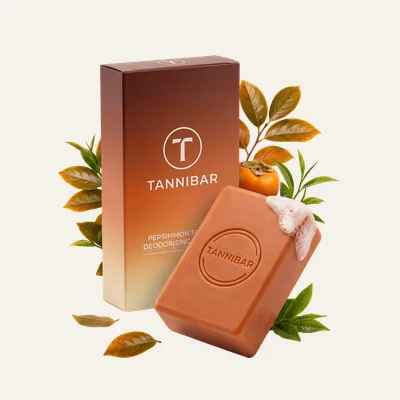
TanniBar Persimmon Tannin Bar
Fragrance-free and built around persimmon tannin, so it works on the skin-oil side of the problem rather than the microbial side — and adds no scent of its own to whatever you are already trying to get out of the fabric.
Check price →We own TanniBar and earn from sales. 30-day refund, no return needed.When to see a doctor
The NHS advises seeing a GP if body odour has not improved after treating it yourself and it is affecting your self-esteem, you notice a change in how it usually smells, or you suddenly begin to sweat much more than usual. A smell that has changed character or appeared abruptly is worth a professional opinion rather than another spray bottle.
The bottom line
Hypochlorous acid is a real antimicrobial with a real evidence base, and if the smell you are chasing is made by bacteria it is a defensible thing to own — used on a surface kept wet for the labelled contact time, from a bottle stored cool and dark.
It is not a universal odour eliminator, and the most confident recommendations online are the least specific about which smell they mean. For the oxidised-sebum smell, nothing has been measured, the mechanism has no microbes in it for a disinfectant to act on, the organic load consumes the spray before it gets anywhere, and the one published reaction between HOCl and skin oil leaves the oil sitting there with chlorine added to it. Get the oil out. That is a laundry and cleansing problem, not a disinfection problem.
Frequently asked questions
Does hypochlorous acid get rid of body odour?
It depends entirely on which body odour you mean. The sharp, sweaty underarm smell is produced when skin bacteria convert odourless precursors from apocrine sweat into thioalcohols, so an antimicrobial is aimed at the right target. The greasy, musty smell associated with age is 2-nonenal, which Haze and colleagues showed is generated by the oxidative degradation of omega-7 unsaturated fatty acids in skin oil, with lipid peroxides acting as the initiator of a chain reaction. There are no microbes in that mechanism, so there is nothing there for a disinfectant to inactivate.
Has anyone actually tested it on nonenal?
No. A PubMed search of titles and abstracts for hypochlorous acid together with body odour returns no results at all, and there is nothing linking it to 2-nonenal or to persimmon. Every claim you read about hypochlorous acid and body odour, including the cautious version on this page, is reasoning from what the compound is known to do in other settings rather than from a study that measured the smell.
Does spraying it into the air deodorise a room?
Gaseous hypochlorous acid in indoor spaces has been studied seriously, and Fukuzaki's 2023 review sets out the evidence for its safety and effectiveness. Read the endpoint carefully though: that work is about controlling microorganisms, not about removing odour molecules from the air. If a room smells because skin oil has soaked into a chair or a mattress, a fog in the air is not reaching the oil, and the odour will keep being produced.
Is hypochlorous acid safe on clothes and upholstery?
Spot-test first. Hypochlorite chemistry has been used as a decolorizing agent for over two centuries, and the sprays sold for household use are far more dilute and far less alkaline than bottled bleach but are not a different substance. There is also a practical limit: EPA's guidance on disinfectants is that the surface should remain visibly wet for the whole of the contact time on the label, and a light mist over a sofa is dry long before that.
Why does my bottle seem to stop working?
Because it does. Ishihara and colleagues found a 200 ppm solution at pH 6 was unstable against UV light, sunshine, contact with air and temperatures at or above 25 °C, and recommended storage in dark, cool conditions below 10 °C to hold both the concentration and the microbicidal activity. A clear bottle on a sunny windowsill or in a hot car is the worst case. This is the chemistry behind the widely repeated observation that it turns back into salt water.
Is it safe to put on skin?
Hypochlorous acid is produced by our own immune cells, and the dermatology literature is broadly positive about topical use in wound care, atopic dermatitis, seborrhoeic dermatitis, pruritus and acne. The same 2025 review notes that results across studies are not entirely consistent and that more work is needed to minimise tissue irritation and damage, so this is a conversation to have with a clinician rather than an argument for spraying it on daily. It is not a reason to expect it to change age-related odour.
Sources
- Haze S. et al. (2001). 2-Nonenal newly found in human body odor tends to increase with aging. J Invest Dermatol 116(4):520–4. (2-nonenal is generated by oxidative degradation of omega-7 unsaturated fatty acids, with lipid peroxides as the initiator of an oxidative chain reaction — no bacteria in the mechanism)
- Minhas G.S. et al. (2018). Structural basis of malodour precursor transport in the human axilla. eLife 7:e34995. (the bacterial thioalcohol route — the odour an antimicrobial is actually aimed at)
- Schwartz-Narbonne H. et al. (2019). Heterogeneous chlorination of squalene and oleic acid. Environ Sci Technol 53(3):1217–24. (gaseous HOCl forms chlorohydrins across the carbon–carbon double bonds of squalene without breaking the carbon backbone; all six double bonds chlorinated within 1–2 h at 600 ppbv)
- Ishihara M. et al. (2017). Stability of weakly acidic hypochlorous acid solution with microbicidal activity. Biocontrol Sci 22(4):223–7. (unstable to UV, sunshine, air contact and temperatures at or above 25 °C; rapidly consumed by proteins, carbohydrates and various ions, which significantly decreased microbicidal activity)
- Kumaran D., Ramirez-Arcos S. (2024). Sebum components dampen the efficacy of skin disinfectants against Cutibacterium acnes biofilms. Microorganisms 12(2):271. (sebum-like components significantly reduced the efficacy of all disinfectant strategies tested, including a hypochlorous-acid-based disinfectant; none eradicated the bacteria)
- Fukuzaki S. (2023). Uses of gaseous hypochlorous acid for controlling microorganisms in indoor spaces. J Microorg Control 28(4):165–75. (HOCl vs OCl−; hypochlorite salts long used as disinfecting, cleaning, deodorizing and decolorizing agents; indoor-space evidence is about microbial control)
- Kim C. et al. (2019). Evaluating the effectiveness of HOCl application on odor reduction and earthworm population growth during vermicomposting of food waste. PLoS One 14(12):e0226229. (HOCl reduced ammonia by 40% and amines by 80% — nitrogen compounds from active microbial decay, not a lipid oxidation aldehyde)
- Haralović V. et al. (2025). Hypochlorous acid: clinical insights and experience in dermatology, surgery, dentistry, ophthalmology, rhinology and other specialties. Biomedicines 13(12):2921. (HOCl is part of the innate immune system; broadly favourable topical review, but results are not entirely consistent and irritation remains a concern)
- Palladino E.N.D. et al. (2018). The chlorinated lipidome originating from myeloperoxidase-derived HOCl targeting plasmalogens. Arch Biochem Biophys 641:31–8. (immune-cell HOCl attacking plasmalogens liberates 2-chlorofatty aldehydes — inside tissue, not on a sofa, and not 2-nonenal)
- Møllebjerg A. et al. (2021). The bacterial life cycle in textiles is governed by fiber hydrophobicity. Microbiol Spectr 9(2):e0118521. (polyester absorbed more sebum than cotton — why synthetic upholstery and sleepwear are the hard cases)
- US EPA: What are antimicrobial pesticides? (definitions of sterilizer, disinfectant and sanitizer). (a disinfectant is used on nonliving surfaces and objects to destroy or irreversibly inactivate infectious fungi and bacteria but not necessarily their spores)
- US EPA: Selected EPA-registered disinfectants (label directions and contact time). (the surface should be visibly wet for the entire contact time)
- NHS: Body odour (BO) — when to see a GP.
- TanniBar product page (ingredients, fragrance-free and triple-milled, refund and shipping terms) — brand's own claims.