Home › Laundry & Home › Old person smell in clothes
Laundry & HomeHow to Get Old Person Smell Out of Clothes: A Laundry Guide to Nonenal
A caregiver on r/laundry put it perfectly this month: the soap fixed the smell on the person, then the laundry came out of the washer still smelling. That's not a hygiene failure. It's chemistry.

Disclosure: The Soap Digest is owned by the same company that makes TanniBar. We rank it first and we earn money when you buy it. Every other brand here is linked without payment, and we try to describe each one fairly. Check the facts for yourself. How we handle this.
In this guide
A caregiver posted on r/laundry this month with a problem that comes up constantly. The elderly relative they look after is meticulous about hygiene, has started using persimmon soap, and no longer smells at all. Then the laundry came out of the washing machine still carrying that stale, greasy note.
“reduced the odor to nothing on their person”
That gap between the person and their clothes catches almost everyone out. Fixing the skin doesn’t fix the fabric, because the fabric is already holding months of the oil the smell lives in. Here’s why, and the wash that gets it out.
The short version
- 2-Nonenal is oil-soluble and insoluble in water. It doesn’t rinse away; it stays in the skin oil soaked into the fibres.
- The target is sebum, not “odor.” Any routine that doesn’t remove built-up body oil will keep failing, however good it smells afterwards.
- What works: a long soak, an enzyme powder detergent, oxygen bleach, the warmest temperature the label allows, and an extra rinse.
- Smell each item damp, before it goes near the dryer. Heat can’t remove what the wash left behind.
- Synthetics are the hard cases. Polyester holds body odor more than cotton in controlled testing.
- Wash the machine too, then keep the source down at the skin so you aren’t re-loading fabric every night.
Why nonenal survives a normal wash
2-Nonenal is the aldehyde behind what people call “old person smell.” It was identified in 2001 by researchers at Shiseido, who found it in the body odor of subjects aged 40 and over but not in younger ones, and traced it to the oxidative breakdown of omega-7 unsaturated fatty acids in skin surface lipids (Haze et al., Journal of Investigative Dermatology). In other words, it is made from skin oil, by oxidation, on the surface of the skin — and from there it transfers to everything you lean on, sleep on and wear.
The chemistry explains the laundry problem. PubChem lists 2-nonenal as insoluble in water and soluble in fixed oils, with an XLogP3 of 3.1 — a fat-loving molecule. Water alone has almost nothing to grab. What carries it off the fabric is the removal of the oil it’s dissolved in.
And that oil accumulates. A 2025 review of laundering and body odor in Textile Research Journal describes how sebum — cholesterol, triglycerides, wax esters and fatty acids — deposits on textiles and becomes the food supply for the bacteria that generate further malodor, and notes that it’s the enzymes in detergent that break sebum down (Waqar et al., 2025). Miss the oil and you leave both the smell and the thing that keeps making more of it.
Readers describe exactly this without the vocabulary. One r/laundry post about a 60-year-old husband’s shirts talks about sheets with a greasy body outline and fabric that feels “stiff and coated.”
“the dryer just bakes the grease into them more”

Modern laundry habits make it worse
Three things have changed in the last two decades, and all three favour the smell.
Wash temperatures came down. A review of laundry hygiene in the Journal of Applied Microbiology points out that the drive for energy efficiency has lowered domestic washing temperatures across Europe, while convenience has pushed people toward liquid detergents that contain no bleach — and that both changes reduce the antimicrobial effect of a domestic wash (Bockmühl, 2017).
Cycles got shorter. In a controlled study washing contaminated cotton swatches at 20–60 °C, the temperature required to decontaminate them depended on both the wash time and the detergent: adding activated oxygen bleach improved the result even at the lowest temperatures, and longer cycles compensated for cooler water (Honisch et al., 2014). The practical reading is that time, temperature and detergent chemistry trade off against each other — you need enough of at least two.
Wardrobes got more synthetic. When researchers at Ghent University had 26 people cycle in cotton and polyester T-shirts, then had a trained odor panel assess them after 28 hours, the polyester shirts were rated significantly more intense and less pleasant, with a different bacterial population (Callewaert et al., 2014). The reader threads match: the garments people give up on are almost always poly-spandex pyjamas, athletic tops and fleece.
The wash that actually works

1. Isolate the offenders first. One heavily loaded shirt will share its smell with a whole load in the wash and again in the dryer — a widely repeated experience in r/CleaningTips threads on nonenal. Pull out the pillowcases, collars, sheets, undershirts and the chair-blanket, and treat them as one batch.
2. Soak them, properly. A long soak in hot water with a good powder detergent — several hours to overnight, in a tub or a bucket rather than the machine — is the single step people credit most. It gives the enzymes and surfactants time to lift oil that a 40-minute cycle never reaches. Use a container you can leave undisturbed, and don’t pack it tight.
3. Wash long, warm and with powder. Choose the warmest wash the care label allows, the longest or “heavy soil” cycle, and a powder detergent containing enzymes and oxygen bleach (sometimes labelled as an oxi or activated-oxygen booster). Powders are where the bleach chemistry usually lives; most liquids don’t carry it. Add an oxygen-bleach booster if your detergent doesn’t include one.
4. Don’t overload, and add a rinse. Fabric needs room to move for the oil to actually leave. Run an extra rinse, or a second short cycle with no detergent, so nothing sits back down on the fibres.
5. Check while it’s damp. This is the step people skip. Smell the collar and the underarm before the item goes in the dryer. If the smell is still there, wash it again — it will not improve with heat. If it’s gone, dry it however you like; line-drying in fresh air costs nothing and several readers report that air-drying alone rescued a load that a tumble dryer had made worse.
If you use ammonia, never mix it with bleach. Ammonia comes up constantly in laundry threads as an additive for rancid odors. It does work as an alkaline builder, but NIOSH lists ammonia as incompatible with halogens (the chemistry of chlorine bleach), and combining the two releases chloramine gas; ammonia is also corrosive and an eye, skin and respiratory irritant (NIOSH Pocket Guide). If you use it, use it with detergent only, never with chlorine bleach or any product that might contain it, and ventilate the room.
Things readers try, and how much to expect
- Vinegar or citric acid soak. Frequently disappointing on its own for this smell — one r/CleaningTips poster soaked in vinegar to no effect. An acidic rinse is useful against hard-water and detergent residue, which are real contributors to stiff, stale-smelling fabric. Keep it as a rinse-step tool, not the treatment.
- Borax. A common booster, used by several people in these threads. It raises wash alkalinity, which helps oil removal, but it isn’t a substitute for enzymes or oxygen bleach.
- Enzyme detergents and boosters (lipase, protease, amylase). Mechanistically the best-aimed option, since lipases target exactly the lipid residue in question. This is where a powder with a full enzyme package earns its place.
- Rubbing alcohol soak. Reported to help on stubborn secondhand fabric, and it makes sense for an oil-soluble molecule. Test on a hidden corner, keep it far from heat and flame, and don’t use it on anything delicate or dry-clean-only.
- Extra fabric softener and scented beads. These add scent over the problem and can leave their own residue. If anything, use less.
Don’t forget the machine itself
If everything you wash comes out faintly stale, suspect the washer. German researchers who sampled 13 domestic washing machines found distinct bacterial communities in the detergent drawer, door seal, sump and wash fibres, and note that low-temperature washing and bleach-free liquid detergents help microbes survive the process and colonise the machine — with machine and laundry malodor among the consequences (Jacksch et al., 2019).
Run an empty maintenance wash at the hottest setting with an oxygen-bleach powder, wipe the door seal and the detergent drawer, and leave the door ajar between loads so it dries.
Stop the resupply
Laundry is downstream. If the skin is still making 2-nonenal every night, a fresh pillowcase is re-loaded within days. The people who solve this properly do both ends at once:
- Wash the odor hot spots on the body — the neck, behind the ears, the scalp line, the chest and the upper back — rather than scrubbing everywhere. Our guide to how to use persimmon soap covers where and how often.
- Change pillowcases more often than feels necessary: every two or three nights while you’re getting on top of it.
- Don’t ignore the furniture. One reader described an office chair so saturated that their own clothes picked the smell up during a shift. Fabric chairs, car headrests and throws re-contaminate clean laundry.
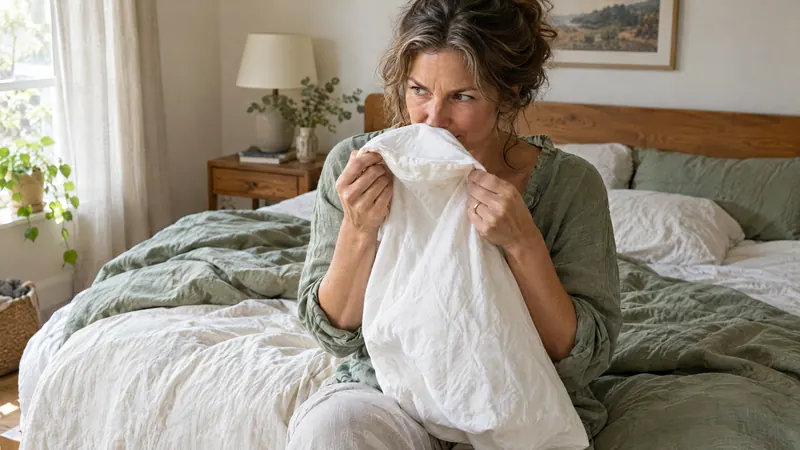
- Check whether it’s working with the pillowcase test, since almost nobody can smell this on themselves.

TanniBar Persimmon Tannin Bar
If you're choosing a bar for the skin side of this, TanniBar is the one we rank first: fragrance-free, so it doesn't add a second smell to fabric you're trying to strip.
Check price →We own TanniBar and earn from sales. 30-day refund, no return needed.Bars vary a lot on price, ingredients and whether they’re scented. Our best persimmon soap comparison lines up the five we consider worth looking at, including what each brand does and doesn’t disclose. And if you’ve already tried a bar and nothing changed, seven common reasons persimmon soap doesn’t work is the place to start.

When it’s worth seeing a doctor
Nonenal odor is a normal, gradual, oily-stale smell that builds with age. What doesn’t fit that pattern is worth mentioning to a clinician. The NHS advises seeing a GP if body odour hasn’t improved with self-care and it’s affecting your self-esteem, if you notice a change in how it usually smells, or if you suddenly sweat much more than usual (NHS: Body odour). A sweet, fishy, ammonia-like or otherwise unfamiliar odor, or one that appears abruptly, can have medical causes and deserves a proper look rather than a better detergent.
The bottom line
Old person smell in clothes is an oil problem wearing an odor costume. 2-Nonenal doesn’t dissolve in water, so it leaves with the sebum or it doesn’t leave at all — which is why a cold, quick, liquid-detergent wash can return a pillowcase that still smells. Soak it, wash it long and warm with an enzyme powder and oxygen bleach, rinse it twice, and smell it damp before it ever reaches the dryer. Then keep the skin side handled so you’re not starting over every night.
Frequently asked questions
Why do clothes still smell after washing?
Because the odor rides in skin oil, and oil is what a short, cool, liquid-detergent wash removes least well. 2-Nonenal is insoluble in water and dissolves readily in oils, so if the sebum stays on the fibres, the smell stays with it. A longer, warmer wash with an enzyme powder and oxygen bleach targets the oil rather than masking it.
Does vinegar get old person smell out of clothes?
On its own, often not. Readers who soaked fabric in vinegar report no change. An acidic rinse (vinegar or citric acid) can help with hard-water and detergent residue, which is a real but different problem. Treat it as a finishing step, not the treatment.
Should I use hot water?
Use the warmest temperature the care label allows, and give the cycle more time. In a 2014 study of domestic laundering, the temperature needed to reduce microbes depended on both wash time and detergent type, and an activated-oxygen-bleach detergent improved results even at the lowest temperatures. Longer and better-formulated can substitute for hotter.
Can the dryer make it worse?
The dryer can't remove what the wash left behind, and readers repeatedly describe clothes smelling fine out of the washer and bad again out of the dryer. Smell each item damp, before it goes in. If it still smells, rewash it; if it's clean, line-drying costs you nothing.
Do I have to throw out the worst items?
Usually not, but synthetics are the hardest cases. Polyester holds body odor more than cotton in controlled testing, and poly-spandex pyjamas and athletic tops are the items readers most often give up on. Try one dedicated soak-and-strip cycle before you bin anything.
Sources
- Haze S. et al. (2001). 2-Nonenal newly found in human body odor tends to increase with aging. J Invest Dermatol 116(4):520–4.
- PubChem compound summary: (E)-2-nonenal (CID 5283335) — XLogP3 3.1; "soluble in most fixed oils; insoluble in water"
- Waqar S. et al. (2025). Textile laundering and body odor: a comprehensive review. Textile Research Journal.
- Callewaert C. et al. (2014). Microbial odor profile of polyester and cotton clothes after a fitness session. Appl Environ Microbiol 80(21):6611–9.
- Honisch M., Stamminger R., Bockmühl D.P. (2014). Impact of wash cycle time, temperature and detergent formulation on the hygiene effectiveness of domestic laundering. J Appl Microbiol 117(6):1787–97.
- Bockmühl D.P. (2017). Laundry hygiene — how to get more than clean. J Appl Microbiol 122(5):1124–33.
- Jacksch S. et al. (2019). Influence of sampling site and other environmental factors on the bacterial community composition of domestic washing machines. Microorganisms 8(1):30.
- NIOSH Pocket Guide to Chemical Hazards: Ammonia (incompatibilities, health hazards)
- NHS: Body odour (BO) — self-care and when to see a GP
- TanniBar product page (brand's own claims: fragrance-free, ingredients, refund terms) (company information; we own TanniBar)
- r/laundry: "How to get rid of 'old people' smell from clothes"
- r/laundry: "My husband smells like rancid grease"
- r/laundry: "Getting musty/rancid body oil smell out of clothes"
- r/CleaningTips: "Nonenal ('old people smell') in furniture and clinging to my clothes"
- r/laundry: "Can't get rid of underarm body odor from clothes"