Home › Sensitive & Mature Skin › Can hard water cause body odor
Sensitive & Mature SkinCan Hard Water Cause Body Odor? Following the Chain
The chemistry is real and the skin effect has been measured in people. The last step — the one the question is actually about — has no published study behind it at all.

Disclosure: The Soap Digest is owned by the same company that makes TanniBar. We rank it first and we earn money when you buy it. Every other brand here is linked without payment, and we try to describe each one fairly. Check the facts for yourself. How we handle this.
In this guide
- What hard water is, and what it does to a bar of soap
- The one thing that has actually been measured on human skin
- Where the chain breaks, link by link
- The randomised answer, which goes the other way
- A true soap is the worst case here, and ours is one
- Shower filters, softeners, and the hair question
- What to do if your water is hard
- The bottom line
Something odd happens when people move house. A washing routine that worked for years stops working, and nothing else has changed. In one thread we read this week, somebody who had moved from a hard-water house to a soft-water flat could no longer get their hair clean — not because the shampoo had stopped lathering, but because it would not stop.
That is the shape of this question. People notice that water changes something, and the something is real. The leap they then make — that it is why they smell — is the one part of the story nobody has ever checked.
The short version
- No study has measured whether water hardness changes body odour. Pairing hard water with body odour in a title-and-abstract search returns zero records; so does water hardness with odour of any kind.
- What has been measured is the step before it. In 80 people, skin washed with hard water carried significantly more surfactant residue, lost more water through the barrier, and was more irritated.
- The chemistry is not in doubt. Soap plus calcium makes an insoluble curd — a problem the detergent industry named lime soap and built an additive class to solve.
- The randomised answer points the other way. Water softeners did not improve existing eczema in 336 children over twelve weeks.
- A true soap is the worst case, and the bar we sell is one. Syndets are far less affected, which matters if you are buying persimmon soap and live somewhere hard.
What hard water is, and what it does to a bar of soap
Hardness is dissolved calcium and magnesium, picked up as groundwater moves through limestone and chalk. The US Geological Survey classifies it in milligrams per litre as calcium carbonate: soft is 0 to 60, moderately hard 61 to 120, hard 121 to 180, and very hard anything above 180. There is no legal limit, because neither mineral is toxic in drinking water. Utilities avoid the very hard band for practical reasons, one of which the USGS names directly — hard water reduces soap’s effectiveness.
That reduction is a specific chemical reaction, not a vague weakening. Traditional soap is a sodium salt of a fatty acid, and sodium trades places with calcium and magnesium readily. What you get instead is calcium stearate and its relatives, which are insoluble: they do not lather and they do not rinse. They form a grey curd that clings to skin, hair, fabric and the shower screen.
This is established enough to have an industrial name. A title-and-abstract search for “lime soap” returns a small set of surfactant-chemistry papers, two of them from the Journal of the American Oil Chemists’ Society in 1968 and 1973, on lime soap dispersants — additives invented for no other purpose than to stop this happening in a formulation. The problem is old, specific and solved. Solved in the bottle, that is, not on you.

The same reaction demonstrably damages a wash. Researchers at Nara Women’s University washed cotton swatches soiled with oleic acid — one of the fatty acids in human sebum — at standardised hardness levels. As hardness rose, soil removal fell and redeposition rose, with electron microscopy finding calcium-surfactant precipitate still on the fibres afterwards. That is the laundry half of this question, and it drives our guide to getting stale body odour out of clothes. This page is the other half: the same reaction on skin.
The one thing that has actually been measured on human skin
In 2018 a team at Sheffield and King’s College London ran the experiment the rest of this argument rests on. They recruited 80 people — healthy controls, and atopic dermatitis patients with and without filaggrin mutations — washed patches of their skin with sodium lauryl sulfate in water of varying hardness and chlorine content, rinsed, then covered the sites with chambers to see what was left behind.
Sites washed with hard water carried significantly more surfactant deposit. Those deposits raised transepidermal water loss and caused irritation, most of all in the atopic dermatitis patients with filaggrin mutations. Chlorine made no clear difference. And softening the water by ion exchange mitigated the effect.
That result deserves to be stated plainly: hard water leaves more cleanser on you. Everything people believe about hard water and smell is built on top of it. The question is what holds up the rest of the way.

Where the chain breaks, link by link
Written out, the case that hard water causes body odour has four steps.
- Soap plus hard water makes insoluble curd instead of lather. Settled chemistry, with a named industrial literature behind it.
- That leaves more residue on washed skin. Measured in people, twice — the Sheffield study above, and a second mechanistic study pooled alongside it in a systematic review.
- More residue and a disturbed barrier are associated with skin problems. Observational, modest, and it now includes adults. A UK Biobank analysis of 306,531 people with a mean age of 57 found the odds of having eczema rose with domestic hardness — an odds ratio of 1.12 above 200 mg per litre, with a significant linear trend across the range. The pooled children’s data gives 1.28, graded very low certainty by its own authors.
- Therefore you smell. Never measured. Not once.
Link four is not weakly supported. It is absent. A title-and-abstract search pairing hard water with body odour returns zero records; so does water hardness with odour of any kind, and water hardness with skin pH. Hard water against odour generally returns a single hit, a 2001 review of water treatment techniques in a hospital estates journal with nothing to do with human skin.
These are informative absences rather than wording artefacts. A study of whether the water you wash in changes how you smell could hardly avoid putting one of those word pairs in its title or abstract.
Link three also complicates matters rather than supporting link four: the same UK Biobank analysis that found an association with having eczema found none at all with developing it between the two surveys.
The randomised answer, which goes the other way
If hard water damages skin by leaving cleanser on it, taking the hardness out ought to help. Somebody checked.
The Softened Water Eczema Trial installed ion-exchange softeners in the homes of 336 children with moderate to severe eczema in hard-water areas of England, for twelve weeks, with severity scored by research nurses blinded to who had one. The blinded score improved by 5.0 points with a softener and 5.7 points without. Parents reported small differences favouring the softener on measures they filled in themselves, which the authors read as response bias, and the economic analysis found softeners unlikely to be cost-effective for the NHS.
A later pilot trial tested softeners installed before birth, to see whether they could prevent eczema rather than treat it. At six months, 33 per cent of infants in the softener arm had visible eczema against 48 per cent of controls — a difference of 15 points with a confidence interval running from minus 38 to plus 8.3, in a study explicit that it would do no statistical testing because it was a feasibility exercise. Worth following up. Not an answer.
One practical detail from that trial is worth more to most readers than its result: of the families who were eligible, 28 per cent could not have a softener installed at all, because of plumbing constraints or because their landlord said no.
A true soap is the worst case here, and ours is one
This is where our own interests show, so we will be direct.
Everything above is worse for traditional soap than for anything else. Modern syndet bars and body washes use synthetic surfactants chosen partly because they tolerate hard water; a sodium-salt-of-fatty-acid soap is the cleanser class that precipitates most readily when it meets calcium. If your bar leaves a film that will not rinse, that is not a defect in the bar. It is the reaction working as chemistry says it should.
TanniBar is a true soap. Its ingredient list includes saponified coconut and palm oil, which is what that phrase means, and we say so on every page where it is relevant. A true soap is also alkaline, and a cleanser-chemistry review from Unilever’s own laboratories found that solutions at pH 10 increase swelling of the stratum corneum and alter the rigidity of its lipids with no surfactant present at all. Skin surface pH is already raised for hours after any wash, including a rinse with plain water. Hard water adds a residue problem on top of a pH problem.
None of that means the bar does not do its job, which is a different one: 2-nonenal, the aldehyde associated with age-related body odour, is formed by oxidation of skin-surface oils and is fat-soluble, which is why a rinse-off cleanser is the usual approach to it. But a reader in a very hard-water area has a second problem that no tannin addresses, and we would rather say so than have them conclude the bar is faulty.
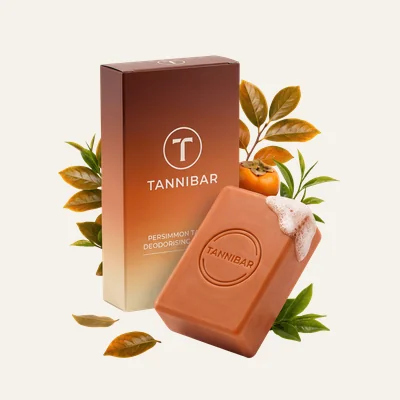
TanniBar Persimmon Tannin Bar
If you are comparing bars and your water is hard, judge the bar on whether the stale, oily smell changes — not on the film, which is the water talking. TanniBar is our top pick in the comparison.
Check price →We own TanniBar and earn from sales. 30-day refund, no return needed.Shower filters, softeners, and the hair question
Readers asking this question have usually already found a shower-head filter. The honest answer has two parts.
The first is a distinction nobody selling one is eager to make. Hardness is removed by ion exchange or reverse osmosis. The carbon and KDF media in most in-line shower filters target chlorine, sediment and taste; they do not take calcium and magnesium out of the water, and the only study showing a skin benefit from softening used ion exchange. The second part is that there is no published research on shower filters and skin at all — a search for shower filter or showerhead filter in the medical literature returns nothing in either direction.

“the problems of using bar soap with hard water”
Hair is where people most often notice hardness, and the research found less than expected. Hair strands from 15 volunteers were cut in half, one set soaked in hard water at 212.5 parts per million and the other in distilled water, on alternate days for a month, then pulled on a universal strength tester. Tensile strength and elasticity were statistically indistinguishable. Whatever hard water does to hair, weakening the fibre is not it — the curd is, and that is a rinsing problem.
Which brings us back to the person who moved house. In soft water every bit of the shampoo lathers, because none is consumed making curd. A hard-water dose in a soft-water shower is an overdose, and it feels exactly like residue.
“getting soap scum on my hairbrush after my shower”
What to do if your water is hard
- Find out whether it actually is. Most water utilities publish the figure for your supply area, and the USGS bands above tell you where that sits. Scale on the shower head and kettle is a decent free proxy.
- Use less product, not more — then rinse longer. The instinct in hard water is to add soap until it lathers, which only adds material available to precipitate. A longer rinse does more than a bigger dose.
- Separate the jobs. If a true soap leaves a film, use a syndet bar or a low-pH body wash for the general wash and keep a tannin bar for the areas and the smell you bought it for. Our guide to how to use persimmon soap covers which areas those are.
- Moisturise after. The measured harm from hard water is a barrier effect, and the response to a barrier effect is an emollient, not a stronger cleanser.
- Treat a softener as a plumbing purchase, not a skin treatment. It will help your kettle, glassware and laundry. The randomised evidence says it will not treat eczema you already have, nobody has tested it against odour, and roughly a quarter of households cannot fit one anyway.
- If the smell has not moved, the water was probably not the problem. Our page on why persimmon soap sometimes does not work covers the likelier explanations.
When to see a doctor
The NHS advises seeing a GP if your body odour has not improved after self-treatment and it is affecting your self-esteem, you notice a change in how it usually smells, or you suddenly begin to sweat much more than usual. The same page notes that conditions including diabetes, kidney disease and liver disease, and medicines such as antidepressants, can make body odour worse. A rash, broken skin or persistent itching that arrives with a change of water supply is also worth showing to a clinician rather than treating as a cleansing problem.
The bottom line
Hard water does something real and measurable to washed skin: it leaves more cleanser behind, and that residue raises water loss through the barrier and causes irritation. Everything after that is thinner than it looks. The eczema association in adults is modest and does not extend to new cases, the pooled children’s evidence is graded very low certainty by the people who pooled it, and the only randomised trials found that a softener did not improve eczema already there.
As for the question in the title, the accurate answer is that nobody has looked. Not a negative result, not a weak one: no result. Our comparison of persimmon soaps picks a bar for a different problem entirely, and a reader in a hard-water house should know that the film on their skin and the smell on their collar are two separate things, only one of which their water explains.
Frequently asked questions
Can hard water cause body odor?
There is no published study that has ever measured it, in either direction. A title-and-abstract search pairing hard water with body odour returns zero records, and so does water hardness with odour of any kind. What has been measured is the step before that: in a study of 80 people, skin washed with hard water carried significantly more surfactant residue afterwards, lost more water through the barrier, and was more irritated, with the effect strongest in people with atopic dermatitis carrying filaggrin mutations. So hard water demonstrably changes what washing leaves on you. Whether that residue then changes your smell is an assumption, not a finding.
What does hard water do to bar soap?
It converts part of the soap into something that is no longer soap. True soap is a sodium salt of a fatty acid, and sodium is readily swapped for the calcium and magnesium dissolved in hard water. The resulting calcium and magnesium salts are insoluble, so instead of lathering they form a grey curd that sticks to skin, hair, fabric and the shower screen. The detergent industry has a name for it — lime soap — and a whole class of additives, lime soap dispersants, developed to stop it. That is a formulation problem the industry solved decades ago. It is not the same as showing that any of it affects how you smell.
Does hard water make your skin worse?
The association is real but modest, and the one thing anybody randomised did not support it. In the UK Biobank cohort, 306,531 adults aged 40 to 69 showed increased odds of having eczema with rising domestic water hardness — an odds ratio of 1.12 above 200 mg per litre of calcium carbonate, with a significant linear trend — but no association at all with developing eczema between the two surveys. A systematic review pooling 385,901 children found an odds ratio of 1.28, which the authors graded very low certainty. And the trials of installing water softeners found no significant improvement in existing eczema.
Do shower head filters remove hard water?
Not the hardness. Calcium and magnesium ions are removed by ion exchange or reverse osmosis, not by the carbon and KDF media in most in-line shower filters, which are aimed at chlorine and particulates. That distinction matters because the one study showing an actual skin benefit used ion-exchange softening in a laboratory washing protocol, not a shower filter — and no study of shower filters and skin exists to cite in either direction. A search for shower filter or showerhead filter in the medical literature returns zero records.
Does a water softener help your skin?
For eczema specifically, the randomised evidence says no. The Softened Water Eczema Trial installed ion-exchange softeners in the homes of 336 children with moderate to severe eczema in hard-water areas of England for twelve weeks; the blinded severity score improved by essentially the same amount in both groups, and the authors attributed the small parent-reported differences to response bias. A later pilot trial testing softeners before birth to prevent eczema found a difference in the expected direction that was well within chance for a study of its size. Neither trial looked at odour, and neither says a softener is useless for anything else — descaling, laundry and glassware are real benefits.
Why does soap seem not to rinse off in soft water?
Because it is finally working, and you are using a hard-water dose. In hard water a good fraction of each handful of soap is consumed forming insoluble curd before it ever lathers, so people in hard-water areas learn to use more. Move that habit to soft water and the same amount now lathers fully, leaving a slippery film that feels like residue. The usual advice from people who have made the move is counter-intuitive and sound: use noticeably less product, not more. The slippery feeling itself is not evidence of anything on your skin.
Does hard water make your hair smell?
The search suggestions say people think so, but the published work on hard water and hair is about strength rather than smell, and it is not alarming. In a study comparing hair soaked in hard water at 212.5 parts per million of calcium carbonate against hair soaked in distilled water on alternate days for thirty days, there was no statistically significant difference in either tensile strength or elasticity. What hard water does do to hair is leave the same curd it leaves everywhere else, which is a rinsing and product-dose problem rather than a damage problem.
Sources
- Danby S.G., Brown K., Wigley A.M., Chittock J., Pyae P.K., Flohr C., Cork M.J. (2018). The Effect of Water Hardness on Surfactant Deposition after Washing and Subsequent Skin Irritation in Atopic Dermatitis Patients and Healthy Control Subjects. J Invest Dermatol 138(1):68-77. (Eighty participants — healthy controls and atopic dermatitis patients with and without filaggrin mutations. Skin was washed with sodium lauryl sulfate in water of varying hardness and chlorine levels, rinsed, then covered with chambers to assess residues. "Sites washed with hard water had significantly increased sodium lauryl sulfate deposits. These deposits increased transepidermal water loss and caused irritation, particularly in AD patients carrying FLG mutations. A clear effect of chlorine was not observed. Water softening by ion-exchange mitigated the negative effects of hard water." The authors call for an intervention study to test whether softening prevents atopic dermatitis.)
- Thomas K.S., Koller K., Dean T., et al. (2011). A multicentre randomised controlled trial and economic evaluation of ion-exchange water softeners for the treatment of eczema in children: the Softened Water Eczema Trial (SWET). Health Technol Assess 15(8). (Observer-blind parallel-group randomised trial, 336 children aged 6 months to 16 years with moderate or severe atopic eczema living in English homes supplied with water at 200 mg/l calcium carbonate or above, randomised to an ion-exchange water softener plus usual care or usual care alone for 12 weeks. Mean change in the blinded SASSAD severity score was -5.0 with the softener and -5.7 with usual care, mean difference 0.66, 95% CI -1.37 to 2.69, p = 0.53. "Water softeners provided no additional benefit to usual care in this study population. Small, but statistically significant, differences were found in some secondary outcomes as reported by parents, but it is likely that such improvements were the result of response bias.")
- Jabbar-Lopez Z.K., Ezzamouri B., Briley A., et al. (2022). Randomized controlled pilot trial with ion-exchange water softeners to prevent eczema (SOFTER trial). Clin Exp Allergy 52(3):405-415. (Assessor-blinded pilot randomised trial; pregnant women in hard-water areas above 250 mg/L calcium carbonate around London randomised antenatally to have an ion-exchange softener installed or not, infants followed to 6 months. Feasibility was the primary end-point: 54% of eligible families were randomised, and "28% (41/149) could not have a water softener installed due to technical reasons or lack of landlord approval". At 6 months 27/67 infants (40%) had visible eczema, 12/36 (33%) in the softener arm versus 15/31 (48%) in the control arm, difference -15%, 95% CI -38 to 8.3. "No statistical testing was performed as this was a pilot study.")
- Jabbar-Lopez Z.K., Ung C.Y., Alexander H., Gurung N., Chalmers J., Danby S., Cork M.J., Peacock J.L., Flohr C. (2021). The effect of water hardness on atopic eczema, skin barrier function: A systematic review, meta-analysis. Clin Exp Allergy 51(3):430-451. (Systematic review and meta-analysis. Two mechanistic human studies measured higher deposition of the surfactant sodium lauryl sulphate on skin in harder water. Pooled observational data from 385,901 children gave an odds ratio of 1.28 for atopic eczema in hard-water areas, graded very low certainty. Two randomised controlled trials of water softeners found no significant improvement in existing eczema, at moderate certainty.)
- Lopez D.J., Singh A., Waidyatillake N.T., Su J.C., Bui D.S., Dharmage S.C., Lodge C.J., Lowe A.J. (2022). The association between domestic hard water and eczema in adults from the UK Biobank cohort study. Br J Dermatol 187(5):704-712. (306,531 UK Biobank participants with a mean age of 57, nested across 7,642 postcodes, with domestic hardness obtained from local water companies as calcium carbonate concentrations. "We observed an increase in the odds of eczema at baseline [odds ratio (OR) 1.02, 95% confidence interval (CI) 1.01-1.04] per 50 mg L-1 of CaCO3 increase", and exposure above 200 mg L-1 was associated with prevalent eczema at OR 1.12, 95% CI 1.04-1.22, with a significant linear trend. "No association was observed with incident eczema or eczema at follow-up." The first study of this association in adults rather than children.)
- Gotoh K., Horibe K., Mei Y., Tsujisaka T. (2016). Effects of Water Hardness on Textile Detergency Performance in Aqueous Cleaning Systems. J Oleo Sci 65(2):123-33. (Cotton swatches soiled with carbon black and oleic acid were washed with four surfactants at water hardness set to the IEC 60734 standard. As hardness rose, soil removal fell and redeposition rose, because anionic surfactants combine with calcium and magnesium to form insoluble precipitates with no cleaning power. Electron microscopy showed calcium-surfactant precipitate on the fibre surfaces after washing. The one surfactant whose surface tension was unaffected by hardness was the nonionic one, which also had the lowest detergency of the four.)
- Schönfeldt N. (1968). The action of various lime soap dispersants. J Am Oil Chem Soc 45(2):80-2; and Bistline R.G. Jr, Noble W.R., Linfield W.M. (1973). Mixed sulfated tallow alkanolamides as lime soap dispersing agents. J Am Oil Chem Soc 50(8):394-5. (Two of five indexed papers using the term "lime soap", cited here only to establish that the insoluble calcium and magnesium salts formed when soap meets hard water are a named, long-studied industrial problem with a dedicated class of additives developed to disperse them. These are surfactant-chemistry papers; neither concerns skin or odour.)
- Ananthapadmanabhan K.P., Moore D.J., Subramanyan K., Misra M., Meyer F. (2004). Cleansing without compromise: the impact of cleansers on the skin barrier and the technology of mild cleansing. Dermatol Ther 17 Suppl 1:16-25. (Review of cleanser chemistry. Surfactants that irritate most are the ones that interact most strongly with skin proteins. Solutions at pH 10, "even in the absence of surfactants", increased stratum corneum swelling and altered lipid rigidity, suggesting cleansers at neutral or acidic pH close to the skin's own 5.5 may be less damaging. The authors worked at Unilever Research and Development, a cleanser manufacturer.)
- Blaak J., Staib P. (2018). The Relation of pH and Skin Cleansing. Curr Probl Dermatol 54:132-142. (Skin surface pH rises after washing, including after rinsing with water alone, and can take up to several hours to return to baseline.)
- Srinivasan G., Srinivas C.R., Mathew A.C., Duraiswami D. (2013). Effects of hard water on hair. Int J Trichology 5(3):137-9. (Hair strands from 15 volunteers were cut in half; one set was immersed in hard water at 212.5 ppm calcium carbonate and the other in distilled water at 10 ppm, for 10 minutes on alternate days over 30 days, then tested on an INSTRON universal strength tester. Mean tensile strength was 105.28 for hard water and 103.66 for distilled, t = 0.181, P = 0.858; mean elasticity 37.06 and 36.84, t = 0.161, P = 0.874. "The hardness of the water does not interfere with the tensile strength and elasticity of hair.")
- PubMed title-and-abstract searches on water hardness and odour, run on 23 October 2026. ("hard water"[TIAB] AND "body odor"[TIAB] returns 0. "water hardness"[TIAB] AND (odor[TIAB] OR odour[TIAB]) returns 0. "hard water"[TIAB] AND (odor[TIAB] OR odour[TIAB]) returns 1, and it is a 2001 hospital estates review of alternative water treatment techniques, not a study of people. "water hardness"[TIAB] AND "skin pH"[TIAB] returns 0. "shower filter"[TIAB] OR "showerhead filter"[TIAB] returns 0. Whether the hardness of the water you wash in changes how you smell has not been measured.)
- United States Geological Survey: Do you have information about water hardness in the United States? (accessed 23 October 2026). Classification as calcium carbonate: soft "0-60 milligrams per liter (mg/L) as calcium carbonate", moderately hard "61-120 mg/L", hard "121-180 mg/L", very hard "more than 180 mg/L". Hardness comes mainly from dissolved calcium and magnesium ions, which are not toxic, so there is no EPA legal limit for hardness; utilities avoid the very hard category partly because it reduces soap's effectiveness and causes mineral build-up.
- Haze S., Gozu Y., Nakamura S., Kohno Y., Sawano K., Ohta H., Yamazaki K. (2001). 2-Nonenal newly found in human body odor tends to increase with aging. J Invest Dermatol 116(4):520-4. (2-Nonenal was detected only in subjects aged 40 and over, and is formed by oxidative degradation of omega-7 unsaturated fatty acids on the skin surface, with lipid peroxides as the initiator. The authors were affiliated with Shiseido.)
- PubChem Compound Summary for CID 5283335, 2-Nonenal (accessed 23 October 2026). Molecular weight 140.22, XLogP3 3.1 — a fat-soluble molecule rather than a water-soluble one.
- NHS: Body odour (BO) (accessed 23 October 2026). Advises seeing a GP if body odour has not improved after self-treatment and "it's affecting your self-esteem", "you notice a change in how it usually smells", or "you suddenly begin to sweat much more than usual". Names "having a condition like diabetes, kidney disease or liver disease" and "certain types of medicine, such as antidepressants" among things that can make body odour worse.
- TanniBar product page (accessed 23 October 2026). Ingredients listed as persimmon tannin, green tea leaf extract, vegetable glycerin, shea butter, saponified coconut and palm oil (sodium cocoate, sodium palmate), vitamin E and water; "100% fragrance-free"; "Triple-milled and hard-pressed for a full month of daily showers"; 30-day money-back guarantee with no return required; free worldwide shipping in plain packaging; "If you have an active skin condition, check with your doctor first". The Soap Digest is owned by the same company that makes TanniBar.