Home › Talking About It › Strong urine smell in elderly
Talking About ItWhat Causes Strong Urine Smell in Elderly People
Most answers to this treat the smell as a property of the urine — too concentrated, an infection, something wrong with the kidneys. The chemistry points somewhere else: at how long it has been sitting on a surface, and on what.

Disclosure: The Soap Digest is owned by the same company that makes TanniBar. We rank it first and we earn money when you buy it. Every other brand here is linked without payment, and we try to describe each one fairly. Check the facts for yourself. How we handle this.
In this guide
- Fresh urine barely smells. Stale urine does.
- Why that changes where you look
- It is not the same molecule as “old person smell”
- Does a strong smell mean a urinary tract infection?
- The ordinary causes, including one that works backwards
- What the ammonia does to the skin
- What actually shifts the smell in the room
- The bottom line
Ask why an older person’s home smells of urine and the answers come back fast: dehydration, kidneys, an infection, not drinking enough water. Those are all real possibilities and we will get to each of them. But they share an assumption worth testing first — that the smell is a property of the urine itself. For the sharp, catching, ammonia note, the one that meets you in a doorway, it mostly is not. That smell is manufactured after the urine leaves the body, by bacteria, on a surface, over hours. Which makes “what is wrong with their urine” the wrong opening question, and “what is it sitting on, and for how long” the right one.
The short version
- Fresh urine is mildly acidic and barely ammoniacal. Urea, its main nitrogen compound, is close to odourless on its own.
- Urease-producing bacteria split that urea into ammonia. That takes hours and happens on skin, pads, cushions, mattresses and carpet — not in the bladder.
- So smell intensity tracks contact time with a surface, not how “bad” someone’s urine is. This is why the room often smells worse than the person.
- Strong-smelling urine is a weak test for a urinary tract infection. In nursing-home research it got the call wrong in about a third of cases, and smell is not on the NHS UTI symptom list at all.
- The ammonia raises skin pH and damages the skin barrier, which is the reason harder, more frequent washing tends to make the skin worse rather than the smell better.
- This is a completely different molecule from “old person smell”. Persimmon soap is aimed at that one and does nothing here.
Fresh urine barely smells. Stale urine does.
Urine leaves the body mildly acidic. In a sanitation study that lacto-fermented human urine to cut odour emissions, fresh samples measured pH 5.2 to 5.3. Its dominant nitrogen compound is urea, a small, extremely water-loving molecule — PubChem lists it at 60 g/mol with an XLogP of −1.4 — and urea by itself is not what you are smelling.
What happens next is enzymatic. Bacteria that produce urease hydrolyse urea into ammonia. The same study measured the consequences directly: untreated stored urine climbed from its starting pH to 6.1 while its ammonium content rose by 32%, explicitly attributed to urea hydrolysis, and urine that had sat in a storage tank for a week was measured at pH 8.9. As the pH climbs, more of that nitrogen exists as free ammonia rather than ammonium, and free ammonia is a gas. The authors put the mechanism plainly: during storage, urea is biologically decomposed to ammonia, which is lost through volatilisation and causes significant unpleasant smell.
That was jars and tanks rather than a sofa cushion, and it is worth labelling it as such. But the chemistry does not care about the container. Anywhere urine is held damp and warm against a bacterial population — a pad, pyjama bottoms, the foam under an upholstery cover — the same reaction runs on the same timescale.
Why that changes where you look
If the ammonia is made on surfaces over hours, the strongest smell in a house will be wherever urine has been sitting longest, which is almost never the person. It is the chair they sit in all day. It is the mattress. It is the two feet of carpet beside the bed. It is the laundry basket.
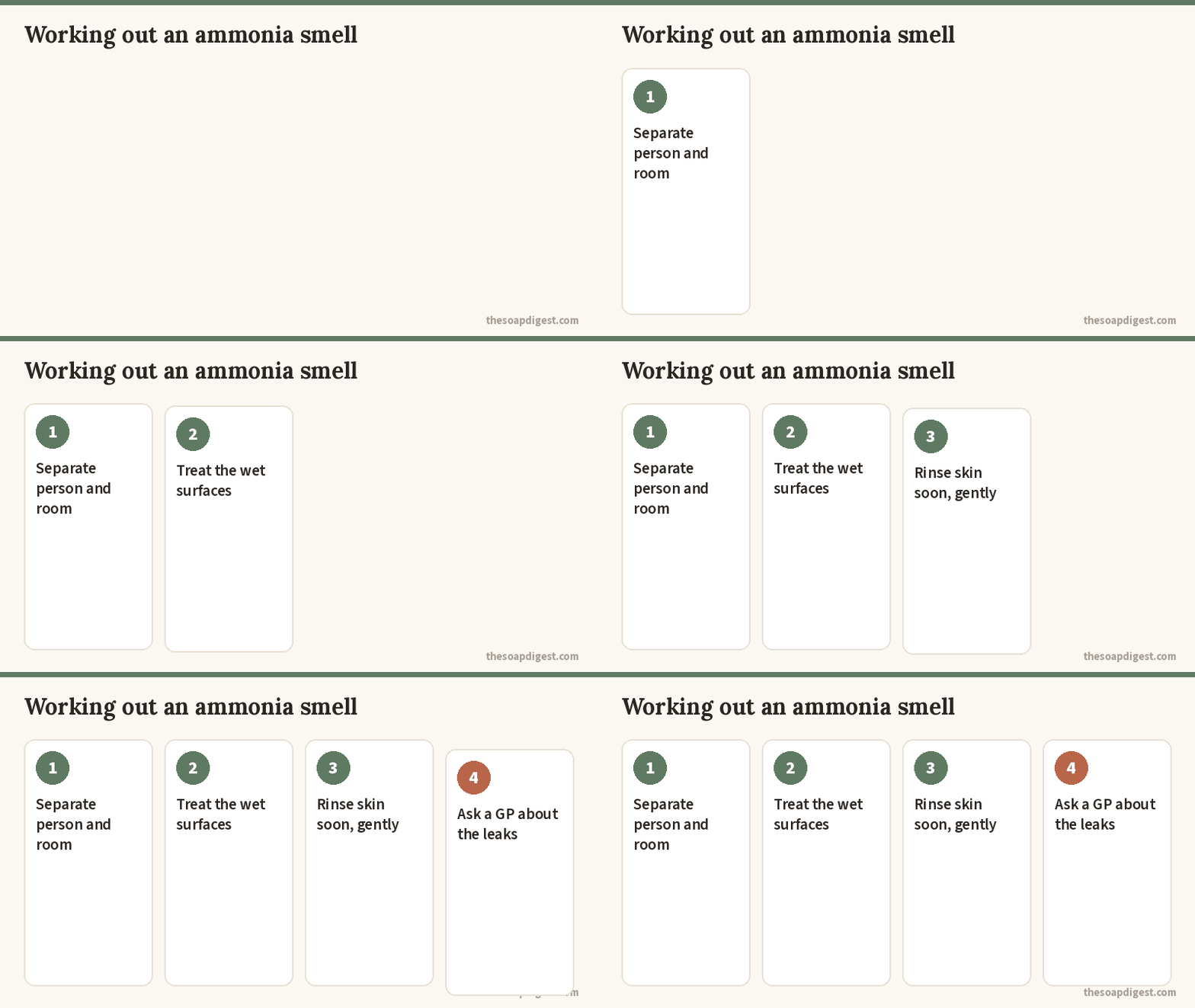
There is a simple way to separate the two. Ask the person to leave the room for an hour, open nothing, and come back. If the room still smells, the source is in the room; if the smell travels with them, it is on them or their clothes. We use this timing test for every smell in a house, and it matters more here than anywhere, because getting it wrong means having a painful conversation about a person when you should have been talking about a cushion.
Caregivers arrive at this the hard way. In one r/AgingParents thread about a couch accident, the top replies were all enzyme cleaners, and the original poster had already tried the obvious thing first, reporting that it
“now it just smells like Febreeze and urine”
. In another, on a parent denying incontinence, the blunt summary of the laundry side was that
“You can wash clothes over and over and it will not come out”
.
It is not the same molecule as “old person smell”
These two get filed together constantly, and they have almost nothing in common.
The stale, greasy, slightly cardboard odour associated with age is driven by 2-nonenal. Haze and colleagues described it as a product of the oxidative degradation of ω7 unsaturated fatty acids in skin surface lipid, with lipid peroxides as the initiator. There is no bacterium anywhere in that mechanism — it is oxidation of oil. PubChem lists 2-nonenal at 140 g/mol with an XLogP of 3.1, and notes it is soluble in most fixed oils and insoluble in water.
Ammonia is the mirror image. It weighs 17 g/mol, has an XLogP of −0.7, is produced by bacteria rather than by oxygen, and is thoroughly at home in water. One of these molecules leaves a fabric when the oil leaves; the other leaves when the water-soluble residue is broken down and rinsed. Opposite chemistry, opposite handling.
It is a measure of how separate these two literatures are that a PubMed search for "2-nonenal"[TIAB] AND incontinence[TIAB] returns zero results. Nobody has studied them as a single problem, because they are not one.
That has a direct consequence for anyone who arrived here after reading about persimmon soap: it is aimed squarely at the 2-nonenal side and it will do nothing at all for an ammonia smell. We would rather say that than sell you a bar that cannot work. If, having run the timing test, the odour you are actually chasing turns out to be the stale greasy one on skin rather than ammonia on fabric, that is a different article and our persimmon soap comparison is the place to start.

TanniBar Persimmon Tannin Bar
Only relevant if the smell is the stale, oily 2-nonenal kind on skin — for ammonia from urine, a soap of any sort is not the lever.
Check price →We own TanniBar and earn from sales. 30-day refund, no return needed.Does a strong smell mean a urinary tract infection?
This is the question most families want answered, and the honest answer is that odour is a poor test — which matters more here than in a younger person, because the cost of guessing wrong is an unnecessary course of antibiotics.
The most relevant study was done in exactly this population. Researchers assessed 97 recently wet incontinence pads from residents of six nursing homes within an hour of voiding, then compared the odour judgement against microscopy and culture of clean-catch samples. Using urine odour to identify a UTI, they reported, resulted in error in one third of cases — an absent or misleading symptom in elderly nursing-home residents.
The one place where a measured association does exist is in small children, and even there it is not diagnostic: a prospective study of 331 children aged one to 36 months found parent-reported malodorous urine associated with UTI at an odds ratio of 2.83, and the authors wrote explicitly that this is not strong enough to rule the diagnosis in or out.
Underneath this sits a bigger problem: bacteria in the urine of older adults are extremely common without being an infection. A cross-sectional study of 421 nursing-home residents found 32% with positive urine cultures, and residents without new nonspecific symptoms had positive cultures just as often as those with them; the authors concluded that nonspecific symptoms in this group are unlikely to be caused by bacteria in the urine. A 2024 review of urinary infection management in frail older people puts it practically: asymptomatic bacteriuria is common here and does not require treatment. The Infectious Diseases Society of America maintains a guideline on the subject, updated in 2019, largely because treating it anyway is a recognised driver of inappropriate antibiotic use.
Smell does not appear on the NHS list of UTI symptoms at all. What the NHS does flag for older, frail people, including those with dementia, is different: changes in behaviour such as agitation or confusion (delirium), leaking urine that is worse than usual, and new shivering or shaking. Those are the signals worth a phone call. A bad-smelling pad, on its own, is not.
The ordinary causes, including one that works backwards
Set infection aside and the NHS list of causes for smelly urine is short and mundane: certain foods and drinks such as asparagus or coffee, not drinking enough fluid, some medicines, and vitamin B6 supplements. It adds that smelly urine can be caused by other conditions such as type 2 diabetes or kidney stones. The self-care advice is equally plain — drink enough to be passing urine regularly through the day, more in hot weather, and go easy on sugary drinks, coffee and alcohol.
Dehydration deserves a second look in older people, though, because the usual mental model is slightly wrong. A review of water homeostasis in ageing notes that older adults lose the thirst sensation and the ability to concentrate urine. The first half is the familiar part and the reason fluids are worth watching. The second half cuts against the intuition that elderly urine is simply more concentrated and therefore smellier — if anything the kidney’s concentrating power is going the other way with age.
That is the same shape of finding we keep meeting on this site: what rises with age is rarely the quantity of smelly material, but what happens to it afterwards.
What the ammonia does to the skin
There is a reason the instinct to wash harder backfires here, and it is not squeamishness about soap.
A 2024 study in Skin Health Disease modelled what urease-expressing bacteria do to skin, using ex vivo porcine and in vivo human models. Urease-produced ammonia raised skin pH and caused inflammation, producing a significant breakdown in stratum corneum barrier function; that raised pH then increased the activity of faecal enzymes and of opportunistic organisms such as Candida albicans and Staphylococcus aureus. Inhibiting urease reduced the damage. (Two authors are founders of a company developing urease inhibitors, which they declare; read the mechanism, treat the therapeutic implication as interested.)
Now put that next to what ordinary washing does. True soap is alkaline by definition, and a buffer at pH 10 has been shown to increase stratum corneum swelling with no surfactant present at all. Skin surface pH stays elevated for hours after an alkaline wash. Skin that is already being pushed alkaline by ammonia, several times a day, does not need a second source of the same insult.
This does not mean leaving urine on skin. Prompt removal matters more than anything else here — the damage comes from contact time, exactly as the smell does. It means being gentle and quick rather than vigorous and scheduled.
What should you use instead? The honest answer is that the evidence is thin. The 2025 Cochrane review of skin cleansers and leave-on products for preventing incontinence-associated dermatitis pooled 15 trials and 1,020 participants, found the overall risk of bias high, could not perform a meta-analysis because the studies were too heterogeneous, and rated every comparison very low certainty. One small trial of 65 participants suggested a foam cleanser might outperform soap and water (RR 0.35, 95% CI 0.14 to 0.85). That is a hint, not a result. What it is enough to say is that soap and water is not the obviously correct default for urine-exposed skin, and that a barrier product on top is standard practice for good reason. The practical alternative is a rinse-free cleanser used with a cloth, which keeps the wash near skin pH and does not need water the person may not tolerate.
What actually shifts the smell in the room

Enzyme cleaners are the right category, for a reason people usually state backwards. Caregiver and cleaning threads converge on them, and you will often see the explanation that they “break down the enzymes”. They do the reverse: they supply enzymes, and frequently live bacteria that keep producing them, to digest the organic residue left behind after the water evaporates. That residue is the reservoir. Apply enough to reach as deep as the urine went — which on a cushion means saturating, not misting — and keep it wet long enough to work.
We should be straight about what that recommendation rests on, because it is reasoning from the residue rather than from a trial. There is no published study of an enzyme cleaner on a household smell at all: a title-and-abstract search for the phrase returns eleven papers, every one about reprocessing equipment — cardiac catheters, surgical and dental instruments, implant prostheses, contact lenses, dairy plant. And the enzymes themselves are less robust than the packaging implies. In one protein-engineering study, a lipase had to go through sixteen cycles of directed evolution before it could both attack naturally occurring fats and survive a laundry protease and very low concentrations of a common surfactant. So depth and dwell time are not optional extras in the instructions; they are most of what you are buying. If the smell you are chasing turns out to be oxidised skin oil rather than ammonia, the same question has a different answer, which we work through in whether enzyme cleaners touch body odour in upholstery.
Water is what brings it back. The residue sits inert while dry and reactivates when re-wetted, which is why a spot can smell worse for a day after a wet vacuum, why humid weather and the first week of central heating both seem to resurrect it, and why a leather couch can still smell eighteen months later if the liquid went through a seam into the foam. Dry thoroughly and, where you can, dry outdoors.
Masking makes it worse over time. Fabric sprays trap or cover odour molecules rather than destroying them, and the fragrance you add is itself persistent — we went through what Febreze actually does to body odour in detail, and the single most common complaint in those threads is not that the spray failed but that the spray is now the smell. The same applies to upholstery: furniture holds its own reservoir and adding scent on top does nothing to it.

Stop the reservoir forming. Waterproof mattress and cushion protectors, washable chair pads, and changing pads promptly are worth more than any cleaner, because they move the problem from “remove ammonia from foam” to “launder a cover”. This is the one intervention that families consistently say changed the house, and it has the additional merit of asking nothing of the person at the centre of it — which matters if washing has itself become difficult, as we set out in why an older relative stops showering.
If they insist there is no smell, that is usually not denial. The nose filters constant familiar odours out of awareness, and most people cannot smell their own background odour at all.
When to see a doctor. NHS guidance is to see a GP about any type of urinary incontinence — it is common and often treatable, and it is not something to manage with more laundry. See a GP about smelly urine if it comes with needing to pee more often, pain on passing urine, or cloudy urine; seek urgent advice if there is blood in the urine, abdominal or back pain, fever, confusion or unusual drowsiness. For body odour more generally, the NHS advice is to see a GP if it has not improved with self-care and you notice a change in how it usually smells, if sweating has suddenly increased a lot, or if it is affecting self-esteem. This article is general information, not medical advice.
The bottom line
Strong urine smell around an older person is, far more often than not, a surface problem wearing a medical costume. Urea is nearly odourless; the ammonia is manufactured by bacteria on whatever the urine landed on, over hours, and the smell scales with how long it sat there. That reframing redirects effort to what actually moves the needle: find the reservoir, treat it deeply enough with enzymes, stop it re-forming, and clean skin promptly and gently rather than hard and often.
It also argues against two tempting shortcuts. Do not read a strong smell as proof of an infection — in the population where this question comes up most, odour was wrong about a third of the time, and it is not on the NHS symptom list. And do not reach for a deodorising soap, ours included: that is a tool for a different molecule entirely.
Frequently asked questions
What causes strong urine smell in elderly people?
Usually not the urine itself. Fresh urine is mildly acidic and carries very little free ammonia — in one sanitation study fresh samples sat at pH 5.2 to 5.3. Urea, its main nitrogen compound, is close to odourless. The sharp ammonia note appears when urease-producing bacteria break that urea down into ammonia, which takes hours and happens wherever the urine has landed: skin, a pad, a cushion, a mattress, a carpet. In the same study, untreated stored urine rose to pH 6.1 with a 32% increase in ammonium, and week-old urine in a storage tank was measured at pH 8.9. So the intensity of the smell tracks contact time with a surface far more closely than it tracks anything about the person's health.
Does strong-smelling urine mean a urinary tract infection?
It is a poor test on its own, and that matters most in exactly this population. A study of 97 recently wet incontinence pads across six nursing homes compared odour with microscopy and culture, and found that using urine odour to identify a UTI was wrong in about a third of cases. Smell does not appear on the NHS list of UTI symptoms at all. In older, frail people the NHS instead flags new confusion or agitation, incontinence that is suddenly worse than usual, and new shivering or rigors. Those are the signs worth acting on.
Why does the room smell when the person says they are fine?
Two separate things are usually true at once. The nose stops reporting a constant, familiar background odour, so someone living inside it genuinely may not register it — and smell loss is common with age besides. On top of that, the source often is not the person. If the smell is strongest within a foot or two of a particular chair, bed or stretch of carpet, and it is still there after they have left the room for an hour, you are smelling the furniture, not them.
Does persimmon soap help with urine smell?
No, and it is worth being plain about that. Persimmon tannin soap is aimed at 2-nonenal, the stale, greasy aldehyde produced when skin surface oils oxidise. Ammonia from urine is a different molecule arriving by a different route — bacterial breakdown of urea rather than oxidation of sebum — and the two have opposite solubility, so they do not even leave by the same door. A PubMed search for 2-nonenal together with incontinence returns nothing at all; nobody has studied them as one problem, because they are not one problem. If the smell you are chasing is ammonia, soap choice is beside the point.
Do enzyme cleaners actually work on human urine?
They are the most-recommended answer in caregiver and cleaning threads, and the logic is sound even though the common explanation of it is not. People often say these products "break down the enzymes" — they do the opposite. They supply enzymes, and usually bacteria that keep producing them, to digest the organic residue left behind once the water has evaporated. That residue is what reactivates and smells again when the spot is re-wetted by humidity, a spill or a steam cleaner. The practical consequence is that they need to be applied generously enough to reach as deep as the urine went, and left wet long enough to work, which is why a quick surface spray so often disappoints. One honest limit: there is no published study of an enzyme cleaner on a household smell. A search of titles and abstracts for the phrase returns eleven papers, all of them about reprocessing medical or industrial equipment, so the case for these products rests on the residue chemistry rather than on a measured odour result.
Why does the smell come back when it is warm or damp?
Because the residue is still there and water is what mobilises it. This is the same pattern people report with fabric sprays, where the item seems fine on the hanger and smells again an hour after it is worn. It is also why a carpet or mattress treated with a wet machine can smell worse for a day or two before it smells better — you have re-wetted the reservoir. The fix is not more fragrance on top but enough dwell time, enough depth, and then thorough drying.
Sources
- Alfaro-Chávez A.L., Liu J.W., Stevenson B.J., Goldman A., Ollis D.L. (2019). Evolving a lipase for hydrolysis of natural triglycerides along with enhanced tolerance towards a protease and surfactants. Protein Eng Des Sel 32(3):129–143. (Starting variants were "inactivated both by treatment with a protease used in laundry detergents and by very low concentrations of sodium dodecyl sulfate" and had "very low levels of activity with triglycerides with long aliphatic chains and with naturally occurring oils, like olive oil"; sixteen cycles of directed evolution were needed to obtain both properties together. A protein-engineering study, not a test of a consumer cleaner.)
- PubMed title-and-abstract search for enzyme cleaner, walked record by record (27 October 2026). (Eleven results, every one about reprocessing instruments or equipment — cardiac catheters, electrosurgical instruments, dental instruments, implant prostheses, soft contact lenses, crystallisation robots and dairy ultrafiltration plant. None is about household odour.)
- Andreev N. et al. (2017). Lactic acid fermentation of human urine to improve its fertilizing value and reduce odour emissions. J Environ Manage 198(Pt 1):63–9. (Fresh urine pH 5.2–5.3; untreated stored urine rose to pH 6.1 with ammonium up 32% "due to urea hydrolysis"; one-week-old urine in a storage tank measured at pH 8.9. Sanitation/fertiliser study in jars and tanks, not on textiles.)
- Owen E.J. et al. (2024). The multi-factorial modes of action of urease in the pathogenesis of incontinence associated dermatitis. Skin Health Dis 4(3):e349. (Urease-positive bacteria convert urea to ammonia; ammonia raised skin pH and broke down stratum corneum barrier function. Two authors are founders of Watercress Research Ltd — declared in the paper.)
- Midthun S.J., Paur R., Lindseth G. (2004). Urinary tract infections. Does the smell really tell? J Gerontol Nurs 30(6):4–9. (97 recently wet incontinence pads, six nursing homes, odour assessed within one hour of voiding against microscopy and culture; using odour to identify a UTI "resulted in error in one third of cases".)
- Gauthier M. et al. (2012). Association of malodorous urine with urinary tract infection in children aged 1 to 36 months. Pediatrics 129(5):885–90. (Odds ratio 2.83, 95% CI 1.54–5.20; authors conclude the association "is not strong enough to definitely rule in or out a diagnosis of UTI". Children, not older adults.)
- Sundvall P.D. et al. (2014). Interleukin-6 concentrations in the urine and dipstick analyses were related to bacteriuria but not symptoms in the elderly: a cross sectional study of 421 nursing home residents. BMC Geriatr 14:88. (32% had positive urine cultures; residents without nonspecific symptoms had positive cultures as often as those with them.)
- Nicolle L.E. et al. (2019). Clinical Practice Guideline for the Management of Asymptomatic Bacteriuria: 2019 Update by the Infectious Diseases Society of America. Clin Infect Dis 68(10):e83–e110.
- Bausch K. et al. (2024). Urinary Infection Management in Frail or Comorbid Older Individuals. Eur Urol Focus 10(5):731–3. ("Asymptomatic bacteriuria is also common in this group and does not require treatment.")
- Graham T. et al. (2025). Skin cleansers and leave-on product interventions for preventing incontinence-associated dermatitis in adults. Cochrane Database Syst Rev 7:CD011627. (15 trials, 1,020 participants; overall risk of bias high, meta-analysis precluded, all comparisons very low-certainty. One trial: foam cleanser vs soap and water, RR 0.35, 95% CI 0.14–0.85, 65 participants.)
- Lorenzo I., Serra-Prat M., Yébenes J.C. (2019). The Role of Water Homeostasis in Muscle Function and Frailty: A Review. Nutrients 11(8):1857. ("Older adults lose the thirst sensation and the ability to concentrate urine.")
- Haze S. et al. (2001). 2-Nonenal newly found in human body odor tends to increase with aging. J Invest Dermatol 116(4):520–4. (2-nonenal formed by oxidative degradation of ω7 unsaturated fatty acids, with lipid peroxides as initiator — no bacterial step in the mechanism.)
- Ananthapadmanabhan K.P. et al. (2004). Cleansing without compromise: the impact of cleansers on the skin barrier and the technology of mild cleansing. Dermatol Ther 17 Suppl 1:16–25. (pH 10 buffer increased stratum corneum swelling with no surfactant present. Unilever-affiliated authors.)
- Blaak J., Staib P. (2018). The relation of pH and skin cleansing. Curr Probl Dermatol 54:132–42. (Skin surface pH stays elevated for hours after washing with an alkaline product.)
- PubChem compound summary: Ammonia (CID 222) — molecular weight 17.03, XLogP −0.7
- PubChem compound summary: Urea (CID 1176) — molecular weight 60.06, XLogP −1.4
- PubChem compound summary: (E)-2-nonenal (CID 5283335) — molecular weight 140.22, XLogP 3.1; "soluble in most fixed oils; insoluble in water"
- NHS: Smelly pee — causes, self-care, and when to see a GP
- NHS: Urinary tract infections (UTIs) — symptoms, including the different signs in older, frail people (confusion or agitation, incontinence worse than usual, new shivering or rigors)
- NHS: Urinary incontinence — "See a GP if you have any type of urinary incontinence"
- NHS: Body odour (BO) — when to see a GP
- r/AgingParents — "How to deal with urine smell" (couch accident; Febreze made it worse; enzyme cleaners the dominant reply)
- r/AgingParents — "How to handle an aging parent with incontinence they're denying"
- r/CleaningTips — "There is still a urine smell in my leather couch after a year and a half"
- TanniBar product page (brand's own claims: fragrance-free, triple-milled, six-ingredient list, 30-day refund, advice to check with a doctor first if you have an active skin condition)