Home › Talking About It › No-rinse body wash for elderly
Talking About ItNo-Rinse Body Wash for Elderly Care: Does It Really Clean?
Families reach for no-rinse body wash when the bathroom has become a battleground, and quietly assume they are settling for less. The trial evidence says otherwise on cleanliness and skin, says a great deal about distress, and says nothing whatsoever about smell.

Disclosure: The Soap Digest is owned by the same company that makes TanniBar. We rank it first and we earn money when you buy it. Every other brand here is linked without payment, and we try to describe each one fairly. Check the facts for yourself. How we handle this.
In this guide
- What a no-rinse body wash actually is
- Does rinse-free washing actually get someone clean?
- The thing rinse-free washing is measurably better at
- On skin exposed to urine, skipping the soap is the point
- What rinse-free washing will not do for the smell
- Reading the label, and how often a full wash is really needed
- The bottom line
Families usually arrive at rinse-free washing in the same mood. The shower has become a weekly argument, somebody suggests wipes or a bottle of no-rinse body wash, and it gets bought with a slight sense of defeat — a stopgap, a worse clean, the thing you use because the proper thing has stopped being possible. That framing is so widespread it barely gets stated, and it is the part of this subject most worth examining, because on every outcome anyone has gone to the trouble of measuring, rinse-free washing is not the lesser option. It is a different method with one specific blind spot, and the blind spot is not dirt.
If you have not got as far as buying anything yet, and the shower is still the argument, it is worth reading why a parent refuses to bathe in the first place before changing the product. Roughly a third of community-living people over 73 have measurable difficulty with bathing, most of them with several subtasks at once, and the method that fits depends on which part has stopped working.
The short version
- In the randomised trial of in-bed washing with no-rinse soap, neither method resulted in fewer body parts being bathed, both improved skin condition, and neither raised colonisation with problem organisms.
- The measured advantage of the rinse-free route is distress: aggressive incidents during bathing fell by 60%, and discomfort was lower than with a person-centred shower.
- On skin exposed to urine, leaving the soap out is the point rather than the compromise. Alkaline soap pushes skin pH the same direction ammonia already has.
- Nobody has measured smell. A PubMed search for bed bathing together with odour returns nothing. The experience caregivers report is real but unstudied.
- Molecule matters: a damp cloth suits water-soluble ammonia and only half-suits oil-soluble 2-nonenal, whose reservoir is in the bedding and the chair, not on the skin.
- A true soap — including a persimmon tannin bar — cannot be used rinse-free at all. It needs water, and on urine-exposed skin it is the wrong tool even when you can rinse.
What a no-rinse body wash actually is
The category covers several formats that behave similarly: liquids and foams you apply with a cloth and leave on, prepacked disposable washcloths that arrive dry to be wetted or pre-moistened to be warmed, and no-rinse shampoo caps and perineal washes for specific areas. The common design decision is that the surfactant system is mild enough and the pH near enough to skin that nothing has to be washed back off.
That is the whole trick, and it is worth being precise about why it is not available to ordinary soap. A true soap is saponified fat — alkaline by definition, not by accident — and its cleaning depends on being rinsed away. Leave it on and you have left an alkaline residue on skin, which is close to the opposite of what a rinse-free product is engineered to do.
The clinical version of this method has a trial behind it, which is unusual for anything in home caregiving.
Does rinse-free washing actually get someone clean?
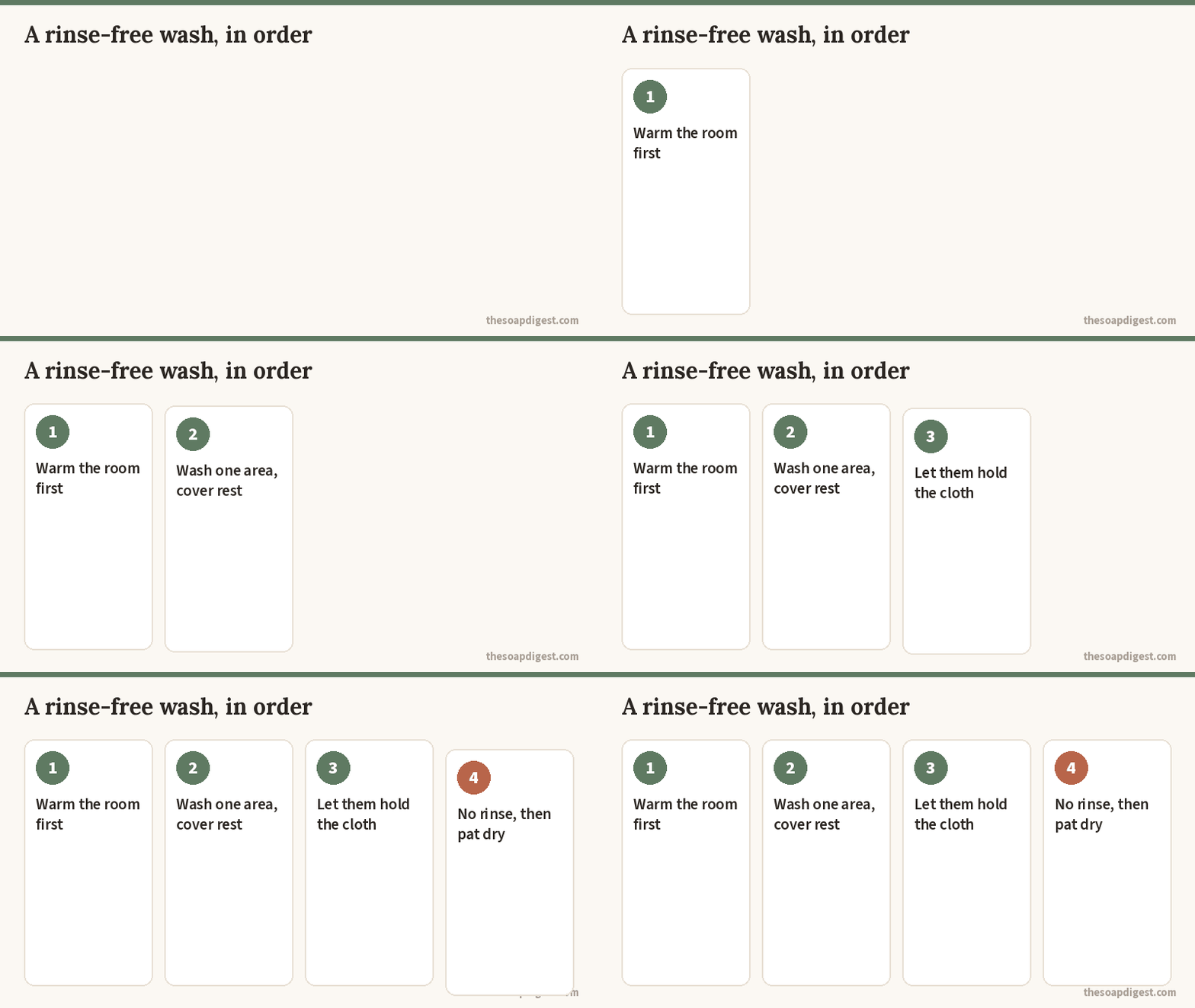
The best evidence comes from a randomised controlled trial run across nine skilled nursing facilities in Oregon and six in North Carolina. Seventy-three residents who became agitated during bathing, and the 37 nursing assistants who bathed them, were randomised to usual care, a person-centred shower, or a towel bath — described by the authors as a person-centred, in-bed bag-bath with no-rinse soap. Baths were videotaped and coded by raters blinded to which group each resident was in.
The cleanliness findings are the ones that get quoted least and matter most here. Neither intervention resulted in fewer body parts being bathed. Both improved skin condition. And neither increased colonisation with potentially pathogenic bacteria, corynebacteria or Candida albicans. Whatever the in-bed, no-rinse method lacks, it was not coverage, and it did not leave residents carrying more of the organisms anyone worries about.
Two smaller studies point the same way from different angles. In one, 26 healthy women aged 65 to 90 each received both a disposable no-rinse bath and a towel bath, with resident skin bacteria, stratum corneum water content, transepidermal water loss and mood measured before and after. Both baths significantly decreased resident skin bacteria; the disposable bath additionally reduced Staphylococcus aureus significantly and did better at maintaining the water content of the stratum corneum. In the other, 58 hospital patients received a traditional basin bed bath one day and a prepacked disposable bath the next, from the same nurse both times. Both scored very highly on quality, supply costs were indistinguishable, and the disposable bath was significantly faster.
None of this makes rinse-free washing right for everyone, and the evidence is thin in places. The hydration study used healthy volunteers rather than residents with dementia, and the hospital trial assessed quality by observation rather than biochemistry. When Cochrane reviewers appraised the bathing trials inside a wider review on aggression in healthcare, they graded the evidence low to very low quality. The direction of these findings is consistent; the certainty is modest.
The thing rinse-free washing is measurably better at
If coverage comes out level, the case for the method rests somewhere else, and in the trial it rests on what the bath costs the person having it.
All measures of agitation and aggression declined significantly in both treatment groups and not in the control group. Aggressive incidents fell 53% with person-centred showering and 60% with the towel bath, both at P<.001. Discomfort scores fell significantly in both groups too, and here the two methods separated: discomfort was lower with the towel bath, P=.003. The shower also got slower, adding an average of 3.3 minutes; the towel bath did not.
Readers describe the mechanism better than the paper does. In a late-September r/dementia thread about weeks of refusal, one commenter laid out why the bathroom is the hardest room in the house for someone with dementia, noting that
“Bathing is set at the highest level of difficulty”
— undressing, a step up, taps, a spray of water, bottles to identify, all of it sequenced, any one of which can tip a person into saying no. Remove the transfer, the running water and the cold, and most of the decisions go with them.
The same thread contains the assumption this article is arguing with, stated out loud by someone who had already changed their mind:
“many people assume that wipes aren't a good clean. That isn't true”
.
The charities have landed in the same place. The Alzheimer’s Society suggests trying a bed bath if the person refuses a bath or shower, washing them with a wet sponge or cloth without them getting into a bath or under running water, and notes that bed bath wipes and cloths exist for this, along with waterproof wraps that help with privacy and keep the bed dry. The Alzheimer’s Association lists sponge baths and non-rinse soap products among its alternatives, suggests covering the person with a bath towel while undressing to reduce feelings of vulnerability, and advises encouraging the person to do as much as possible themselves. That last point has teeth: in the trial, the towel bath did not win by washing less.
On skin exposed to urine, skipping the soap is the point
There is one situation where rinse-free is not merely equivalent but arguably preferable, and it comes up constantly in the households reading this.
Ammonia is not a property of urine. It is manufactured afterwards, when urease-producing bacteria hydrolyse urea — in a sanitation study, fresh urine measured pH 5.2 to 5.3 and untreated stored urine climbed to pH 6.1 with ammonium up 32%, attributed explicitly to urea hydrolysis. On skin that reaction does more than smell. A 2024 study using ex vivo porcine and in vivo human models found urease-produced ammonia raised skin pH and caused a significant breakdown in stratum corneum barrier function, and that the raised pH then increased faecal-enzyme activity and opportunistic organisms. Two of its authors founded a company developing urease inhibitors and declare it; the mechanism stands on its own, the therapeutic implication is interested.
Now add what an ordinary wash does. A buffer at pH 10 increases swelling of the stratum corneum with no surfactant present at all, and skin pH stays elevated for hours after an alkaline wash. Skin already being pushed alkaline several times a day does not need a second source of the same push.
The trial evidence on this exact comparison is weak but one-directional. The 2025 Cochrane review of skin cleansers for preventing incontinence-associated dermatitis included 15 trials and 1,020 participants, rated overall risk of bias high, and found heterogeneity substantial enough to preclude meta-analysis, with every comparison very low certainty. Within that, three trials compared a cleanser against soap and water: one found a foam cleanser might be more effective at preventing dermatitis (RR 0.35, 95% CI 0.14 to 0.85, 65 participants), one found little or no difference for a dimethicone washcloth in just 12 participants, and the third reported lower erythema scores with a no-rinse cleanser than with soap and water, though the reviewers could not analyse those data. That is a long way from proof. It is also the only direction the evidence points.
What rinse-free washing will not do for the smell
This is where we have to be straight with you, because it is the question most people are quietly asking.
Nobody has measured it. A PubMed search for bed bathing together with odour or odor returns zero results. The trials above measured agitation, discomfort, body-part coverage, skin condition, bacterial colonisation, hydration, time and cost — not smell. Caregivers report, repeatedly and consistently, that switching to wipes made a smell problem better, and that is real lived experience; it is not a measured finding, and we are not going to dress it up as one.
What we can do is say which smell a damp cloth is suited to, because the two main candidates behave in opposite ways.
Ammonia is tiny and water-loving: PubChem lists it at 17 g/mol with an XLogP of −0.7, and urea at 60 g/mol and −1.4. It sits on the skin surface and in whatever is held against it, and it is being made there continuously. A mild rinse-free wash with adequate coverage is a sensible tool for that, and the alkalinity argument above says it is a better one than soap. If ammonia is the smell you are chasing, the fuller picture is in our piece on strong urine smell.
The stale, greasy, faintly cardboard odour is a different proposition. It is driven by 2-nonenal, which PubChem lists at 140 g/mol with an XLogP of 3.1 — soluble in most fixed oils, insoluble in water. It rides in skin surface sebum, and the mechanism described by Haze and colleagues is oxidative degradation of ω7 unsaturated fatty acids with lipid peroxides as initiator, with no bacterial step at all. That last detail is why washing can only ever be half an answer. An oil-loaded surface keeps generating the molecule from the oil already in it, whether or not anything living is present. The pillow, the chair and the shirt collar are bigger reservoirs than the skin, and a wash of any kind leaves them untouched. That half of the job is laundry and upholstery, not bathing — and it is the usual reason a wash seems to buy two good days and then stop working.
There is also no way to check your work. The gas-phase biosensor built to detect 2-nonenal reaches a theoretical limit of detection around 0.23 ppm, and its developers sampled skin by wiping it with alcohol-soaked cotton and measuring the headspace. No consumer test exists. Your nose, and the limits of your own nose, are what you have.
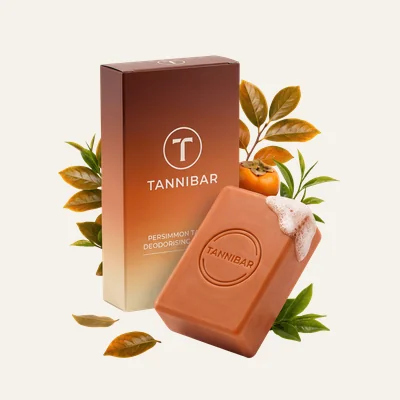
TanniBar Persimmon Tannin Bar
Relevant only to the stale, oily 2-nonenal smell, on skin, in a shower where it can be rinsed off — not to ammonia, and not usable in a rinse-free routine at all.
Check price →We own TanniBar and earn from sales. 30-day refund, no return needed.To be explicit about our own product, since we own one: a persimmon tannin bar is a true soap. TanniBar’s own ingredient list is persimmon tannin, green tea leaf extract, vegetable glycerin, shea butter, saponified coconut and palm oil, vitamin E and water, and saponified oils are what make a soap alkaline. It needs rinsing, which means it has no place in a bed bath, and on skin regularly exposed to urine the pH evidence above says it is the wrong choice even where rinsing is easy. Added glycerin and shea butter do not change the pH of a true soap. If a full wash is no longer realistic for the person you are caring for, a rinse-free product is the tool for that, and no bar of soap is a substitute.
Reading the label, and how often a full wash is really needed
Two practical points close this out.

The first is fragrance. Many rinse-free products are scented, and caregivers routinely describe them by their scent. If you are using one to manage a smell that works against you, because fragrance adds rather than removes — one of the ordinary reasons a wash seems not to have worked. The front of the bottle is not reliable either: a screen of 300 moisturisers against their ingredient lists found fragrance the most frequently identified allergen at 84.7%, and of 53 labelled fragrance-free, 46 genuinely were. The authors note that fragrance-free and hypoallergenic are not consistently regulated. So read the ingredient list for parfum, fragrance, aroma or named essential oils.
The second is frequency, the question underneath most bathing arguments. Neither charity gives a number for a whole-body wash, and that is a deliberate answer rather than an evasion. The Alzheimer’s Society does give specifics for the parts that matter: the bottom and genitals washed every day to prevent infection, the face every day to keep the skin clear, and respect for the person’s choices about the rest so long as they wash enough to reduce the risk of ill health. The Alzheimer’s Association suggests washing one part of the body each day of the week, and tells carers to be open to adjusting their bathing standards. Daily attention to the areas that need it, in a way the person tolerates, beats a weekly confrontation that may not happen.
There is a real boundary on the other side of that, though. Dermatosis neglecta is an acquired skin condition caused by sustained neglect of self-cleaning: in the largest published case series, 28 patients, it appeared most often on the trunk and most commonly at a recent surgical site, and soap and water cleansing cleared the lesions in the majority. So this is not an argument that washing does not matter. It is an argument that the method should be chosen to fit the person, because a method they will accept gets used.
When to involve a professional
A wash of any kind is a hygiene measure, not a diagnosis. The NHS advises seeing a GP if body odour has not improved with self-care and it is affecting your self-esteem, you notice a change in how it usually smells, or you suddenly begin to sweat much more than usual. Broken, weeping or infected-looking skin, and recurrent soreness in skin folds or anywhere in contact with incontinence pads, want a district nurse or GP rather than a different cleanser. If someone has an active skin condition, check with a doctor before changing what goes on their skin — TanniBar’s own page says the same. And if washing has become a daily battle, it is worth asking the GP what help is available; in the UK, NHS Carers Direct can be reached on 0300 123 1053.
The bottom line
Rinse-free washing is not a concession. In the one randomised trial that tested it properly it washed the same number of body parts as a shower, improved skin condition, did not raise colonisation with problem organisms, took no longer, and cut aggressive incidents by 60% with less discomfort. On urine-exposed skin the absence of alkaline soap is a feature, and the sparse trial evidence leans the same way.
Its blind spot is the one this site exists to think about. No study of bed bathing has measured odour, and the chemistry says a cloth suits the water-soluble ammonia smell far better than the oil-soluble 2-nonenal one, whose supply sits in bedding, upholstery and clothing rather than on skin. If the smell is the stale greasy one and the person can still manage a shower, that is a different conversation and our best persimmon soap comparison is where to start it. If a shower has stopped being realistic, the honest answer is that a no-rinse product plus a laundry routine will get you further than any bar of soap, including ours.
Frequently asked questions
Does no-rinse body wash actually get someone clean?
On the outcomes that have been measured, yes. In the randomised trial that tested an in-bed towel bath with no-rinse soap against person-centred showering and usual care in fifteen nursing homes, neither method resulted in fewer body parts being bathed, both improved skin condition, and neither increased colonisation with potentially pathogenic bacteria, corynebacteria or Candida albicans. A separate study of 26 women aged 65 to 90 found that both a disposable no-rinse bath and a towel bath significantly decreased resident skin bacteria, with the disposable bath also significantly reducing Staphylococcus aureus and better maintaining the water content of the stratum corneum. What has not been measured in any of this work is odour.
Is a bed bath or wipe-down as good as a shower?
For getting the body washed, the evidence does not show it being worse. The nursing-home trial found the same body-part coverage either way and less discomfort with the towel bath than with the shower, and a trial of 58 hospital patients found both the traditional basin bath and a prepacked disposable bath scored very highly on quality, with the disposable version significantly faster. The sensible way to read this is that the water volume is not the active ingredient — coverage is. Whether a shower is still right for a particular person is a question about their safety, their skin and how much the process costs them, not about rinse-free products being second rate.
Can I use regular soap for a bed bath if I do not rinse it off?
No. A true soap is saponified fat and is alkaline by design, and it is formulated on the assumption that it will be rinsed away. Rinse-free products are built to be left on skin at a near-skin pH. Leaving an alkaline soap on is the worst of both approaches: an alkaline wash keeps skin surface pH elevated for hours, and buffer at pH 10 has been shown to increase swelling of the stratum corneum with no surfactant present at all. If what you have in the cupboard is a bar of soap, it needs water and rinsing, or it needs to be swapped for a product designed for the job.
Will a no-rinse wash get rid of old person smell?
Partly, and it helps to know which part. If the smell is the sharp ammonia note, a rinse-free wash is a reasonable tool, because ammonia is small and water-soluble and is being made on the skin surface by bacteria breaking down urea. If the smell is the stale, greasy one, it is driven by 2-nonenal, which is oil-soluble, rides in skin surface sebum and is continuously regenerated by oxidation of the oil that is already there. Washing lifts what is on the skin now; it does nothing to the much larger reservoir sitting in the pillow, the chair and the clothes. That half of the problem is laundry, not bathing. No published study of bed bathing or disposable bathing has measured odour as an outcome at all.
How often does an older person actually need a full wash?
There is no single number, and the dementia charities are refreshingly blunt about this. The Alzheimers Society advises that the person's bottom and genitals should be washed every day to prevent infection and the face every day to keep the skin clear, and that if the person chooses not to wash as often as you would, you should respect that while making sure they wash enough to reduce the risk of ill health. The Alzheimers Association suggests washing one part of the body each day of the week rather than insisting on a whole bath, and tells carers plainly to be open to adjusting their bathing standards. Daily attention to the areas that matter beats a weekly fight about a shower.
Are no-rinse products scented?
Many of them are, and caregivers in discussion threads routinely describe them by their scent. That matters if you are using the product to deal with a smell, because fragrance does not remove anything — it sits on top of what is left, which is one of the standard reasons a wash seems not to have worked. Read the ingredient list rather than the front of the bottle: a screen of 300 moisturisers found fragrance the most frequently identified allergen at 84.7%, and among products labelled fragrance-free about one in eight still contained a fragrance ingredient. The paper notes that terms like fragrance-free and hypoallergenic are not consistently regulated.
Sources
- Sloane P.D. et al. (2004). Effect of person-centered showering and the towel bath on bathing-associated aggression, agitation, and discomfort in nursing home residents with dementia: a randomized, controlled trial. J Am Geriatr Soc 52(11):1795–804. (The towel bath is described as "a person-centered, in-bed bag-bath with no-rinse soap". Nine facilities in Oregon and six in North Carolina; 73 residents, 69 completed. Aggressive incidents fell 53% with person-centred showering and 60% with the towel bath, both P<.001; discomfort was lower with the towel bath, P=.003; bath duration rose by a mean 3.3 minutes with showering but not with the towel bath. "Neither intervention resulted in fewer body parts being bathed; both improved skin condition; and neither increased colonization with potentially pathogenic bacteria, corynebacteria, or Candida albicans.")
- Matsumoto C. et al. (2019). Effects of disposable bath and towel bath on the transition of resident skin bacteria, water content of the stratum corneum, and relaxation. Am J Infect Control 47(7):811–5. (26 healthy women aged 65–90, each receiving both a disposable no-rinse bath and a towel bath. Both significantly decreased resident skin bacteria; the disposable bath also significantly reduced Staphylococcus aureus and effectively maintained stratum corneum water content. Healthy volunteers, not residents with dementia; outcomes were bacteria, hydration and mood, not odour.)
- Nøddeskou L.H., Hemmingsen L.E., Hørdam B. (2015). Elderly patients' and nurses' assessment of traditional bed bath compared to prepacked single units — randomised controlled trial. Scand J Caring Sci 29(2):347–52. (58 patients, each receiving a traditional basin bed bath on one day and a disposable bed bath on the other, from the same nurse. Both scored very highly on quality; significantly less time was used with the disposable baths, P<0.001; supply costs were indistinguishable. Quality was rated by observation, not measured biochemically.)
- Spelten E. et al. (2020). Organisational interventions for preventing and minimising aggression directed towards healthcare workers by patients and patient advocates. Cochrane Database Syst Rev 4:CD012662. (Independent appraisal of the bathing-intervention evidence: two trials where the event was aggression during bathing of nursing home residents provided low-quality evidence of a medium-sized reduction in overall aggression, SMD −0.49, 95% CI −0.93 to −0.05; physical aggression SMD −0.85, 95% CI −1.46 to −0.24, very low-quality evidence; no clear effect on verbal aggression.)
- Graham T. et al. (2025). Skin cleansers and leave-on product interventions for preventing incontinence-associated dermatitis in adults. Cochrane Database Syst Rev 7:CD011627. (15 trials, 1,020 participants; overall risk of bias high, substantial heterogeneity precluded meta-analysis, all comparisons very low-certainty. Three trials compared a skin cleanser with soap and water: one found a foam cleanser might be more effective at preventing IAD, RR 0.35, 95% CI 0.14–0.85, 65 participants; another found little or no difference for a 3% dimethicone washcloth, RR 0.14, 95% CI 0.01–2.28, 12 participants; "the third trial reported lower erythema scores with a no-rinse skin cleanser compared with soap and water, but we were unable to analyse these data". Supersedes the 2016 version, PMID 27841440.)
- Owen E.J. et al. (2024). The multi-factorial modes of action of urease in the pathogenesis of incontinence associated dermatitis. Skin Health Dis 4(3):e349. (Ex vivo porcine and in vivo human skin: urease-produced ammonia raised skin pH and caused a significant breakdown in stratum corneum barrier function; the raised pH increased faecal-enzyme activity and opportunistic Candida albicans and Staphylococcus aureus. Two authors are founders of Watercress Research Ltd, which develops urease inhibitors — declared in the paper.)
- Ananthapadmanabhan K.P. et al. (2004). Cleansing without compromise: the impact of cleansers on the skin barrier and the technology of mild cleansing. Dermatol Ther 17 Suppl 1:16–25. (A buffer at pH 10 increased stratum corneum swelling with no surfactant present at all. Unilever-affiliated authors.)
- Blaak J., Staib P. (2018). The relation of pH and skin cleansing. Curr Probl Dermatol 54:132–42. (Skin surface pH stays elevated for hours after washing with an alkaline product.)
- Haze S. et al. (2001). 2-Nonenal newly found in human body odor tends to increase with aging. J Invest Dermatol 116(4):520–4. (2-nonenal is formed by oxidative degradation of ω7 unsaturated fatty acids in skin surface lipid, with lipid peroxides as the initiator — no bacterial step in the mechanism.)
- Andreev N. et al. (2017). Lactic acid fermentation of human urine to improve its fertilizing value and reduce odour emissions. J Environ Manage 198(Pt 1):63–9. (Fresh urine pH 5.2–5.3; untreated stored urine rose to pH 6.1 with ammonium up 32% "due to urea hydrolysis". Sanitation study in jars and tanks, not on skin or textiles.)
- Møllebjerg A. et al. (2021). The bacterial life cycle in textiles is governed by fiber hydrophobicity. Microbiol Spectr 9(2):e0118521. (Polyester, being more hydrophobic, adhered more bacteria and absorbed more sebum than cotton. Sweat-odour and bacteria work rather than 2-nonenal; first author affiliated with Novozymes A/S.)
- Palaniappan V., Sadhasivamohan A., Kaliaperumal K. (2023). Dermatosis neglecta: a retrospective study at a tertiary care center in southern India. Indian J Dermatol 68(6):628–33. (28 patients with dermatosis neglecta, an acquired condition arising from neglect of self-cleaning in people with an underlying risk factor; the most common site to develop it was a recent surgical site, and soap and water cleansing removed the lesions in the majority. Retrospective case series.)
- Kemicha D. et al. (2026). Allergic Risk of Moisturising Cosmetic Products: A Study on the Composition of 300 Products Commercialised in Tunisia. Contact Dermatitis 94(6):645–51. (300 moisturisers screened against their INCI lists; fragrance was the most frequently identified allergen at 84.7%; of 53 products labelled "fragrance-free", 46 of 53 (86.8%) truly were. The authors note that "hypoallergenic" and "fragrance-free" are not consistently regulated. Moisturisers in one national market, not cleansers.)
- Iitani K. et al. (2023). Gas-phase biosensors (bio-sniffers) for measurement of 2-nonenal, the causative volatile molecule of human aging-related body odor. Sensors 23(13):5857. (Theoretical limit of detection 0.23 ppm; skin samples were collected as headspace gas from alcohol-absorbed cotton wiped on participants' skin. A research sampling method, not a consumer test.)
- Alzheimer's Society: When a person with dementia doesn't want to change their clothes or wash. ("Try a bed bath if the person refuses a bath or shower. You can wash them with a wet sponge or cloth without them getting into a bath or under a running shower." Special bed bath wipes and cloths are available; a waterproof bed-bathing wrap helps with privacy, comfort and keeping the bed dry. "To prevent infection, the person's bottom and genitals should be washed every day. Their face should also be washed every day to keep their skin clear." "If the person chooses not to wash as often as you would wash, you should respect their choices.")
- Alzheimer's Association: Bathing. ("Wash one part of the body each day of the week." Sponge baths and non-rinse soap products are offered as alternatives between showers. "Consider covering the person with a bath towel while undressing to decrease feelings of vulnerability." "Encourage the person to do as much as possible, but be ready to assist when needed." "Be open to adjusting your bathing standards.")
- Naik A.D., Concato J., Gill T.M. (2004). Bathing disability in community-living older persons: common, consequential, and complex. J Am Geriatr Soc 52(11):1805-10. (626 community-living persons aged 73 and older assessed by trained research nurses. "Disability in bathing was present in 195 (31%) participants", with a mean of 4.0 affected subtasks out of eight, and 59% gave more than one reason for it.)
- NHS: Body odour (BO) — self-care and when to see a GP. ("You have body odour that has not got better after treating it yourself and: it's affecting your self-esteem; you notice a change in how it usually smells; you suddenly begin to sweat much more than usual.")
- PubChem compound summary: (E)-2-nonenal (CID 5283335) — molecular weight 140.22, XLogP 3.1; soluble in most fixed oils, insoluble in water
- PubChem compound summary: Ammonia (CID 222) — molecular weight 17.03, XLogP −0.7
- PubChem compound summary: Urea (CID 1176) — molecular weight 60.06, XLogP −1.4
- TanniBar: ingredients, fragrance-free claim, refund and shipping terms (brand's own page, re-checked 7 October 2026)