Home › Persimmon Soap › Is persimmon soap legit?
Persimmon SoapIs Persimmon Soap Legit? How to Check Before You Buy
Asking whether persimmon soap is legit turns out to be three questions in one coat, and they have three different answers. The hardest one is not about the soap at all — it is about whether the reviews, roundups and ratings you are using to decide are worth anything.

Disclosure: The Soap Digest is owned by the same company that makes TanniBar. We rank it first and we earn money when you buy it. Every other brand here is linked without payment, and we try to describe each one fairly. Check the facts for yourself. How we handle this.
In this guide
- Three questions wearing the same coat
- What is actually published about persimmon tannin and skin
- Why so many persimmon soap reviews arrived with a free bar
- The roundups, including this one
- The Consumer Reports verdict you are looking for does not exist
- The one check you can run yourself
- Claims that should make you close the tab
- The bottom line
Searching for a persimmon soap and working out whether it is real are two different projects, and the second is much harder. The bars are cheap enough to risk and expensive enough to resent, the listings all say roughly the same thing, and the reviews are glowing. Somewhere in the middle of that, a reasonable person starts typing “is persimmon soap legit” into a search box.
That query is live, and so is a cluster around it — whether it is a hoax, a gimmick, a con, a scam, a real thing at all, what Reddit says, what Consumer Reports says, and brand-by-brand versions for most of the names on the shelf. Sitting among them are two questions of a different kind, about whether the bar is antibacterial or antifungal — people reaching past the odour claim for some other mechanism that might hold. The volume does not suggest anybody has made up their mind; it suggests they cannot find anything solid to decide with.
So this article is about that second problem: not whether the soap works, which we have covered at length elsewhere, but whether the material you are using to judge it is worth anything. For a great deal of persimmon soap it is not, and the reasons are checkable in about five minutes.
The short version
- “Is persimmon soap legit” is three questions at once. The molecule is real and independently measured. The soap’s effect on it is unproven. And the evidence you are shown is frequently not evidence.
- A title-and-abstract search of PubMed for persimmon and soap together returns zero results. The entire published record of persimmon tannin on living skin is one 2021 paper about guinea pig pigmentation.
- Persimmon bars circulate heavily through Amazon Vine, where reviewers get the product free. Amazon badges these — but a launch run through the programme produces the burst of reviews the FTC tells shoppers to distrust.
- There is no Consumer Reports verdict on persimmon soap and no published dermatology trial. People search for both.
- The check that works is the ingredient list: persimmon tannin or kakishibu named as an ingredient, not “persimmon extract” and not a persimmon scent.
Three questions wearing the same coat
People asking whether persimmon soap is legitimate are usually asking all of these at once, and the answers point in different directions.
The first is whether the smell is real. It is. 2-Nonenal was identified in human body odour in 2001 and found to increase with age, formed by oxidative degradation of unsaturated fatty acids in skin surface lipid. That work came out of a cosmetics company, which is worth knowing, but it has not stayed there: the compound has since been measured off human skin independently with a passive flux sampler, shown to be generated endogenously and to bind lysine residues in living tissue, and used as a target analyte by a Japanese national research institute building gas-sensor arrays. A molecule invented to sell soap does not usually end up in an instrumentation paper co-authored with an automotive supplier. That is not the same as agreeing with the marketing about it: the independent work also contains findings the category would rather not quote, including a sensory study in which old-age body odour was rated less intense and less unpleasant than middle-aged odour, which we unpick in what age does old person smell start, and the fact that no published study describes what 2-nonenal smells like on human skin at all.
The second is whether the soap does anything to it, and here nobody knows. We keep a full index of the nonenal literature, and the finding is simply stated: there is no peer-reviewed human trial of persimmon soap on body odour. The most-cited human data is a 2001 company patent in which ten people per formula rated their own results over two weeks — using leave-on preparations, not soap.
The third question is the one nobody answers, and the only one you can act on before buying. Are the reviews, roundups and ratings in front of you a signal about the product, or about someone’s marketing budget?
What is actually published about persimmon tannin and skin
A bare “no studies exist” is easy to say and easy to dismiss, so it is worth walking the search rather than quoting a count.
A title-and-abstract search of PubMed for persimmon together with soap returns nothing at all. Broadening it to persimmon, tannin and skin returns eight papers — which sounds more promising until you read them. Seven are food science or animal work: tannins in puddings, in egg-white gels, in bread, in low-allergen wheat flour, in ruminant feed; proanthocyanidins from peanut skins; and cognition in ageing mice. Five of the eight come from a single Japanese food-science group working on repurposing agri-food waste.

That leaves exactly one paper in which persimmon tannin is applied to living skin: a 2021 study in the Journal of Cosmetic Dermatology that put persimmon tannin extract on guinea pig skin and measured pigmentation. Not odour. Skin colour.
So the published record of the active ingredient meeting skin is one animal study about a different outcome. That is more useful than a null result, because it tells you what to do with a seller who gestures at “studies”: ask which one. Note too that “skin” in this literature very often means the skin of a fruit or a nut, so a count of search hits here means little without reading them.
None of this makes the soap useless — tannins do bind small molecules, and the mechanism is coherent. It does mean anyone presenting the category as scientifically established is going beyond what has been published, and so is anyone declaring it debunked.
Why so many persimmon soap reviews arrived with a free bar
This is the part that changes how you read a listing, and it is easy to verify.
Persimmon soaps, body washes, scrubs and even shampoos circulate in volume through Amazon Vine, the programme in which Amazon sends free samples to selected reviewers. In an early-September thread on the Vine subreddit, reviewers described these products arriving constantly.
“I get a daily offering of persimmon soap and body washes”
Another commenter in the same thread noted that dozens of different companies are selling the same thing with the same marketing language. Across four months, separate persimmon-soap threads appeared on the main Vine subreddit, its Australian and Canadian counterparts, and a beauty-focused Vine community — seven in all.
Amazon is reasonably transparent about the mechanics. Its seller-facing page says reviewers “try out your product free of charge, then share their honest, unbiased opinions in a review”. Its shopper-facing page says that “for transparency, reviews given through this program are identified with a ‘Vine Review’ badge”, and that participation “is not dependent on the reviewer providing positive feedback”. That is borne out in the threads: among the enthusiastic verdicts, one recipient said plainly the bar was unremarkable and they preferred other soaps. The programme does produce candid negatives.
It is still a different kind of evidence. The FTC’s position on free products is unambiguous — “it doesn’t matter whether the company gives you a code, ships it directly to you”, the connection must be disclosed, and a business may not condition an incentive on a review being positive. A badge satisfies that; it does not make the review equivalent to one from somebody who paid $29 and had to decide whether it was worth it. And a launch run through the programme produces precisely what the FTC’s consumer guidance tells people to treat as a warning sign: “watch for a burst of reviews over a short period of time.”
There is a wrinkle Amazon’s own page leaves unresolved, too. The same document explaining the Vine badge states that Amazon prohibits reviews given for compensation, and that its systems look for anomalies suggesting a review “was incentivized with a gift card, free product, or other form of reimbursement”. Both are true at once; the difference is that one channel is disclosed. Which is the practical lesson: look for the disclosure, not the enthusiasm. Sort for reviews without a Vine badge, read the three-star ones first, and bear in mind the FTC’s warning that some fake positives avoid five stars to look credible — and that fake reviews are not always positive.
The roundups, including this one
Then there are the comparison articles, and here we have to talk about ourselves.
In a late-August thread on an Australian skincare subreddit, someone asked for a trustworthy source for “the real soap” for their mother. The replies were a blizzard of competing brands and bare marketplace links, and one commenter passed along a best-five persimmon soap roundup as an interesting read — a page arriving with advertising and click-tracking parameters still attached to the URL. Another, having been pointed at a brand, explained their reasoning with uncomfortable clarity:
“Thank you, I was worried because they came up first in google”
Ranking first is a statement about a page, not about a product, and the two are routinely confused.
The FTC’s Rule on the Use of Consumer Reviews and Testimonials, in force since October 2024, has a provision aimed squarely at this: a business may not misrepresent that a website or entity it controls provides independent reviews or opinions about a category that includes its own products. The existence of that clause tells you how common the practice is, and violations can now carry civil penalties.
So: this site is owned by the same company that makes TanniBar, which is our number one pick. That disclosure appears on every page here, and it is the first thing you should look for on any roundup you read — ours included. The follow-ups are whether links to the top pick earn the publisher money, and whether the article will tell you what the product cannot do. On that second test, a roundup with nothing bad to say about its winner is not being kind to you.
If you want our reasoning laid out, the persimmon soap comparison is the home page of this site, with the five bars, their prices and their ingredient lists side by side. Read it knowing who wrote it.
The Consumer Reports verdict you are looking for does not exist
“Persimmon soap reviews consumer reports” is a live search, and the answer is a clean no — with a detail that matters more than the no.
Consumer Reports does test bar soaps. Its 2026 round covered eleven, all mainstream names: Dove, Dr. Bronner’s, Dr. Squatch, Irish Spring, Kirkland Signature, Tom’s of Maine, Zest and others. No persimmon or kakishibu bar appears, and persimmon, nonenal and age-related body odour are not mentioned at all.

The test design is the interesting part. Consumer Reports rated how the writer’s skin felt and how much she liked each scent, then ran weighed chunks under cold water for twenty minutes to measure dissolution as a proxy for how long a bar lasts. That is a durability and skin-feel test. Even with a persimmon bar included it would not answer the odour question, because nobody in that protocol smells anything over time.
The same goes for the “dermatologist review” people search for. No published clinical trial exists; the dermatology-journal paper in this space is the guinea pig pigmentation study. A video review by a dermatologist is a professional’s impression — worth something, but not a trial. Nor is there a consumer test you could run yourself: measuring 2-nonenal off skin takes passive flux samplers, gas chromatography and experimental biosensors.
The one check you can run yourself
What is left is the back of the package, and it is more informative than the front.
Look for the tannin by name. “Persimmon tannin”, or kakishibu, listed as an actual ingredient is a different proposition from “persimmon fruit extract”, and both differ from a persimmon fragrance. The distinction is chemical rather than pedantic: the astringency the category is named for is the pucker of an unripe persimmon, and commercial deastringency treatment significantly reduces soluble tannin and total phenolic content. Processing the fruit to make it pleasant removes the thing you are buying.
That is also why a persimmon smell is not a clue. Astringency is a taste-and-texture property, not an aroma, so any scent comes from added fragrance, essential oils or the soap base. If a listing leans on how fruity it smells, it is selling the one feature that cannot be the active ingredient. Among the five bars we compare, three arrive scented by default, one is sold both ways and one is fragrance-free only — and if you are buying to deal with a smell, added fragrance works against you, which is a standard reason the soap seems not to work. Check that “fragrance-free” survives contact with the ingredient list, too: a screen of 300 moisturisers found fragrance the most frequent allergen at 84.7%, and of 53 labelled fragrance-free, 46 genuinely were — the authors noting that such terms are not consistently regulated.
One structural check to finish. Under FDA rules, what a product claims determines what it legally is: something intended for the “cure, mitigation, treatment, or prevention of disease” is a drug, and “certain claims may cause a product to be considered a drug, even if the product is marketed as if it were a cosmetic”. Body odour is not a disease, so a soap aimed at it sits in cosmetic territory — which is exactly why none of these products has been through a drug approval process, and why “clinically proven” has no business on the label.
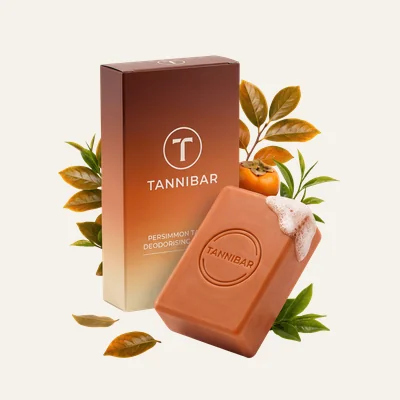
TanniBar Persimmon Tannin Bar
Fragrance-free with persimmon tannin named on the ingredient list, from a brand that publishes the full list and offers a refund without a return — and sold by a company that tells you plainly it owns this website.
Check price →We own TanniBar and earn from sales. 30-day refund, no return needed.Claims that should make you close the tab
Each of these is common, and each is checkable against something above.
“Clinically proven.” There is no clinical trial. The phrase does work no published study supports.
“Only persimmon tannin can break down nonenal.” A confident version of this circulates widely, including among people on Reddit trying to help each other. It is not established. Ordinary washing removes skin surface oil, which is where the compound is made and carried, and 2-nonenal is generated in place by peroxidation of the skin’s own lipids rather than arriving from outside. The claim overstates both what the tannin uniquely does and what ordinary soap fails to do. The pattern is not unique to persimmon, either: the same shape of argument — a plausible mechanism, one measured step, and a final step nobody has tested — turns up in the case for glycolic acid against body odor, where it is possible to point at exactly which link is empty.
“Japanese persimmon is a different ingredient from persimmon.” This one circulates with real confidence, and it is the most common version of a true premise taken somewhere it does not go. In an r/AskWomenOver60 thread, a commenter described buying an ordinary persimmon bar, being unimpressed, then finding one that specified Japanese persimmon and reporting a clear improvement — two different things, they explained. Nothing published supports a distinction of that kind. Kakishibu, the traditional preparation, is simply fermented persimmon juice, long used to protect wood and paper, and what has been studied in it behaves like tannin generally. A geographic adjective is not an ingredient; what varies between bars is whether tannin is named at all, and in what form. The ingredient list is still the only place that settles it.
All-day protection from a bar of soap. No measurement exists of persimmon tannin remaining on skin after rinsing — we looked, and could not find one. A true soap leaves with the water. A wash is a removal event, and the honest question is how fast the oil rebuilds, not how long the bar keeps working.
A percentage with no study behind it. Figures like “removes 99% of nonenal” trace back to nothing peer-reviewed. If a number appears, ask what was measured, in whom, over how long. The 2001 patent’s lab test, for comparison, was a gram of sample in a jar of nonenal gas for ten minutes.
Reviews that all arrived in the same fortnight. The FTC says it in one line: watch for a burst of reviews over a short period.
When to see a doctor rather than buy a soap
The NHS advises seeing a GP if body odour has not improved with self-care and you notice a change in how it usually smells, if you suddenly start sweating much more than usual, or if it is affecting your self-esteem. A smell that has changed character or arrived suddenly is a reason to get checked rather than a reason to try another bar.
The bottom line
Persimmon soap is not a fabrication and it is not an established treatment, and the discomfort of holding both at once is why the question keeps getting asked. The molecule is real, independently measured and studied well outside the soap trade. The soap’s effect on it rests on a company patent and a great deal of personal testimony — and the published record of persimmon tannin touching living skin is one study, on guinea pigs, about pigmentation.
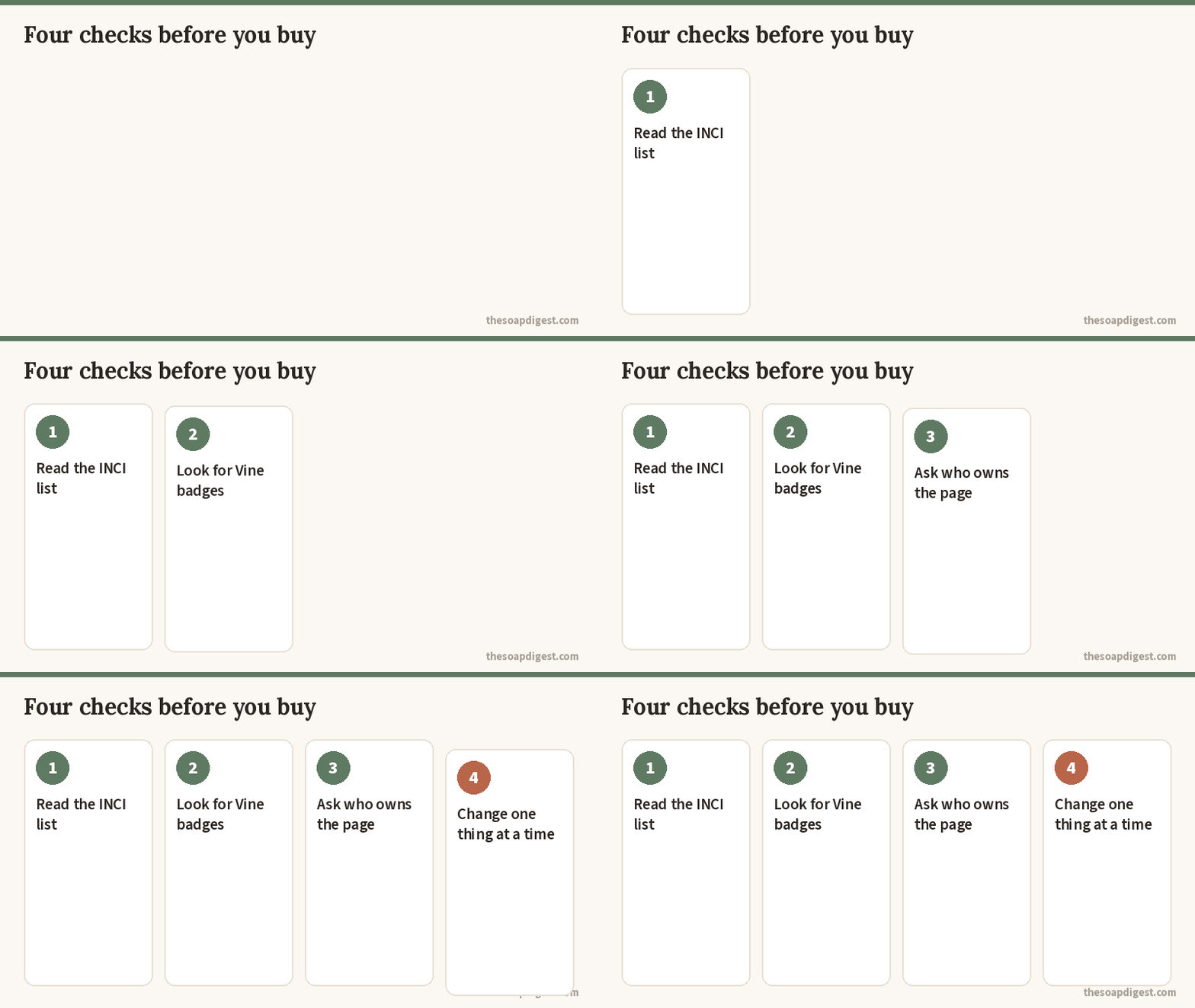
What you can verify before paying is narrower but genuinely useful: whether the tannin is named on the ingredient list, whether the scent claims make chemical sense, whether the glowing reviews came with a free bar, and who owns the article telling you which one to buy. That last question has a rule of its own now, which should tell you something.
Then try it the way you would try anything unproven and low-risk: one variable at a time, on a fresh pillowcase, for a fortnight, with a method rather than a hope. If it works for you, it works for you — that is a perfectly good reason to keep buying it, and it is not the same thing as the category being proven.
Frequently asked questions
Is persimmon soap legit, or is it a scam?
Neither word fits cleanly, which is why the question keeps getting asked. The odour compound these soaps are sold against, 2-nonenal, is a genuine, repeatedly measured age-associated skin compound with a documented formation mechanism. The soap's effect on it is a separate claim, and it is unproven: a title-and-abstract search of PubMed for persimmon and soap together returns no results at all, and the most-cited human data is a company patent in which ten people per formula rated their own results over two weeks, using leave-on formulas that were not soap. So the category is not a fabrication, and it is also not established. A scam implies the seller knows the product does nothing; what is actually going on is that nobody, including the sellers, has run the study that would settle it.
Why are persimmon soap reviews on Amazon so positive?
Partly because a large share of them came with a free bar. Persimmon soaps and body washes circulate heavily through Amazon Vine, the programme in which Amazon sends free samples to selected reviewers in exchange for feedback; Amazon's own seller page says Vine Voices "try out your product free of charge". Amazon marks these with a "Vine Review" badge and states that participation "is not dependent on the reviewer providing positive feedback", and plenty of Vine reviewers do post lukewarm verdicts. But a free bar is still a material connection, and a product launch pushed through the programme produces exactly what the FTC tells shoppers to be suspicious of: a burst of reviews in a short period. Read the badges, and weight the paid-full-price reviews more heavily.
Has Consumer Reports tested persimmon soap?
No. Consumer Reports does test bar soaps — its 2026 round named eleven of them, all mainstream brands — but no persimmon or kakishibu bar is among them, and the article does not mention persimmon, nonenal or age-related body odour anywhere. It is also worth knowing what that test measures: how the writer's skin felt and how much of each bar dissolved under cold water for twenty minutes, which is a durability test rather than an odour test. So the Consumer Reports verdict people are searching for does not exist, and the test design means it would not answer the odour question even if it did.
Is there a dermatologist study on persimmon soap?
There is no published clinical trial of persimmon soap on human body odour. The entire published record of persimmon tannin meeting living skin is a single 2021 paper in the Journal of Cosmetic Dermatology, which applied a persimmon tannin extract to guinea pig skin and measured pigmentation, not smell. A broader title-and-abstract search for persimmon, tannin and skin returns eight papers, and seven of them are food science or animal work: puddings, egg-white gels, bread made with chestnut inner skin, low-allergen wheat flour, ruminant feed, peanut skins, and cognition in ageing mice. If a seller cites dermatological evidence, ask which paper.
How can I tell a real persimmon soap from a look-alike listing?
Read the ingredient list rather than the front of the package, and look for what the tannin is doing there. "Persimmon tannin" or kakishibu named as an actual ingredient is a different thing from "persimmon fruit extract" or a persimmon fragrance, and the distinction matters chemically: the astringent tannin is the compound the category is named for, and commercial deastringency treatment of persimmons significantly reduces soluble tannin content. A persimmon scent tells you nothing at all, because astringency is a texture and taste property rather than an aroma, so any smell in the bar comes from added fragrance or the soap base. Also check whether "fragrance-free" is backed by the ingredient list, since a screen of 300 moisturisers found that terms like fragrance-free are not consistently regulated.
Does a glowing roundup article mean a soap is good?
Not on its own, and the ownership question is the one to ask first. Under the FTC's Rule on the Use of Consumer Reviews and Testimonials, a business may not misrepresent that a website it controls provides independent reviews of a category that includes its own products — which tells you the practice is common enough to need a rule. Ranking first in Google is a statement about a page, not about a product. The practical test is to look for who owns the site, whether links to the top pick are commission-bearing or owner-operated, and whether the article tells you what the product cannot do. This site is owned by the same company that makes TanniBar, which is our top pick, and we say so on every page for exactly that reason.
Sources
- Federal Trade Commission: The Consumer Reviews and Testimonials Rule — Questions and Answers (16 CFR Part 465, effective 21 October 2024). (§ 465.6 on company-controlled review websites: a business may not misrepresent that a website or entity it controls provides "independent reviews or opinions" about a product or service category that includes its own products. § 465.4 on incentivised reviews: offering an incentive is not prohibited in itself, the violation is an express or implied requirement that the review express a particular sentiment. § 465.5 on insider reviews: reviews by employees, agents or relatives generally require a clear and conspicuous disclosure of the relationship. § 465.7 on review suppression; § 465.8 on fake social-media indicators.)
- Federal Trade Commission press release (14 August 2024): FTC Announces Final Rule Banning Fake Reviews and Testimonials. (Bans creating, selling, buying or disseminating fake or false reviews including AI-generated ones where the business knew or should have known; compensating for reviews expressing a particular sentiment; undisclosed insider reviews; misrepresenting company-controlled sites as independent; and suppressing negative reviews by groundless legal threats or intimidation. The rule allows the FTC to "seek civil penalties against knowing violators".)
- Federal Trade Commission: The FTC's Endorsement Guides — What People Are Asking. (On free products and discounts: "It doesn't matter whether the company gives you a code, ships it directly to you" — the connection must be disclosed, and "your connection to the company should be disclosed everywhere you endorse the product". "You can't condition an incentive – for example, a discount – on a review being positive." Sellers offering something of value should "tell them in advance that they should disclose what they received from you". On summary ratings, a business "should disclose next to every overall or other summary rating" built from incentivised reviews.)
- Federal Trade Commission consumer advice: How To Evaluate Online Reviews. (Recommends considering the source and the reviewer, comparing several sources including "trustworthy and impartial expert reviews", checking dates and watching "for a burst of reviews over a short period of time", checking the reviewer's posting history, and looking for incentive labels — "on some websites, you'll see a label or badge next to the review that tells you the reviewer got an incentive". Cautions that "some fake positive reviews give less than the highest possible rating in order to seem more believable" and that "fake reviews are not always positive". Also: "Don't assume that, just by looking, you can spot the difference between a real review and a fake one.")
- Amazon: Get customer reviews with Amazon Vine (seller-facing programme page). (Describes Vine as "a program that helps you collect high-quality reviews for your products—even before launch". Of the reviewers: "They try out your product free of charge, then share their honest, unbiased opinions in a review." Amazon says it maintains the anonymity of Vine Voices, and that Voices "are responsible for income tax on the products". Company programme documentation, not independent evidence.)
- Amazon: How Amazon maintains a trusted review experience (Trustworthy Shopping at Amazon). ("For transparency, reviews given through this program are identified with a 'Vine Review' badge." Amazon sends "free samples of products to members of Vine Voices in exchange for their unbiased feedback on products", and "Participation in Vine Voices is not dependent on the reviewer providing positive feedback." The same page states that Amazon prohibits reviews given for compensation, and that its systems look for anomalies indicating a review "was incentivized with a gift card, free product, or other form of reimbursement". Company documentation.)
- U.S. Food and Drug Administration: Is It a Cosmetic, a Drug, or Both? (Or Is It Soap?). ("Whether a product is a cosmetic or a drug under the law is determined by a product's intended use." Drugs are "articles intended for use in the diagnosis, cure, mitigation, treatment, or prevention of disease" or intended "to affect the structure or any function of the body". FDA applies the term soap only where "the bulk of the nonvolatile matter in the product consists of an alkali salt of fatty acids" and "the product is labeled, sold, and represented solely as soap", in which case it is regulated by the CPSC rather than FDA. "Certain claims may cause a product to be considered a drug, even if the product is marketed as if it were a cosmetic.")
- Consumer Reports: 5 Best Bar Soaps of 2026, Tested and Reviewed. (Eleven bar soaps tested — Buff City Soap, Dove Original, Dove Sensitive Skin, Dr. Bronner's, Dr. Squatch, Irish Spring, Kirkland Signature, Malin+Goetz, Tom's of Maine, Up&Up and Zest. Evaluated by in-shower use for skin feel, comfort and scent preference, plus a lab test in which weighed chunks were run under cold water for 20 minutes to measure dissolution as a proxy for how long a bar lasts; top performers also assessed against the SkinSafe allergen database. No persimmon or kakishibu bar is included, and persimmon, nonenal and age-related body odour are not mentioned. Results are behind a membership paywall.)
- Sun W., Chen X., Nan X. (2021). Inhibition of persimmon tannin extract on guinea pig skin pigmentation. J Cosmet Dermatol. (Persimmon tannin extract applied to guinea pig skin, with pigmentation as the measured outcome. As of this writing it is the only published study in which persimmon tannin is applied to living skin, and it measures skin colour rather than odour.)
- PubMed title-and-abstract search for persimmon, tannin and skin, walked record by record (October 2026). (Eight results. Seven are food science or animal work: tannin-rich chestnut and persimmon extracts in puddings, PMID 41744983; tannin extract and allergenic proteins in egg-white gels, PMID 38612933; chestnut inner skin in bread, PMID 38398615; tannins from agri-food wastes in wheat flour products, PMID 37509814; ensiled fruit byproducts as ruminant feed, PMID 29879816; proanthocyanidin dimers from peanut skins and persimmon pulp, PMID 24001713; and persimmon tannin and cognition in senescent mice, PMID 21539885. The eighth is Sun 2021. Note that "skin" in this literature frequently means fruit or nut skin. A title-and-abstract search for persimmon and soap together returns zero results.)
- Baek M.W. et al. (2025). Distinct transcriptomic profile underlying high CO2 and ethylene-induced deastringency in 'Daebong' persimmon fruit. Curr Issues Mol Biol. (Commercial deastringency treatment significantly decreased soluble tannin and total phenolic content. Relevant to label reading: the astringency a persimmon soap is named for is measured as a taste-and-texture property, and processing reduces the tannin, so a persimmon aroma is not evidence of tannin content.)
- Kemicha D. et al. (2026). Allergic risk of moisturising cosmetic products: a study on the composition of 300 products commercialised in Tunisia. Contact Dermatitis 94(6):645–51. (300 moisturisers screened against their INCI lists; fragrance was the most frequently identified allergen at 84.7%; of 53 products labelled "fragrance-free", 46 of 53 (86.8%) truly were. The authors note that "hypoallergenic" and "fragrance-free" are not consistently regulated. Moisturisers in one national market, not cleansers.)
- Haze S. et al. (2001). 2-Nonenal newly found in human body odor tends to increase with aging. J Invest Dermatol 116(4):520–4. (The founding paper for the category. 2-nonenal is formed by oxidative degradation of ω7 unsaturated fatty acids in skin surface lipid, with lipid peroxides as the initiator, and no bacterial step in the mechanism. Authored at Shiseido, a cosmetics company — disclosed.)
- Kimura K. et al. (2016). Measurement of 2-nonenal and diacetyl emanating from human skin surface employing passive flux sampler-GCMS system. J Chromatogr B 1028:181–5. (Independent measurement of 2-nonenal off human skin, finding it rises with age in women as well as men.)
- Ishino K. et al. (2010). Lipid peroxidation generates body odor component trans-2-nonenal covalently bound to protein in vivo. J Biol Chem 285(20):15302–13. (2-nonenal is generated endogenously by peroxidation of polyunsaturated fatty acids and reacts preferentially with lysine residues, forming an adduct detectable in vivo — so the compound is made in place, in the skin's own oil, partly bound to protein.)
- Itoh T. et al. (2020). Selective detection of target volatile organic compounds in contaminated air using sensor array with machine learning: aging notes and mold smells in simulated automobile interior contaminant gases. Sensors 20(9):2687. (Eight metal-oxide sensors with PCA/LDA and k-nearest-neighbour classification, discriminating 2-nonenal, pelargonic acid and diacetyl from interference gases. Conducted at AIST, a Japanese national research institute, with a DENSO co-author — both disclosed. Useful evidence that the molecule is studied outside the soap trade.)
- Willems M.E.T. et al. (2022). Intake of New Zealand blackcurrant powder affects skin-borne volatile organic compounds in middle-aged and older adults. J Diet Suppl. (The only human intervention study in this literature, n=14. A supplement taken by mouth, not a soap.)
- Iitani K. et al. (2023). Gas-phase biosensors (bio-sniffers) for measurement of 2-nonenal, the causative volatile molecule of human aging-related body odor. Sensors 23(13):5857. (Theoretical limit of detection 0.23 ppm; skin samples collected as headspace gas from alcohol-absorbed cotton wiped on participants' skin. A research sampling method — there is no consumer test for nonenal.)
- Patent JP2001-302483A: Deodorant (condensed persimmon tannin). Inventors at Menard Cosmetics; assignee Nonogawa Shoji Ltd. Filed 2000, published 2001. (Company patent data, not peer-reviewed. The lab test placed a 1 g sample with nonenal gas in a jar for 10 minutes and measured by gas chromatography against a blank. The human test used 10 people per formula over two weeks with a self-rated five-point scale and no odour measurement, and the formulas tested were leave-on, not soap. Read in full 22 September 2026.)
- Tokin R. et al. (2021). Inhibition of LPMOs by fermented persimmon juice. Biomolecules. (The single PubMed result for kakishibu, fermented persimmon juice. An enzymology study, unrelated to skin or odour — useful mainly as a measure of how thin the kakishibu literature is.)
- TanniBar product page (brand's own claims, October 2026): "completely fragrance-free", "triple-milled and hard-pressed", said to last about a month of daily showers; ingredients persimmon tannin, green tea leaf extract, vegetable glycerin, shea butter, saponified coconut and palm oil, vitamin E and water; 30-day refund with no return needed; free worldwide shipping in plain unbranded packaging; advises checking with a doctor first if you have an active skin condition. Company claims, labelled as such.
- r/AskWomenOver60: "Persimmon soap fail?" (Thread discussion, read 20 October 2026; by then 95 comments. Includes the claim that "Japanese persimmon" soap is a different product from persimmon soap, offered as personal experience rather than as a sourced distinction.)
- NHS: Body odour (BO). (See a GP if body odour has not improved with self-care and you notice a change in how it usually smells, you suddenly start sweating much more than usual, or it is affecting your self-esteem. The page also lists factors that can make body odour worse, including certain medical conditions and some medicines.)