Home › Persimmon Soap › Persimmon soap for hair
Persimmon SoapPersimmon Soap for Hair: What the Scalp Evidence Says
Every guide to this smell, including ours, tells you to start at the scalp. That advice is an inference from where oil glands are dense, not a measurement. The only published characterisation of human scalp odour came out of an entomology lab, and the molecule the category is built on is not in it.

Disclosure: The Soap Digest is owned by the same company that makes TanniBar. We rank it first and we earn money when you buy it. Every other brand here is linked without payment, and we try to describe each one fairly. Check the facts for yourself. How we handle this.
In this guide
- Can you wash your hair with a persimmon soap bar
- The pH gap is the whole practical story
- Why the scalp gets named first
- What has actually been measured up there
- Nonanal is not 2-nonenal
- Three studies, the same handful of compounds, and not the one on the label
- The scalp has glands that the simple two-smells model leaves out
- No shampoo of any kind has been shown to reduce scalp odour
- The persimmon hair study someone will show you
- What readers are actually trying
- If you are going to use a bar on your scalp
- When to see a doctor
- The bottom line
Washing hair with a bar of soap is a habit that keeps coming back — search suggestions fill in washing hair with soap bar and soap instead of shampoo without much prompting. In the persimmon corner of this category the question arrives with a reason attached: nearly every guide to age-related body odour, this site included, tells you to start at the scalp.
That advice has a problem we had not looked at properly until now. The scalp is the first place this category tells you to wash, and it is the one body site where the molecule everyone is washing off has never been measured.
The short version
- A persimmon tannin bar is an ordinary true soap. It will wash hair. In one measurement of market products, soaps sat at pH 9 to 10 and shampoos at pH 6 to 7, against healthy skin at 5.4 to 5.9.
- 2-Nonenal has never been measured on a human scalp. A title-and-abstract search pairing it with scalp or hair returns eleven records, and all eleven are something else.
- The only published characterisation of human scalp odour we can find came from an entomology laboratory studying head lice. It lists twenty-four compounds. 2-Nonenal is not one of them.
- Nonanal is in that list. Nonanal is not 2-nonenal — two nine-carbon aldehydes, one double bond apart.
- No persimmon soap or shampoo has been tested on hair, scalp or human body odour. The one randomised trial linking persimmon to hair used the leaf, swallowed, with two other herbs, and measured hair growth.
Can you wash your hair with a persimmon soap bar
Physically, yes. There is nothing exotic about these bars. Our own is saponified coconut and palm oil with persimmon tannin, green tea leaf extract, glycerin, shea butter, vitamin E and water, which makes it a true soap in the ordinary chemical sense. Saponified oils lather and lift oil off hair exactly as they do off skin.
Whether it is a good idea depends on your hair rather than on the persimmon, because nobody has studied the persimmon part at all.
The pH gap is the whole practical story
The most useful measurement here is also the least glamorous. A dermatology department in Kerala bought ordinary soaps and shampoos off the shelf and put them in front of a pH meter. Most of the soaps came in at pH 9 to 10; most of the shampoos at pH 6 to 7, against healthy skin the authors take as 5.4 to 5.9. They also noted that most products do not disclose their pH, which is still true, ours included.
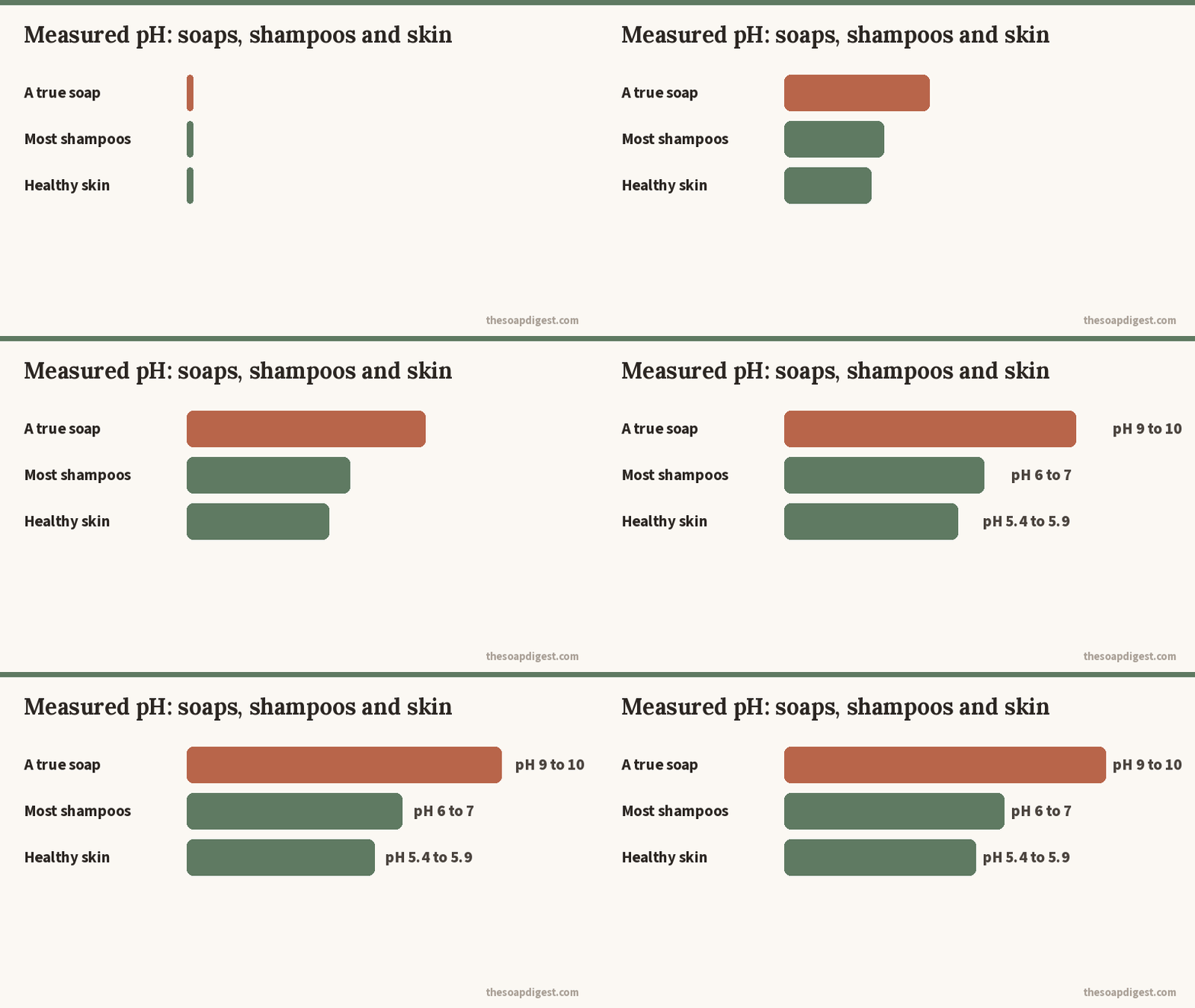
That gap is why hair washed with a soap bar can feel rough, tangle more and look dull, and why conditioner afterwards is not optional. It gets worse where the water is hard: soap and dissolved calcium form a residue on hair and skin that modern shampoo surfactants largely avoid, which we go into in whether hard water can cause body odour.
None of that is an injury. It is a texture problem, and the people most likely to hate it are those with long, curly, coily, bleached or colour-treated hair.
Why the scalp gets named first
The reasoning behind “start at the scalp” is sebum. 2-Nonenal is not made by bacteria; it forms when omega-7 unsaturated fatty acids already present in skin oil are broken down oxidatively, which is what Haze and colleagues showed in 2001 when they identified the compound and found it only in subjects aged 40 and over. If it comes out of skin oil, it should concentrate where oil glands are dense — scalp, hairline, behind the ears, the nape, the upper chest and back. We set that out in our guide to using the bar and in the research index.
Here is the part we should have been clearer about: that is an inference, not a measurement. The founding paper reports body odour and skin surface lipids without naming the site it sampled, and it does not report a scalp result. The reasoning is sound enough to act on. It has simply never been checked.
What has actually been measured up there
So we went looking for the check. Pairing 2-nonenal with scalp or hair in a title-and-abstract search returns eleven records, and we read all eleven. Ten of them are 4-hydroxy-2-nonenal, a different compound used as an oxidative-stress marker — and most of those are measuring it in the hair cells of the inner ear during hearing-loss and ototoxicity experiments. The eleventh is about cattle-derived aldehydes repelling biting midges.
That is a lesson about searching as much as about scalps: in indexed biomedical writing, “hair” usually means the sensory cells of the cochlea. It is also, net of the joke, a clean result. Nobody has measured this molecule on a human head.

What has been measured is stranger. In 2018, a group at an insect research centre in Buenos Aires collected the volatiles coming off human scalps by solid-phase microextraction and ran them through a gas chromatograph-mass spectrometer. Twenty-four compounds were identified, and the four main ones were nonanal, sulcatone, geranylacetone and palmitic acid. Their reason for doing it was head lice, which were attracted to the blend and to its major components individually. A companion paper the following year found lice in an arena preferred whole head odour to whole forearm or foot odour, though the isolated volatiles alone did not produce that preference in an olfactometer.
The published description of what a human scalp smells like, in other words, exists because lice are a public health problem — not because anyone selling scalp products commissioned it.
Nonanal is not 2-nonenal
This deserves its own warning, because the two names are nearly identical and one of them is in the scalp list.
Nonanal is a saturated nine-carbon aldehyde: C9H18O, molecular weight 142.24. 2-Nonenal is the unsaturated version: C9H16O, 140.22. One carbon-carbon double bond, two atomic mass units, and a different smell — we went through the published descriptions of the second one in what nonenal actually smells like.
If you see the scalp volatile list quoted somewhere as evidence that nonenal has been found on the scalp, that is the error being made. It has not.
Three studies, the same handful of compounds, and not the one on the label
Here is what makes the scalp list worth more than a curiosity. Put it beside two things already on this site.
The controlled soap study in elderly residents — fifty-four nursing-facility residents, three soaps, six weeks, blinded — recovered three volatiles from their T-shirts: 2-ethylbutanal, 6-methyl-5-hepten-2-one and geranylacetone. And the indoor-chemistry work in old person smell in a house found that ozone reacting with human skin oil on surfaces releases 6-methyl-5-hepten-2-one and leaves geranyl acetone behind.
Sulcatone is 6-methyl-5-hepten-2-one; two names for one molecule. So three separate lines of work — entomologists sampling scalps, a cosmetics company sampling T-shirts in a nursing home, atmospheric chemists sampling an occupied house — converge on the same small set of skin-lipid breakdown products, and 2-nonenal is absent from all three lists.
That is not proof it does not matter. The three used different methods, populations and purposes, and none set out to find it. But when the compound a product category is named after keeps not appearing in the measurements that were actually taken, a reader should know.
The scalp has glands that the simple two-smells model leaves out
This site leans on a tidy distinction: bacterial odour from apocrine glands in the armpits and groin, oil-borne odour from sebum on the scalp, neck, chest and back. It is a useful model and it is too tidy.
A 2025 review notes that apocrine glands in the scalp are poorly documented and that whether they are consistently present in a normal scalp “remains unclear”. The anatomy that matters: apocrine ducts drain into the hair follicle, mixing with follicular contents and sebum before anything reaches the surface. On the scalp, the two odour routes this site keeps separating are not separate — and the third possibility, a fungal one, lives in the same follicles.
No shampoo of any kind has been shown to reduce scalp odour
Before blaming the persimmon for the absence of evidence, it is worth seeing how empty the shelf is. Pairing shampoo with odour or odor in a title-and-abstract search returns twelve records, and we read all twelve. Not one tests a shampoo for making a human scalp smell better: the set runs from an in-vitro antifungal extract and two dog shampoos to head-lice preparations and a paper on how a herbal shampoo itself smells.
Persimmon does not even reach that shelf. The searches for persimmon with soap, and persimmon with shampoo, both return nothing at all.
The persimmon hair study someone will show you
There is one randomised controlled trial pairing persimmon with hair, and because a seller will eventually find it, it belongs here with its limits stated.
Eighty-eight people took a complex of persimmon leaf extract with green tea and sophora fruit, orally, twice a day for 24 weeks. Hair density and diameter rose significantly against placebo. It is a real trial with a real result, and it is four steps from the question on this page: the leaf rather than the fruit tannin, swallowed rather than rinsed off, combined with two other plants so the persimmon cannot be isolated, and measuring hair growth rather than smell. The same gap applies to the persimmon leaf and eczema papers set out in the side effects guide — different part of the plant, different route, mostly mice.
The pattern is consistent enough to name: where a plant polyphenol of this family has been studied on the human head at all, the outcome measured has been hair growth, not odour.
What readers are actually trying
Search suggestions for this problem are almost entirely descriptive — scalp smells like cheese, sour, musty, like yeast, and over and over, scalp smells even after washing, which we have since taken apart on its own in why a scalp smells even after washing. The threads match. One reader on r/bodyodor describes a strong scalp smell that comes back the moment any moisture reaches the hair:
“It smells like sweat and potatoes”
The same thread contains the constraint most washing advice ignores: that reader washes once a week, because anything more dries 4c hair out significantly. If the scalp really is the largest oil reservoir, then telling someone in that position to wash it daily with an alkaline bar is advice they cannot take — and we have given it.
A second thread is a 41-year-old with heavy scalp sweating and a mildew-like smell, considering cutting their hair very short to manage it. A commenter who had already done that reported back:
“it did make my wash day easier, but the odor still persists”

Another commenter there puts the anatomy plainly: the sweat glands are in the skin, not in the hair. That is the most useful sentence in either thread, and it cuts against a good deal of what gets recommended — including, in its own way, washing more aggressively.
The one positive persimmon account we have found is a reader who cross-posted to the seborrhoeic dermatitis and folliculitis communities describing a year of using a glycerin-based persimmon bar as shampoo, with a long-standing scalp problem mostly cleared. We have no reason to doubt it, and we would note what they said next: two dermatologists never gave them a firm diagnosis. An improvement does not identify a cause, and a glycerin-based bar is not a hard-pressed true soap.
If you are going to use a bar on your scalp
Nothing above says do not. It says know what you are doing and why.
- Wet the hair thoroughly first, then lather the bar in your hands rather than dragging it across your head.
- Work it in with fingertips, not nails, concentrating on the scalp rather than the lengths. The lengths get washed by what rinses through.
- Rinse longer than feels necessary, especially in hard water.
- Follow with conditioner. This is the step that offsets an alkaline wash, and it is the routine the one long-term user we found describes.
- Give it a fortnight, then judge honestly — and judge on a pillowcase or a collar rather than on your own nose, for the reasons in can you smell your own body odour.
- Stop if your scalp gets tight, flaky or itchy. That is not persistence paying off.
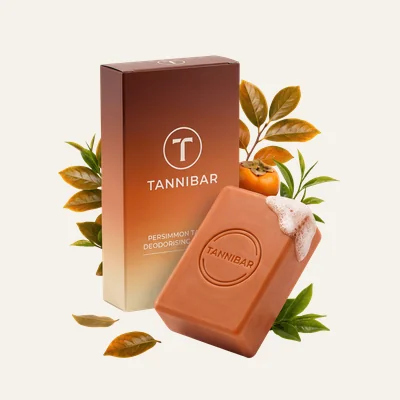
TanniBar Persimmon Tannin Bar
If you are going to try a tannin bar on your scalp, an unscented hard-pressed one with a published ingredient list is the sensible starting point — and ours is sold with a 30-day refund where you keep the bars, which means the experiment costs you a fortnight rather than money.
Check price →We own TanniBar and earn from sales. 30-day refund, no return needed.When to see a doctor
A smell is not the symptom that should send you to a GP; the scalp underneath it is.
The NHS advises seeing a GP if dandruff symptoms persist after at least four weeks of an anti-dandruff shampoo, if the dandruff is bad or the scalp very itchy, if the scalp is red or swollen, or if flaky itchy patches appear on your face or elsewhere. Its recommended self-care is a shampoo containing ketoconazole, coal tar or salicylic acid — and it is worth noting that the NHS dandruff page does not mention smell at all.
Separately, on body odour generally, the NHS says to see a GP if it has not improved after treating it yourself and it is affecting your self-esteem, you notice a change in how it usually smells, or you suddenly begin to sweat much more than usual. The same page lists conditions such as diabetes, kidney disease and liver disease, and medicines such as antidepressants, among the things that can make body odour worse. Pustules, scaling or hair loss alongside the smell are reasons to be seen rather than to keep shopping.
The bottom line
A persimmon tannin bar will wash your hair. It is a true soap at a pH three or four units above what shampoos are formulated to, so it will behave like one, and hard water and chemically treated hair will make that more obvious.
What it will not do is anything that has been demonstrated. No persimmon product has been tested on hair, on the scalp, or on human body odour, and the molecule the category is named after has never been measured on a human head.
Our own advice to start at the scalp is an inference from where the oil is. We still think it is a reasonable one — but it is an inference, and on a site that sells one of these bars, that distinction is ours to make clearly rather than quietly. If you want the full comparison of what is on the market, our best persimmon soap comparison is the place to start; if you want the honest version of what happens when it does not work, that is here.
Frequently asked questions
Can persimmon soap be used on hair?
Physically, yes — a persimmon tannin bar is an ordinary true soap and it will lather and clean hair. Whether it is a good idea depends on your hair rather than on the persimmon. In one measurement of market products, most bathing soaps fell at pH 9 to 10 while most shampoos fell at pH 6 to 7, against healthy skin at 5.4 to 5.9. That gap is why a soap bar can leave hair feeling rough, tangled or squeaky, and it is worse in hard water, where soap and dissolved calcium form a residue that shampoo surfactants do not. If you try it, follow with conditioner. There is no study of any persimmon product on hair, scalp or human body odour.
Is persimmon soap good for hair?
Nobody has tested that, so the honest answer is that it is unknown. No persimmon soap or shampoo of any kind has been tested on human body odour, and a title-and-abstract search pairing persimmon with either soap or shampoo returns nothing at all. What can be said is that a true soap is an alkaline cleanser and hair care has moved towards acidic ones for measurable reasons. People with dry, curly, coily, bleached or chemically treated hair are the most likely to dislike the result.
Is there a persimmon soap shampoo?
Brands do sell persimmon-scented or persimmon-extract shampoos, and readers also use glycerin-based persimmon bars as shampoo. None has been tested. Because there is no evidence either way, the choice between a bar and a bottle comes down to what you will actually use often enough to matter, and to what your hair tolerates. Frequency is the part people underestimate: if the scalp is the biggest oil reservoir and hair gets washed twice a week, washing the neck daily leaves most of that reservoir untouched.
Why does my scalp smell even after washing?
This is one of the most common things people search, and there is no single answer — but the interval before it returns narrows the list. The odour may be produced faster than you are washing it off, which is a frequency problem. It may not be coming from the hair at all — sweat and oil glands are in the skin, so cutting hair shorter changes drying time rather than production. Or there may be a scalp condition underneath it, since yeast-associated flaking and folliculitis both live there. We go through the timing in detail, with what has actually been measured, in our article on why a scalp smells even after washing (/scalp-smells-even-after-washing/). If it persists after four weeks of an anti-dandruff shampoo, or the scalp is red, very itchy or swollen, the NHS advice is to see a GP.
Will washing my hair with a soap bar damage it?
The evidence here is about pH rather than about damage in any dramatic sense. Measured market soaps sit around pH 9 to 10, well above both skin and the acidic range shampoos are formulated to. Higher pH raises the dehydrative effect on skin and alters its surface flora, which is why dermatology guidance has pushed towards lower-pH cleansers. For hair specifically, most people notice texture rather than injury: roughness, tangling and dullness, especially on long, curly, coily or colour-treated hair, and especially in hard water. Conditioner afterwards is the usual fix, and stopping is the other one.
Does persimmon soap help dandruff?
There is no evidence that it does, and dandruff has treatments that have been tested. The NHS advises an anti-dandruff shampoo containing ketoconazole, coal tar or salicylic acid, used for up to four weeks. Notably, the NHS dandruff page does not mention smell at all. A reader on Reddit has described a persimmon bar used as shampoo clearing a long-standing scalp problem, but they also said two dermatologists never gave them a firm diagnosis — and an undiagnosed complaint improving alongside one product change does not identify a cause.
Should I use conditioner after washing my hair with a soap bar?
If you are going to do it at all, yes. A conditioner is mildly acidic and its job is partly to counteract the roughness an alkaline wash leaves. The reader we found who has used a persimmon bar as shampoo for a year describes exactly this routine: massage in, leave briefly, rinse, then condition. That is not evidence that the soap works, but it is a sensible sequence, and it is the one we would suggest to anyone trying it.
Sources
- Galassi F.G., Fronza G., Toloza A.C., Picollo M.I., González-Audino P. (2018). Response of Pediculus humanus capitis (Phthiraptera: Pediculidae) to Volatiles of Whole and Individual Components of the Human Scalp. J Med Entomol 55(3):527-533. (The only published characterisation of human scalp odour we can find, and it comes from an insect laboratory. Volatiles were collected by solid-phase microextraction and analysed by gas chromatography-mass spectrometry: "Twenty-four volatile were identified in the human scalp odor, with the main compounds being the following: nonanal, sulcatone, geranylacetone, and palmitic acid." 2-Nonenal is not among the compounds named. The study's own purpose was host-finding by head lice, which were attracted to the blend and to its major components; nonanal was "repellent at high concentrations and an attractant at low concentrations".)
- Galassi F., Gonzalez-Audino P., Picollo M.I. (2019). Head Lice Recognize and Prefer Head Odor Over Foot and Forearms Odors. J Med Entomol 56(5):1204-1207. (Companion work from the same group. In a two-choice olfactometer the lice "did not show preference for the volatiles of head compared to the volatiles of other parts of the body (forearm or foot)", but in an experimental arena exposed to whole body-part odour "they showed a preferential response to the whole head odor". Cited for the narrow point that the head has an odour profile distinguishable at close range, which is a different claim from any human being able to smell it.)
- Tarun J., Susan J., Suria J., Susan V.J., Criton S. (2014). Evaluation of pH of Bathing Soaps and Shampoos for Skin and Hair Care. Indian J Dermatol 59(5):442-4. (Market samples of soaps and shampoos measured with a pH meter. "Majority of the soaps have a pH within the range of 9-10. Majority of the shampoos have a pH within the range of 6-7." The paper takes normal healthy skin as pH 5.4 to 5.9 and notes that "use of soap with high pH causes an increase in skin pH, which in turn causes an increase in dehydrative effect, irritability and alteration in bacterial flora", also recording that most products do not disclose their pH. A measurement of commercial products, not a trial of outcomes.)
- Haze S., Gozu Y., Nakamura S., Kohno Y., Sawano K., Ohta H., Yamazaki K. (2001). 2-Nonenal newly found in human body odor tends to increase with aging. J Invest Dermatol 116(4):520-4. (The founding paper for this odour. Headspace gas chromatography/mass spectrometry in subjects aged 26 to 75; 2-nonenal was "detected only in older subjects (40 y or older)", and correlated with omega-7 unsaturated fatty acids and lipid peroxides in skin surface lipids. The abstract reports body odour and skin surface lipids without naming a sampling site, and in particular does not report a scalp measurement. All authors were at Shiseido Co. Ltd., which later sold products aimed at this odour; company-affiliated research.)
- PubMed title-and-abstract search pairing 2-nonenal with scalp or hair, walked record by record on 11 November 2026. (Eleven results and not one concerns human scalp odour. Ten are 4-hydroxy-2-nonenal, a different compound used as an oxidative-stress marker, and most of those measure it in cochlear hair cells during noise-induced hearing loss and ototoxicity research — PMIDs 29513056, 29182629, 26771008, 25067875, 23948978, 23850665, 23382052, 21961007, 17109855 and 16202992. The eleventh, 35107692, is cattle-derived unsaturated aldehydes repelling biting midges. In indexed biomedical text, "hair" very often means the sensory cells of the inner ear.)
- PubMed title-and-abstract search pairing shampoo with odor or odour, walked record by record on 11 November 2026. (Twelve results, none of which tests any shampoo for reducing the smell of a human scalp. The set contains an in-vitro antifungal sisal-extract shampoo, a Danish Christmas-decoration dermatology study, migraine odour triggers, the organoleptic properties of a herbal shampoo — that is, how the shampoo itself smells — aloe hair-wash formulations, two canine pyoderma shampoos, two head-lice preparations, a vulvovaginal lactic acid paper, a scalp white piedra case report and a study of odour effects on product evaluation.)
- PubMed title-and-abstract search for persimmon with soap, re-verified 11 November 2026, and for persimmon with shampoo, run the same day. (Both return zero. Any paper about a persimmon soap or shampoo would be expected to carry both words in its title or abstract, so these are the cleanest available demonstrations that no such study is indexed. Note also that the phrase searches "scalp odor" and "scalp odour" return zero between them, which is a search-design artefact rather than a finding: the scalp volatile work described here is indexed without that phrase.)
- Ozeki C., Moro O. (2016). A study of the suppression of body odour in elderly subjects by anti-fungal agents. Int J Cosmet Sci 38(3):312-8. (Fifty-four elderly nursing-facility residents who needed bathing assistance used three body soaps over six weeks, two weeks each, with subjects and examiners blinded to sample versus control. Less unpleasant neck and underarm odour was reported with the soap containing miconazole nitrate. The volatile compounds recovered from the residents' T-shirts were 2-ethylbutanal, 6-methyl-5-hepten-2-one and geranylacetone; 2-nonenal is not among them. Both authors were at Mochida Healthcare Co., Ltd.; company-affiliated research, and a single study.)
- Torres F.N., Donda A.L.V., Melo D.F. (2025). Scalp Apocrine Glands: The Neglected Component of the Hair Follicle Complex. Skin Appendage Disord. (A review, not new measurement. "In humans, apocrine glands are generally associated with chemical signaling and body odor. Their presence in the scalp is poorly documented", and whether they are consistently present in the normal scalp "remains unclear". The anatomical detail that matters for odour is that "the openings of apocrine ducts drain into the hair follicle, mixing with follicular contents and sebum before reaching the skin's surface".)
- Ham S., Lee Y.I., Kim I.A., Suk J., Jung I., Jeong J.M., Lee J.H. (2023). Efficacy and safety of persimmon leaf formulated with green tea and sophora fruit extracts (BLH308) on hair growth: A randomized, double-blind, placebo-controlled clinical trial. Skin Res Technol 29(9):e13448. (The one randomised controlled trial linking persimmon to hair, and it answers a different question. Eighty-eight participants with a mean age of about 38 took the BLH308 complex or placebo orally twice a day for 24 weeks. "The test group showed significantly increased hair density and hair diameter at week 24 compared with the placebo group (p = 0.0015 and p = 0.0001, respectively)"; the gloss difference was not significant. Four separations from the question on this page: it is the leaf rather than the fruit tannin, it was swallowed rather than rinsed, it was combined with green tea and sophora fruit so the persimmon cannot be isolated, and the outcome was hair growth, not odour.)
- Takahashi T., Kamimura A., Hamazono-Matsuoka T., Honda S. (2005). Investigation of the topical application of procyanidin oligomers from apples to identify their potential use as a hair-growing agent. J Cosmet Dermatol. (Included to show the pattern rather than as evidence for anything here: where a plant polyphenol of the tannin family has been studied on the human head, the outcome measured has been hair growth. Cited alongside the persimmon leaf trial because the two together are what a search for "persimmon and hair" or "tannin and hair" actually returns.)
- PubChem compound summaries for nonanal (CID 31289) and 2-nonenal (CID 5283335), via PUG REST, 11 November 2026. (Nonanal: molecular formula C9H18O, molecular weight 142.24, XLogP 3.3. 2-Nonenal: C9H16O, 140.22, XLogP 3.1. Two nine-carbon aldehydes separated by a single carbon-carbon double bond. Nonanal is one of the four main compounds reported in human scalp odour; 2-nonenal is the one this product category is built around. They are not the same molecule and the names are easy to confuse.)
- NHS. Dandruff (accessed 11 November 2026). ("Dandruff is a common skin condition. It's not harmful and you cannot catch it", and it "is not caused by poor hygiene, although it may be more obvious if you do not wash your hair regularly". Self-care is an anti-dandruff shampoo containing ketoconazole, coal tar or salicylic acid, used for up to four weeks. See a GP if symptoms persist after at least four weeks of anti-dandruff shampoo, if the dandruff is bad or the scalp very itchy, if the scalp is red or swollen, or if there are flaky itchy patches elsewhere. The page does not mention smell or odour anywhere.)
- NHS. Body odour (BO) (accessed 11 November 2026). ("See a GP if" body odour has not improved after treating it yourself and "it's affecting your self-esteem", "you notice a change in how it usually smells" or "you suddenly begin to sweat much more than usual". Things that can make body odour worse are listed as exercise, hot weather, hormonal changes, being overweight, "having a condition like diabetes, kidney disease or liver disease" and "certain types of medicine, such as antidepressants".)
- TanniBar product page (checked 11 November 2026). (Our own product, and the source of every TanniBar fact on this page. Described as "100% fragrance-free" and "triple-milled to last a month of daily showers". Ingredients listed as persimmon tannin, green tea leaf extract, vegetable glycerin, shea butter, saponified coconut and palm oil, vitamin E and water — saponified oils make it a true soap, and therefore alkaline. The page carries a 30-day money-back guarantee with nothing to post back, free worldwide shipping in plain packaging, and the cautions that it "is a cosmetic product, not a medicine", that anyone with an active skin condition should check with a doctor first, and that sudden changes in body odour warrant a healthcare professional. No bar weight and no pH figure are published, and the bundle prices did not load on this check.)
- r/bodyodor: "Weird scalp smell" (7 entries, read 11 November 2026). (The poster describes a strong scalp odour that returns whenever moisture reaches the hair, including straight after washing, and a different sweet, yeasty note when the hair is unwashed. Source of the first quoted fragment. A later comment records washing once a week because more often dries 4c hair out significantly — the wash-frequency constraint this article discusses.)
- r/bodyodor: a reader considering cutting their hair very short to reduce a musty scalp odour (7 entries, read 11 November 2026). (A 41-year-old describing excessive scalp sweating and a mildew-like smell that sometimes persists after washing, asking whether a much shorter cut would help. Source of the second quoted fragment, from a commenter who had already done exactly that. Another commenter makes the anatomical point this article also makes, that the sweat glands are in the skin rather than in the hair. The thread contains personal medical discussion, which is not reproduced or interpreted here.)
- r/SebDerm and r/Folliculitis: the same reader cross-posting about using a glycerin-based persimmon bar as shampoo (read 11 November 2026; cited, not quoted). (A year of using a persimmon bar as a shampoo, described as improving a dry, irritated scalp and mostly clearing a scalp folliculitis after years of other products. In a follow-up comment the poster says two dermatologists never gave them a firm diagnosis. The routine they describe — massage in, leave briefly, rinse, then condition — is the one this article suggests to anyone trying it. The companion thread is at reddit.com/r/Folliculitis/comments/1xdz8m2/.)