Home › Nonenal & Body Odor › Scalp smells after washing
Nonenal & Body OdorScalp Smells Even After Washing: What the Clock Tells You
Search suggestions for this problem are almost all about timing — even after washing, after one day, after two days. That is more informative than it looks. Oil, bacteria and the hair fibre come back on three different clocks, and the hour the smell returns tells you which one you are dealing with.

Disclosure: The Soap Digest is owned by the same company that makes TanniBar. We rank it first and we earn money when you buy it. Every other brand here is linked without payment, and we try to describe each one fairly. Check the facts for yourself. How we handle this.
In this guide
- The question underneath the question is how long
- Two hours is roughly how long a measured wash lasts
- What the grease on day two is actually telling you
- The smell that is there while the hair is still wet
- A harsher wash is not a shorter clock
- Nineteen studies of what shampoo does to a scalp, and none of them smelled anything
- When the clock is not the explanation
- What to change, in the order worth trying
- What a bar of soap can and cannot do about the clock
- The bottom line
Search suggestions for this problem are unusually consistent. Type why does my scalp smell and the completions arrive in a rush — bad, like cheese, sour, like mildew, like yeast — and then, over and over, the same complaint in different clothes: even after washing, after one day, after 2 days, right after washing. Six separate stems return a version of it.
What people describe is rarely the smell itself. It is the clock, and that is the most useful thing in the question. Even after washing is a statement about timing rather than cleanliness, and the hour at which the smell comes back points somewhere different each time.
The short version
- Three things return on three clocks. Measured on the face, skin oil was back to baseline two hours after a wash. Skin bacteria return immediately. The hair fibre keeps what it was last exposed to until something removes it.
- A smell present while the hair is still wet is not regrowth. The candidates then are what the wash left behind and what the fibre already carried.
- Across forty-two shampoo formulations tested on an artificial soil, cleansing efficacy ranged from 5% to 100%.
- Nobody has measured scalp odour as an outcome. We read nineteen studies of what shampoos do to the scalp microbiome. All measured flaking, itch, sebum or bacteria. None measured smell.
- Flaking, itch, redness or swelling alongside the smell is where you stop experimenting and follow the dandruff route, then see a GP.
The question underneath the question is how long
Group the search suggestions by interval and they sort into four piles: right after washing, back within hours, back after one day, back after two days. Readers do the same unprompted. One poster this week sets out the whole history as a shrinking interval:
“It used to be that it'd get greasy about 8 hours after washing”
Then sooner, they write, and now it dries greasy — despite applying shampoo straight to the scalp, rinsing for minutes and sometimes washing twice. The thread offers the standard advice all at once: double shampoo, clarifying products, a shower filter, blow-dry the roots, keep conditioner off the scalp, try ketoconazole. None of it is unreasonable, but it reaches someone who has not yet established which clock they are on, and the things a wash removes return at different rates.
Two hours is roughly how long a measured wash lasts
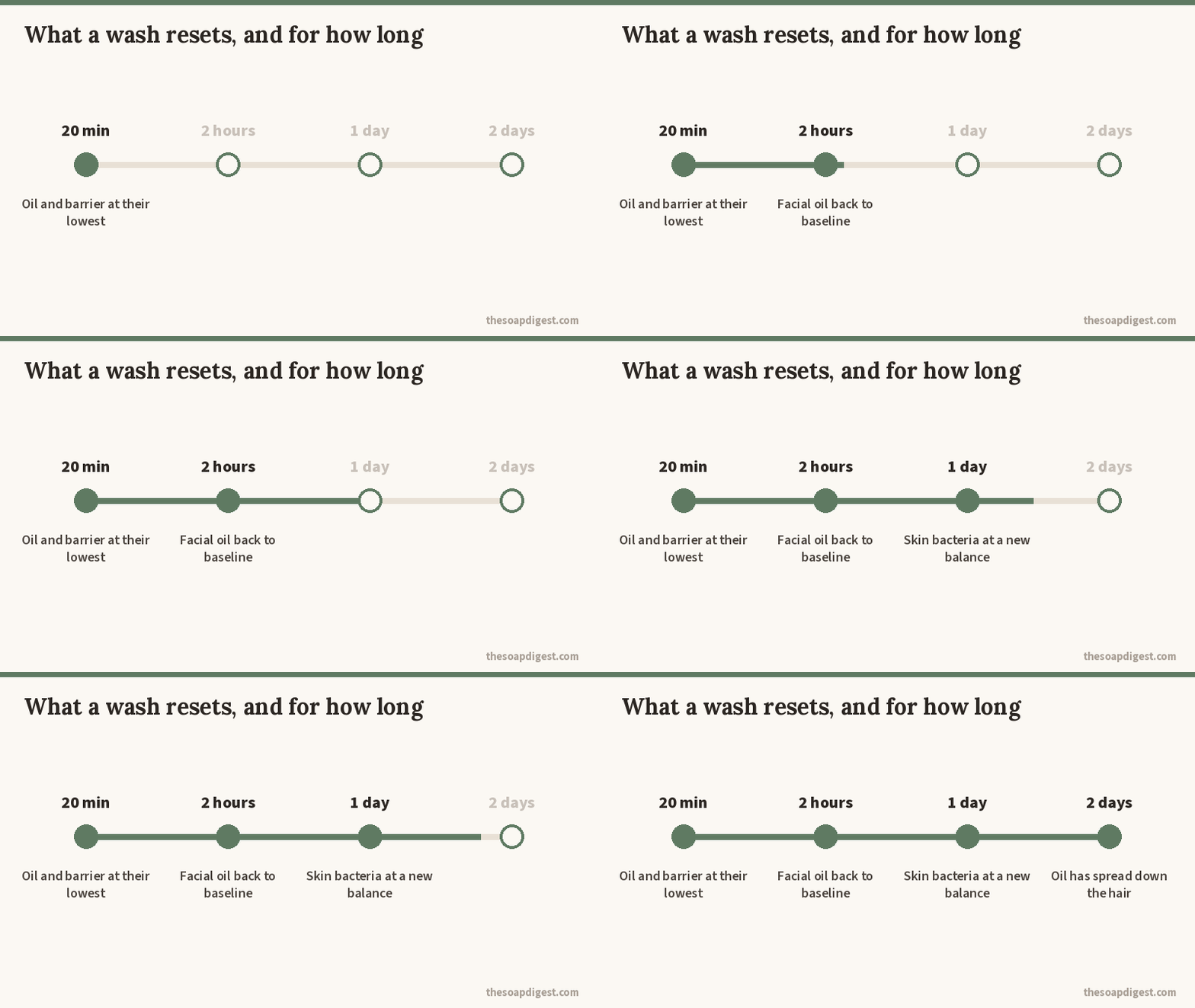
The best timing data we can find was not collected on scalps. Twenty-two Korean women were measured for three hours after washing with a facial cleanser: hydration, sebum and transepidermal water loss were all significantly reduced twenty minutes afterwards, hydration returned at forty minutes, and sebum and water loss at a hundred and twenty.
Two hours. That is the face rather than the scalp, a mild cleanser rather than an alkaline bar, and oil rather than smell — but it is a real number, and much shorter than people assume.
Bacteria are faster. Comparing surgical antisepsis protocols before orthopaedic operations, thirty healthy volunteers were swabbed every thirty minutes after a preoperative shower and full antiseptic preparation; mean load rose significantly under every protocol across ninety minutes. The organisms present at the start were ordinary commensals — coagulase-negative staphylococci, micrococci and coryneforms, the genera body-odour research keeps returning to.

Over days the pattern holds: when thirty women used a body wash twice daily for a week, the microbial shift on their forearms appeared within an hour and settled into a new equilibrium by day one. A wash is a reset rather than a residual — the same conclusion we reached about hypochlorous acid sprays, and not a criticism of any product.
What the grease on day two is actually telling you
The most repeated belief in this subject is that washing more makes the scalp produce more oil. A reader posting today puts it as most people have heard it:
“washing too much might make your scalp pump out even more oil”
That claim has not been tested in the way people mean, so we cannot tell you it is wrong. What has been measured is more interesting. A hundred and twenty-three men were sorted into two groups by whether they considered their own scalp greasy, and their hair was sampled with polymer films along the shaft after shampooing. Regreasing progressed linearly in both groups, and the groups differed roughly two-fold in total spread sebum — but at forty-eight hours the sebum at the root was comparable. What differed was how far the oil had travelled down the hair.
That relocates the complaint. Someone whose scalp is greasy on day two may be describing their hair rather than their skin, and identical gland output looks different on long fine hair than on short or coiled hair. It is a manufacturer’s method paper in one age group in one country, so it settles nothing about frequency — but it does suggest “my scalp produces more oil than other people’s” is harder to establish than it feels.
Oxidation follows the oil. In people with high scalp sebum, the scalp carried more oil, less water and a weaker barrier than the frontal hairline or the nape, and a marker of lipid oxidation tracked the sebum level and self-reported flaking and itch. That marker is not 2-nonenal and no smell was recorded, but oxidised sebum is the right neighbourhood.
The smell that is there while the hair is still wet
A smell present before the hair has dried is a different problem, because nothing has had time to regrow. Two candidates remain: what the wash failed to remove, and what the fibre already held. The first is measurable, and the spread is striking. Forty-two shampoo formulations were tested against an artificial soil of sebum mixed with carbon black. Cleansing efficacy ranged from five per cent for a deliberately bland product to a hundred per cent for a deep-cleansing one; on hair swatches, removal of the same deposit ran from forty to eighty per cent. The endpoint was colour rather than smell, in an industry model — but it is direct evidence that “I washed it” and “it is clean” are not the same statement.
The second candidate has no literature at all. The wet-hair smell readers describe constantly, which search suggestions return as scalp smells like wet dog, appears never to have been studied in people: pairing wet hair with odour, microbial or bacterial terms in titles and abstracts returns three records, and they are a cow, a macaque and a literary essay about meningitis.

So drying matters more than it sounds. Thick or coiled hair stays damp for hours and a towel around it longer still, and changing that is cheaper than changing shampoo. It is also one of the points where the answer depends on hair that cannot simply be washed daily, which we go into in our piece on using a persimmon bar on hair.
A harsher wash is not a shorter clock
The usual next move is a stronger product, on the theory that an alkaline or clarifying wash holds the smell off for longer. We would be cautious, because we hold the counter-example: the only trial we know of that measured skin pH and self-perceived odour in the same volunteers found the two moving in opposite directions. A mechanism is not an outcome, including when we describe it. What survives is narrower — in hard water, soap and dissolved calcium leave a residue ordinary surfactants do not, a rinsing problem rather than a production one, with its own article here on hard water and body odour.
Nineteen studies of what shampoo does to a scalp, and none of them smelled anything
It would be easy to assume nobody has looked at the scalp. The opposite is true, and the shape of the gap is the point.
Pairing scalp, microbiome and shampoo in titles and abstracts returns nineteen records, and we read all nineteen: selenium sulfide, piroctone olamine, zinc pyrithione, ketoconazole, a plant-extract formulation and a paraprobiotic one, several randomised and controlled. The outcomes are dandruff severity, flaking, itch, seborrhoeic dermatitis signs, sebum quality and microbiome composition. Not one recorded whether anything smelled different, and a separate search pairing shampoo with odour returns twelve records, none testing a shampoo for the smell of a human scalp. The phrases scalp odor and scalp odour return nothing at all, re-checked today, and the only published description of what a human scalp smells like that we can find came out of an entomology laboratory studying head lice.
The honest position is not that shampoos fail at this. The question has never been put to them — and that applies to products we sell as much as to anyone else’s.
When the clock is not the explanation
Sometimes the interval is beside the point, because something is on the scalp rather than arriving on it. A commenter in one of today’s threads recommends ketoconazole shampoo unprompted; another replies that it made their own oiliness worse. That is roughly the state of the lay evidence. The useful signal is not the smell but what comes with it.
When to stop experimenting
NHS advice for dandruff is an anti-dandruff shampoo containing ketoconazole, coal tar or salicylic acid, used for up to four weeks, trying more than one product if needed. See a GP if it is still there after at least four weeks, if the dandruff is severe or the scalp very itchy, if the scalp is red or swollen, or if flaky itchy patches appear on the face or elsewhere. The NHS dandruff page does not mention smell at all, so a smell on its own is not a diagnosis of anything.
For body odour generally, the NHS says to see a GP if it has not improved after treating it yourself and it is affecting your self-esteem, you notice a change in how it usually smells, or you suddenly begin to sweat much more than usual. The same page names diabetes, kidney disease, liver disease and medicines such as antidepressants among things that can make it worse.
Whether a fungal problem produces a smell at all has a surprisingly thin evidence base, which we have gone through in can a fungal infection cause body odour.
One caution about the clock itself. The scalp is the only odour source permanently a few inches from your own nostrils, smell adapts to constant exposure on a measured curve, and you are most sensitive the moment something changes. Part of the hour you record belongs to your nose rather than your head, which is the territory of whether you can smell your own body odour — and search suggestions carry scalp odor perimenopause, where a changed sense of smell is itself documented.
What to change, in the order worth trying
- Time it for a week. Note the hour the smell returns after each wash. Present while the hair is wet, skip to step three. Hours, and the clock is behaving normally, so the question is frequency. Two days, and you are inside the range the regreasing data describes.
- Check the wash reaches skin. Shampoo applied to hair is not shampoo applied to a scalp. Work it in with the pads of the fingers and leave it a minute before rinsing.
- Rinse longer, and wash twice when the first lather is thin. The most repeated advice from people who have solved it.
- Dry the roots rather than leaving hair damp under a towel.
- If your water is hard, try a chelating or clarifying wash before changing anything else.
- If there is flaking, itch or redness, switch to the four-week anti-dandruff route above.
- If nothing changes, see a GP. A persistent scalp smell with no visible cause is reasonable to raise.
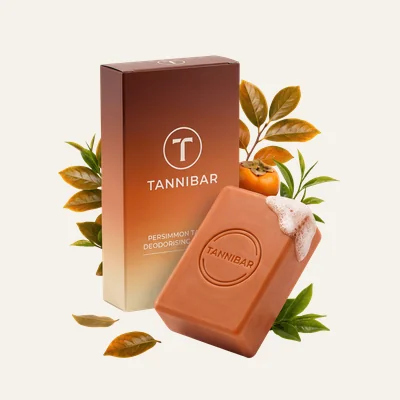
TanniBar Persimmon Tannin Bar
A fragrance-free, rinse-off bar is the sensible starting point for age-related body odour precisely because it adds nothing that has to be smelled through.
Check price →We own TanniBar and earn from sales. 30-day refund, no return needed.What a bar of soap can and cannot do about the clock
Full disclosure, as on every page here: this site and TanniBar share an owner, so treat the next paragraph as a manufacturer talking about its own product.
Checked today, the TanniBar page describes a fragrance-free, triple-milled true soap of persimmon tannin, green tea, glycerin, shea butter, saponified coconut and palm oil, vitamin E and water, with a 30-day refund and nothing to post back. It also says most people see a clear change between day 10 and day 21 of daily use — a company statement rather than a trial result, and we would say the same of any competitor making it.
Here is what it cannot do. A rinse-off soap removes what is on the skin when you use it. Nothing above suggests that any wash — ours, a medicated shampoo, or a bar costing four times as much — slows the rate at which skin refills with oil or bacteria. The clock restarts; it does not run slower. The page says nothing about hair or scalp use, and we will not invent a claim for it. For the category, our best persimmon soap comparison ranks the five bars whose ingredients and prices we can verify, with ours first — exactly the conflict the disclosure exists to flag.
The bottom line
The phrase that brings most people here describes a schedule, not a failure of hygiene. Oil returns in about two hours where it has been measured, bacteria begin returning immediately, and the hair fibre keeps what it was given until something takes it away. Write down the hour, change one thing, and watch whether the interval moves. If flaking, itch or redness come with it, stop the experiment and use the four-week route.
And treat confident claims about scalp odour, product marketing included, with the scepticism the evidence deserves. Nineteen studies measured what shampoos do to a scalp. Not one measured the thing you are asking about.
Frequently asked questions
Why does my scalp smell even after washing?
Because washing removes what is there now, not what produces it. Three things come back on three different clocks. Skin oil, measured on the face after a cleanser, was significantly reduced at twenty minutes and back to baseline at two hours. Skin bacteria begin recolonising immediately — even after full surgical antisepsis, mean bacterial load rose significantly over ninety minutes in healthy volunteers. And the hair fibre itself holds whatever it was last exposed to. The interval before the smell returns is the most useful thing you can record, because it separates these.
How long should hair stay smelling clean after washing?
Nobody has published a figure for the scalp, so there is no normal to compare yourself to. What has been measured is the oil. In a study of 123 men, hair regreasing after a shampoo progressed linearly with time, and at forty-eight hours the amount of sebum at the root region was comparable between men who considered their scalp greasy and men who did not. What differed was how far the oil had spread down the hair shaft. So two days of oil at the root is ordinary; the perception of greasiness is partly about the length of hair, not just the skin.
Why does my scalp smell straight after washing, while the hair is still wet?
At that point almost nothing has had time to regrow, so the likely explanations are what the wash left behind and what the hair was already carrying. Shampoos differ enormously in how much they actually remove: in one industry study of forty-two formulations, cleansing efficacy on an artificial sebum-and-carbon soil ranged from five per cent for a bland shampoo to one hundred per cent for a deep-cleansing one, and on hair swatches the range was forty to eighty per cent. Worth noting that the wet-hair smell people describe has no published literature at all — a search pairing wet hair with odour or microbes returns three records, none of them about human hair.
Does washing your hair more often make your scalp produce more oil?
This belief is repeated constantly and it has not been tested directly in the way people mean. The nearest evidence does not support it: in the regreasing study above, men who perceived their own scalps as greasy and men who did not had comparable sebum at the root forty-eight hours after shampooing. That is not a trial of wash frequency, so it does not settle the question. What is measured is that a single shampoo wash significantly reduces both surface and pore sebum on an oily scalp, and that the reduction does not last.
Can a smelly scalp be seborrheic dermatitis or a fungal problem?
It can, and that is the point at which this stops being a washing question. Flaking, itch, redness or swelling alongside the smell are the signs worth acting on. NHS advice for dandruff is an anti-dandruff shampoo containing ketoconazole, coal tar or salicylic acid, used for up to four weeks, and a GP appointment if the scalp is still bad after that, if it is very itchy, red or swollen, or if flaky itchy patches appear elsewhere. Notably, the NHS dandruff page does not mention smell anywhere, so a smell on its own is not a diagnosis of anything.
Does any shampoo treat scalp odour?
No shampoo has been shown to, because the outcome has barely been measured. There is a substantial literature on what shampoos do to a scalp — we read nineteen studies pairing scalp, microbiome and shampoo, covering selenium disulfide, piroctone olamine, zinc pyrithione, ketoconazole and probiotic formulations. Every one of them measured flaking, itch, microbiome composition or sebum. Not one measured smell. Pairing shampoo with odour in a separate search returns twelve records and none tests a shampoo for reducing human scalp odour.
Could the smell be in my nose rather than on my head?
Partly, and this is more relevant for the scalp than for anywhere else, because it is the only odour source that sits permanently a few inches from your own nostrils. The sense of smell adapts to a constant stimulus over time, and the time course of that self-adaptation has been measured as roughly exponential for some odorants. That means you are least adapted at the moment something changes — stepping out of the shower, coming back indoors — which is exactly when people report noticing it. It does not mean the smell is imaginary. It means the hour you notice it is partly about your nose.
Sources
- Eo J., Seo Y.K., Baek J.H., Choi A.R., Shin M.K., Koh J.S. (2016). Facial skin physiology recovery kinetics during 180 min post-washing with a cleanser. Skin Res Technol 22(2):148-51. (Twenty-two Korean women, normal to oily skin, measured with a Corneometer, Sebumeter, Tewameter and pH meter at intervals for three hours after washing. "Skin hydration, sebum, and TEWL were significantly decreased at 20 min after washing, as compared to the baseline (P < 0.05). And skin hydration returned at 40 min, and skin sebum and TEWL returned at 120 min after washing. However, skin pH did not show significant differences at all times points." Bounds: this is the face, not the scalp, and a facial cleanser, not an alkaline bar; it measures oil, water loss and pH, not smell.)
- Gao J., Liu C., Zhang S., Techer M.P., Bouabbache S., Pouradier F., Panhard S. (2019). Revisiting, in vivo, the hair regreasing process by the Sebuprint method. Skin Res Technol 25(1):79-87. (One hundred and twenty-three Chinese men aged 18 to 35, in two cohorts with opposite self-perceptions of their own scalp greasiness. "Hair regreasing process was found sharing a same linear progression with time. The two cohorts of men presented significantly different values in the total amount of spread sebum by an approximately two-fold coefficient, with however comparable average values in the sebum amount present at the root region 48 hours post shampoo. At such timing, the spread of sebum reaches much longer distances in the greasy scalp cohort." All authors were at L'Oreal Research & Innovation; company-affiliated research, and a method-development paper rather than a trial.)
- Chen K., Lau H., Xu S., Yu A., Wang S., Biehle S., Gemmer C., Zhang C., Li R. (2026). Physiological Characteristics of Scalp Skin With High Sebum Production and the Impacts of Shampoo Cleansing. Skin Res Technol 32(8):e70376. (An Asian population with self-reported scalp oiliness and dandruff and sebum above 75 micrograms per square centimetre. "At baseline, the scalp exhibited higher sebum levels, lower hydration and weaker barrier function compared to the frontal hairline and nape." The oxidative-stress marker HODE correlated positively with scalp sebum and with self-reported dandruff and itchiness, and a single wash with a shampoo containing 0.5% piroctone olamine significantly reduced surface sebum, pore sebum and HODE. All authors were at Procter & Gamble; company-affiliated research. HODE is a linoleic acid oxidation product and is not 2-nonenal, and no odour was measured.)
- Sfriso R., Claypool J. (2020). Microbial Reference Frames Reveal Distinct Shifts in the Skin Microbiota after Cleansing. Microorganisms 8(11):1634. (Thirty women applied a liquid body wash twice daily for a week to the volar forearms "in order to mimic frequent showering", with 16S rRNA sequencing of swabs at set timepoints. "The microbial shift was quite immediate, and we could observe it already at 1 h post cleansing. Interestingly, the new microbial composition reached a certain dynamic equilibrium at day 1 which was then maintained until the end of the study." Both authors were at DSM Nutritional Products, Personal Care; company-affiliated research. The forearm is not the scalp, and composition is not smell.)
- Rouquette L., Traore O., Descamps S., Boisgard S., Villatte G., Erivan R. (2020). Bacterial skin recolonization in the operating room: comparison between various antisepsis protocols. J Hosp Infect 106(1):57-64. (Thirty healthy volunteers, randomised between surgical antisepsis protocols after a preoperative shower, swabbed at thirty-minute intervals up to ninety minutes after draping. "Mean load increased significantly under all protocols up to T90 min, without significant superiority for any one protocol." The organisms present at baseline were "predominantly healthy skin commensals: coagulase-negative staphylococci, micrococci, and coryneforms". Bounds, and they matter: this is hospital-grade antisepsis before orthopaedic surgery, measured as colony counts. Nobody smelled anything. It is cited only for the rate at which ordinary skin bacteria return.)
- Galliano A., Ye C., Su F., Wang C., Rakshit R., Guerin M., Flament F., Steel A. (2023). Assessing the effect of cleansing products on artificially polluted human hairs and skin through in vivo and in vitro models. Skin Res Technol 29(1):e13220. (An artificial soil of sebum mixed with carbon black, called "sebollution", applied to scalp, forearm and hair swatches, with cleansing efficacy read as a colour measurement. Across forty-two shampoo formulations the calculated cleanabilities "covered a large range of efficacy, from 5%, for a basic bland shampoo generally used to reset swatches, to a strong deep cleansing efficacy of 100%". On hair swatches, removal of the deposit ran "in a range of 40%-80%". Separately, the coverage of carbon particles deposited on hair after forty-five different products ranged from 2% to 16%, depending on product category. All authors were at L'Oreal Research and Innovation; company-affiliated research, and the endpoint is colour, not odour.)
- PubMed title-and-abstract search pairing scalp, microbiome and shampoo, walked record by record on 13 November 2026. (Nineteen records, and the set is substantial and recent: selenium sulfide and selenium disulfide shampoos, piroctone olamine, zinc pyrithione, ketoconazole, ampamide, senkyunolide, herbal and paraprobiotic formulations, and a body-site comparison of the healthy skin microbiome. The measured outcomes are dandruff severity, flaking, itch, seborrhoeic dermatitis signs, sebum quality and 16S microbiome composition. Not one of the nineteen measured odour. The industry interest in the scalp is real and well funded; the smell is simply not an endpoint anybody collects.)
- Clavaud C., Michelin C., Pourhamidi S., et al. (2023). Selenium disulfide: a key ingredient to rebalance the scalp microbiome and sebum quality in the management of dandruff. Eur J Dermatol 33(S1):5-12. (Cited as a representative member of the set above. Two single-centre studies of the mode of action of a selenium disulfide shampoo during treatment and relapse, assessing dandruff severity, subjective efficacy perception, microbial balance, microbiota diversity and sebum. All authors were at L'Oreal Research & Innovation; company-affiliated research. Smell is not among the outcomes.)
- PubMed title-and-abstract search pairing wet hair with odour, odor, microbial or bacterial terms, walked on 13 November 2026. (Three records, and none of them concerns human hair: a crossbred Holstein Friesian cow with sweating-sickness-like symptoms, computed tomographic urography in a rhesus macaque, and a literary essay on meningitis in Russian cultural belief. The wet-hair smell that readers describe constantly, and that search suggestions return as "scalp smells like wet dog", has no published literature we can find. Related nulls run the same day: "hair fiber" paired with odour, odor or volatiles returns zero; damp or moisture paired with towels and odour returns zero.)
- PubMed phrase searches for "scalp odor" and "scalp odour", and a title-and-abstract search pairing persimmon with soap, all re-verified 13 November 2026. (Both return zero. The scalp-odour nulls are partly a search-design artefact, since the volatile work that does exist is indexed without that phrase — but they are accurate about the phrase, and they are the reason this article hedges every statement about what is known. Hair washing paired with odour returns one record, a formulation paper about an aloe-based hair wash; shampoo paired with malodour returns two, a fragrance toxicity study and a gynaecological case report.)
- Galassi F.G., Fronza G., Toloza A.C., Picollo M.I., Gonzalez-Audino P. (2018). Response of Pediculus humanus capitis (Phthiraptera: Pediculidae) to Volatiles of Whole and Individual Components of the Human Scalp. J Med Entomol 55(3):527-533. (The only published characterisation of human scalp odour we have found, and it comes from an entomology laboratory studying head lice. Solid-phase microextraction with gas chromatography-mass spectrometry: "Twenty-four volatile were identified in the human scalp odor, with the main compounds being the following: nonanal, sulcatone, geranylacetone, and palmitic acid." 2-Nonenal is not among them. Discussed at greater length in our article on persimmon soap for hair.)
- Agren M.S., Ghathian K.S.A., Frederiksen A.K.S., et al. (2020). Zinc Oxide Inhibits Axillary Colonization by Members of the Genus Corynebacterium and Attenuates Self-perceived Malodour: A Randomized, Double-blind, Placebo-controlled Trial. Acta Derm Venereol. (Cited here as a caution rather than as support. It remains the only trial we know of that measured skin pH and self-reported odour in the same volunteers, and the two did not move together. A pH argument is therefore not automatically an odour argument, including when we make one.)
- Berglund B., Berglund U., Lindvall T. (1978). Olfactory self- and cross-adaptation: effects of time of adaptation on perceived odor intensity. Sens Processes 2(3):191-7. (Perceived intensity of three odorants measured as a function of the number of inhalations. "The results show that the time-course function for self-adaptation seems to be an exponential function for two of the substances (H2S, DMDS), while for the third (pyridine) the form of the function is less distinct." An old laboratory study with named single compounds, not body odour, cited only for the shape of the adaptation curve.)
- Dalton P. (2000). Psychophysical and behavioral characteristics of olfactory adaptation. Chem Senses 25(4):487-92. (A review of why continuous exposure reduces perceived intensity, and why a person is a poor judge of an odour they live inside. The basis of our separate article on whether you can smell your own body odour.)
- Shahtalebi M.A., Ghanadian M., Farzan A., Shiri N., Shokri D., Fatemi S.A. (2013). Deodorant effects of a sage extract stick: Antibacterial activity and sensory evaluation of axillary deodorancy. J Res Med Sci 18(10):833-9. (Cited for its method rather than its product. Deodorancy was assessed with ASTM method E 1207-87, a standard sensory practice that takes readings "before, and two hours, four hours, and eight hours after single application". The industry's own standard for testing whether something stops a smell is built around a clock, which is the argument this article makes. Forty-five female volunteers, mean age 61.5; a single-centre trial of a sage extract, not of anything discussed here, and its introduction makes claims about other deodorant ingredients that we do not repeat.)
- Haze S., Gozu Y., Nakamura S., Kohno Y., Sawano K., Ohta H., Yamazaki K. (2001). 2-Nonenal newly found in human body odor tends to increase with aging. J Invest Dermatol 116(4):520-4. (The founding paper for age-related body odour, included because this article touches the subject. 2-Nonenal was "detected only in older subjects (40 y or older)" and correlated with omega-7 unsaturated fatty acids and lipid peroxides in skin surface lipids. All authors were at Shiseido Co. Ltd.; company-affiliated research. No scalp measurement is reported.)
- Perez Perez G.I., Gao Z., Jourdain R., et al. (2016). Body Site Is a More Determinant Factor than Human Population Diversity in the Healthy Skin Microbiome. PLoS One. (Cited for the single point that skin communities differ more between body sites on one person than between people at the same site, which is why forearm and armpit findings are quoted here with explicit limits rather than transferred to the scalp.)
- NHS. Dandruff (accessed 13 November 2026). (Self-care is an anti-dandruff shampoo containing ketoconazole, coal tar or salicylic acid, used for up to four weeks, and more than one product may need to be tried. See a GP if symptoms persist after at least four weeks of anti-dandruff shampoo, if the dandruff is severe or the scalp very itchy, if the scalp is red or swollen, or if "you have flaky, itchy patches on your face or other parts of your body". Re-checked today: the page does not mention smell or odour anywhere.)
- NHS. Body odour (BO) (accessed 13 November 2026). ("See a GP if" body odour has not improved after treating it yourself and "it's affecting your self-esteem", "you notice a change in how it usually smells" or "you suddenly begin to sweat much more than usual". The page also lists "having a condition like diabetes, kidney disease or liver disease" and "certain types of medicine, such as antidepressants" among the things that can make body odour worse.)
- TanniBar product page (checked 13 November 2026). (Our own product, and the source of every TanniBar fact on this page. Described as "100% fragrance-free" and "triple-milled to last a month of daily showers", with ingredients listed as persimmon tannin, green tea leaf extract, vegetable glycerin, shea butter, saponified coconut and palm oil, vitamin E and water — saponified oils make it a true soap, and therefore alkaline. The page states that "most people see a clear change between day 10 and day 21 of daily use", which is a manufacturer's claim and not the result of a trial. A 30-day money-back guarantee with nothing to post back, free worldwide shipping in plain packaging, a note to check with a doctor first if you have an active skin condition, and advice to see a healthcare professional if body odour changes suddenly. The page says nothing about hair or scalp use, and the bundle prices did not load on this check.)
- r/Haircare: a reader whose hair now dries greasy straight after washing (61 entries, read 13 November 2026). (The source of the first quoted fragment. The poster describes the interval shrinking over time — grease roughly eight hours after washing, then sooner, then present as the hair dries — despite applying shampoo directly to the scalp, rinsing for several minutes and sometimes washing twice. The thread is a useful snapshot of what readers actually try: double shampooing, clarifying and chelating products, shower filters for hard water, blow-drying the roots rather than air-drying, keeping conditioner away from the scalp, and ketoconazole shampoo. Two commenters disagree about whether a charcoal shower filter softens water; it does not.)
- r/Haircare: a reader with an oily scalp and dry ends (posted and read 13 November 2026). (The source of the second quoted fragment, which is the folk belief that washing too often makes the scalp produce more oil. The same poster describes the root-and-ends split that the regreasing study above measures directly.)
- r/Haircare: a reader whose hair smelled of wet dog two days after a salon appointment (read 13 November 2026; cited, not quoted). (A short thread with no useful replies, included because it is a dated instance of the wet-hair descriptor that search suggestions also return, and because the poster notes the smell overwhelmed a strongly scented hair mask.)
- r/bodyodor: two earlier scalp-odour threads (read 11 November 2026; cited, not quoted here). (One poster describes an odour that returns the moment moisture reaches the hair and washes once a week because washing more often dries 4c hair out; another, in their forties, describes a mildew-like smell persisting after washing and considers cutting their hair very short, while a commenter who already did so reports the odour persisted. Both threads are quoted in our article on persimmon soap for hair; they are cited here without re-quoting.)