Home › Nonenal & Body Odor › Why night sweats smell
Nonenal & Body OdorWhy Do Night Sweats Smell Like Vinegar, Sour or Ammonia?
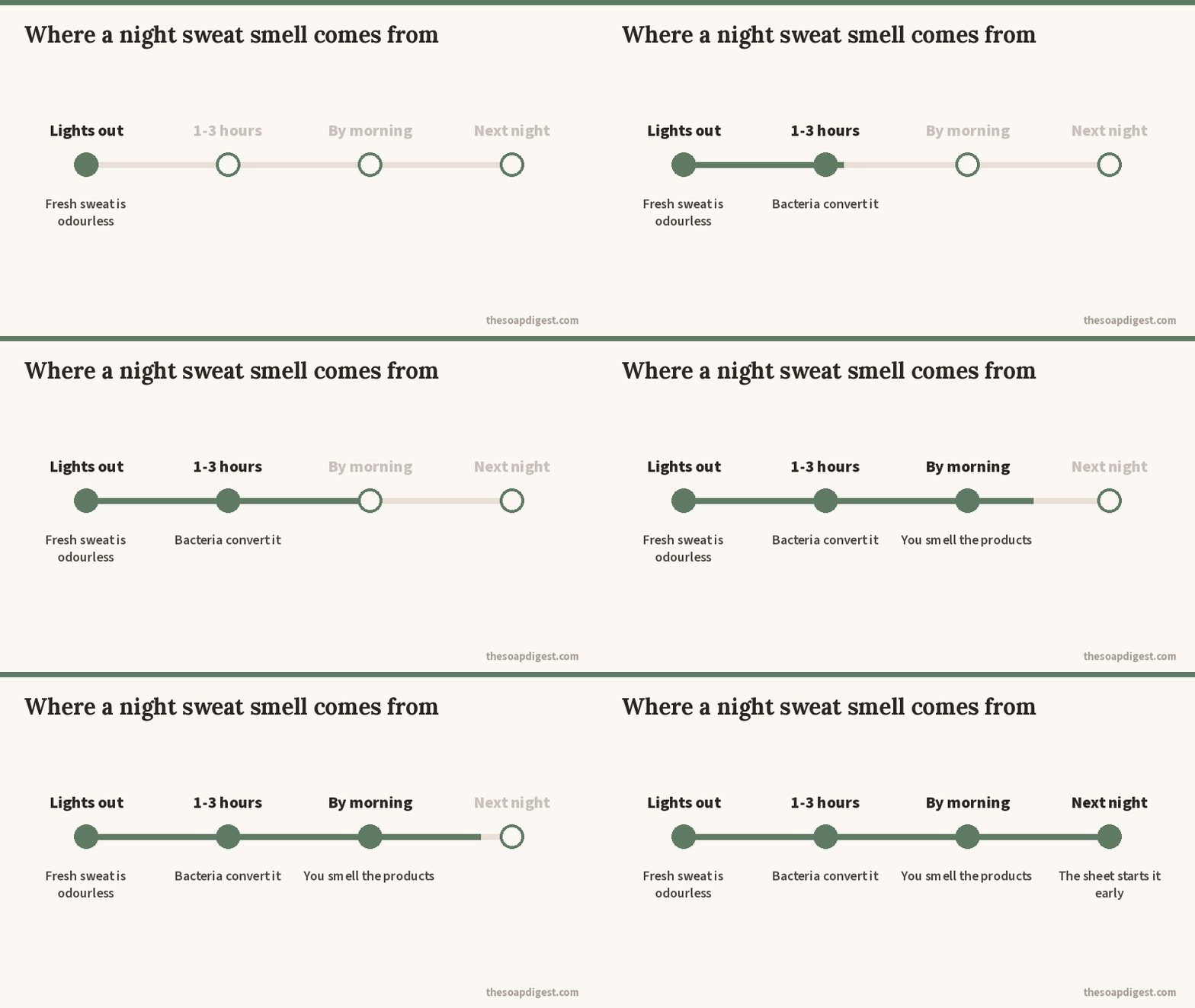
Fresh sweat is close to odourless. Seven hours later it is not, and the gap between those two facts is where almost everything about this question lives.

Disclosure: The Soap Digest is owned by the same company that makes TanniBar. We rank it first and we earn money when you buy it. Every other brand here is linked without payment, and we try to describe each one fairly. Check the facts for yourself. How we handle this.
In this guide
- Night sweat is not a different kind of sweat
- The smell is made after you fall asleep
- What the vinegar smell probably is
- Sour, cheesy, oniony, ammonia: a short map
- The sheet is the other half of the problem
- Nobody has measured any of this in a bed
- What actually helps, and in what order
- When night sweats are a medical question
- The bottom line
Waking in a damp bed is unpleasant enough on its own. The second problem is that the bed smells, and the question usually gets phrased as though night sweat were a special substance: why do night sweats smell, as distinct from the sweat you produce in a gym class. The answer is slightly surprising. The fluid is ordinary. What is unusual is the seven hours it then spends on you, warm, covered, undisturbed, and nowhere near a shower.
The short version
- Fresh sweat is close to odourless. Almost everything you smell in the morning was manufactured afterwards, by bacteria.
- So the clock matters more than the volume: a night sweat gets hours of warm, humid, covered contact with fabric before anyone washes anything.
- The descriptors sort themselves. Vinegar and sour point at short-chain fatty acids, cheesy at one acid in particular, oniony at the sulphur compounds made in the armpit, and greasy or stale at a different process altogether.
- Nobody has measured any of this in a bed. A title-and-abstract search pairing night sweats with odour returns two records, and neither is about smell.
- Night sweats that regularly soak the sheets are a question for a GP rather than for the laundry cupboard.
Night sweat is not a different kind of sweat
The NHS defines night sweats as “when you sweat so much that your night clothes and bedding are soaking wet”, and separates that from the ordinary case: “It’s normal to sweat during the night if the room or your bedding is making you too hot.”
The same two gland types operate at night as during the day. Eccrine glands cover most of the body and produce the dilute, salty fluid that cools you by evaporating; apocrine glands sit in the armpit and groin and secrete something richer. The one small comparison of the two collected sweat from six young men during treadmill running and during a sauna sitting: apocrine sweat carried more urea and potassium, and running produced more urea than passive overheating. The authors call it preliminary and it is about exercise rather than sleep, but the two fluids are not interchangeable.
Why you are sweating is a separate question with a long answer. Vasomotor symptoms are the common one — a 2026 meta-analysis of 41 studies covering nearly 29,000 women aged 40 to 65 put the pooled prevalence of hot flushes and night sweats between 54 and 74 per cent depending on region — and nocturnal sweating is also associated with sleep apnoea, insomnia, restless legs and narcolepsy, mainly through sympathetic overactivity. None of that changes what the fluid is made of. It changes how much of it there is.
“So very tired of my horrible night sweats, been going on for months”
One folk idea is worth clearing away while we are here: that a heavy night sweat is the body flushing something out. The most comprehensive review of sweat gland physiology concludes the opposite — sweating’s role in eliminating waste products “seems to be minor compared with other avenues of excretion via the kidneys and gastrointestinal tract”. A bad night means you were hotter for longer, not that more was expelled.
The smell is made after you fall asleep
Human body odour is not secreted; it is manufactured on the skin surface, by bacteria, out of material that arrives odourless. The standard review of the subject opens with exactly that: malodour “is caused by the microbial biotransformation of odourless natural secretions into volatile odorous molecules”.
The best-mapped example is the sulphurous underarm smell. An odourless precursor is secreted in apocrine sweat, taken up by Staphylococcus hominis, and converted through a transporter and a short chain of enzymes into a volatile thioalcohol. The final enzyme in that chain was described in 2018; the step immediately before it only in 2024, when a dipeptidase in the same bacterium was identified as the missing link. None of that happens instantly. It needs a bacterial population, a substrate, and time.
Nobody has timed it in a bed. The closest anyone has come to timing skin bacteria at all is an odd place: the operating theatre. Thirty volunteers were given a preoperative shower and full surgical antisepsis, then swabbed every thirty minutes, and the mean bacterial load “increased significantly under all protocols up to T90 min” — the baseline organisms being coagulase-negative staphylococci, micrococci and coryneforms, which are the genera that make the smell. That is surgical antisepsis rather than a shower, and the endpoint is bacterial load rather than odour. But ninety minutes after the most thorough wash a hospital can give you, the population is already climbing. A night is four or five times that long.
What the vinegar smell probably is
Of all the descriptors people reach for, vinegar recurs most across search suggestions — and it has the cleanest chemistry behind it.
In assay work published from Unilever’s research labs in 2004, propionibacteria and staphylococci were shown to ferment glycerol and lactic acid into acetic and propionic acid: the two shortest volatile fatty acids. Acetic acid is what makes vinegar smell of vinegar. Lactic acid is a routine constituent of eccrine sweat, the fluid that does most of your night sweating. So the descriptor is not a stray impression. A documented pathway takes the main ingredient of the fluid involved and turns it into the smell being described.

Two honest qualifications. The same paper’s kinetic data suggested these pathways contribute less to underarm fatty-acid levels than fatty-acid biotransformation by a subgroup of corynebacteria. And in 1991 a Munich group cultured 22 strains of coryneform bacteria for 48 hours in a rich medium: only one produced propionic acid, and acetic, butyric and isovaleric acid “could never be detected”. Their conclusion was not that the acids are imaginary but that the organism alone does not predict them — what matters is the substrate the bacteria find on real skin.
Which argues for the bed rather than against it. The question is not only which bacteria you carry, but what they are sitting in, for how long, and at what temperature.
Sour, cheesy, oniony, ammonia: a short map
- Vinegar and sour. Acetic and propionic acid, fermented from glycerol and lactic acid, as above.
- Cheesy, or old trainers. Isovaleric acid, which staphylococci make from branched amino acids such as leucine — the classic acidic note of underarm smell.
- Oniony or sulphurous. Thioalcohols, principally 3-methyl-3-sulfanylhexan-1-ol, produced by S. hominis from an odourless apocrine precursor. An armpit and groin phenomenon, not something a sweaty back produces.
- Ammonia or urine. Urea, which bacterial ureases split into ammonia. The ammonia is made after the fluid leaves the body, which is why a urine smell can be strongest in the laundry basket rather than on the person.
- Greasy, stale, musty, “old”. Not bacterial at all. 2-Nonenal is generated when particular unsaturated fatty acids in skin oils oxidise, and it was detected only in subjects aged 40 and over in the study that first identified it. We have collected every published description of it, and they are not very consistent either.
- Sweet. No published chemistry stands behind this descriptor for night sweating, and we are not going to invent one. A new, persistent sweet smell belongs in the GP conversation below.
Most people have more than one of these at once, which is the commonest reason a product disappoints. Someone who finds a soap fixes the smell behind their ears but not their armpits has not bought a bad soap; they have two different smells and have treated one.
“on some days my sweat yields different smells on different days”
That reader added something worth repeating: the day with the worse smell was the day with less visible sweat. Fluid and odour come apart routinely, because they are the output of two different processes.
The sheet is the other half of the problem
Everything above describes a process that needs warmth, moisture and time. A bed supplies all three better than almost anything else you own.
The nearest thing to a measurement is a bench study from 2014, and it needs labelling carefully: there were no people in it. A simulated torso and a fabric moisture reservoir stood in for sweating skin, to compare a powered moisture-wicking hospital coverlet against a standard hospital sheet. The sheet moved moisture away at 34.1 grams per metre per hour against the powered product’s 129.5; gas chromatography found the powered version controlled odour better; and when both were inoculated with Staphylococcus aureus and incubated at 32 degrees Celsius — roughly the temperature of the gap between a person and their bedding — the ordinary sheet carried more than two logs more growth after 24 hours.
That is a hospital device tested by people with an interest in the answer, in a laboratory rather than a bedroom, so treat it as a demonstration of the principle rather than a measurement of your bed. The principle holds up elsewhere: polyester adheres more bacteria and absorbs more sebum than cotton; polyester and cotton shirts carry different odour profiles after the same exercise session; and a 2025 occupational study found survival on a fabric depends jointly on the fibre and on the temperature and humidity it is held at.

Nobody has measured any of this in a bed
We ran the searches on the morning this was published. Pairing night sweats with odour or odor in title and abstract returns two records, both read: an interview study with oncologists about palliative chemotherapy, and a case report of occupational hypersensitivity pneumonitis. Pairing sweating with circadian rhythm and odour returns nothing at all.
The third search makes the point. Pairing 2-nonenal with night, sleep, bed or nocturnal returns sixteen records. Fifteen are about 4-hydroxy-2-nonenal, a lipid-peroxidation marker that is a genuinely different molecule and the standing false friend of this subject. The sixteenth identifies semiochemicals in bed bug refuge substrate. In the published literature, the word bed means bed bugs.
So the chemistry of each individual smell is reasonably well described, mostly by cosmetics companies with a commercial reason to describe it. The situation almost everyone is actually asking about — one person, sweating for hours into particular bedding, and what that smells like in the morning — has not been studied by anyone.
It is worth saying plainly what that means for the product this site is built around. A persimmon tannin bar is a rinse-off soap, used in a shower, aimed at the oxidised-oil smell rather than at the acids bacteria make from sweat. It does nothing about a vinegar note, and it does nothing at all to a sheet you are going to lie in again tonight. On this particular question the thing we sell is not the answer, and we would rather say so than imply otherwise.
What actually helps, and in what order
- Work on the sweating first, because it is upstream of everything else. The NHS says plainly that sweating at night is normal if the room or the bedding is making you too hot, which makes temperature and bedding weight the cheapest things to change. On cooling bedding specifically the published evidence is one non-randomised pilot: 64 people, mostly women, mean age 48, among whom the proportion reporting trouble sleeping from heat fell from 82.5 to 39.7 per cent over six weeks, with fewer night sweats reported too. No control group, the manufacturer helped recruit and reimburse participants, and the authors say it needs replicating in a randomised, placebo-controlled design. People who buy cooling sheets and then report on them report improvement. That is not nothing, and it is not proof.
- Change fabric on a schedule, not when you notice a smell. You adapt to your own odour within minutes, so your nose is the wrong instrument here; our guide to checking whether you have this smell at all explains why self-assessment fails. Rotate the pillowcase most often, since it gets the longest contact with the oiliest skin, and wash bedding for the oil rather than the sweat: 2-nonenal travels in sebum and is essentially insoluble in water, which is why a cool quick cycle can leave a sheet smelling stale straight out of the machine. Our laundry guide has the detail.
- If the smell is a morning problem, move the wash to the morning. The molecules are built overnight out of what is already on your skin, so washing at 11pm removes the starting material but does not stop the process running again while you sleep. Keep it gentle if your skin is older or dry.
- Separate the smells before buying anything. Sharp and sour, worst in the armpits, arriving with the sweat: the bacterial-acid family, where antiperspirant logic applies. Greasy and stale, worst on the neck, ears, chest and upper back, present on unwashed fabric: the oxidised-oil family, where washing the oil off is what helps. Our comparison of the best persimmon soap options covers the second group only, and says so.
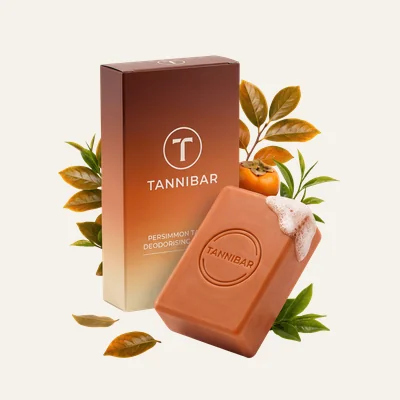
TanniBar Persimmon Tannin Bar
It is fragrance-free, which matters when you are trying to work out what you can actually smell rather than layering something over it.
Check price →We own TanniBar and earn from sales. 30-day refund, no return needed.When night sweats are a medical question
See a GP about night sweats
The NHS advises that if you regularly wake up with soaking wet sheets you should get it checked by a GP, and to see a GP — though not urgently — if:
- you have night sweats regularly that wake you up or worry you
- you also have a very high temperature, or feel hot, cold or shivery, a cough or diarrhoea
- you have night sweats and you are losing weight for no reason
The same page names menopause symptoms, anxiety, medicines such as some antidepressants, steroids and painkillers, low blood sugar, alcohol or drug use and hyperhidrosis among the causes, and notes that sometimes the cause is unknown. On odour itself, the NHS advises seeing a GP if body odour has not improved with self-care and you notice a change in how it usually smells, you suddenly start sweating much more than usual, or it is affecting your self-esteem.
Nothing here substitutes for that conversation. The reason to sort the laundry question from the medical one is that they have completely different answers.
The bottom line
Night sweat smells because of what happens to it after you fall asleep, not because it arrives different from the sweat you make at noon. Bacteria convert the lactic acid, glycerol, urea and amino acids in ordinary sweat into acids and sulphur compounds over hours, and a bed is an unusually good place for that: warm, humid, covered, unwashed until morning. The descriptor you reach for — vinegar, cheese, onion, ammonia, stale grease — is genuinely informative, because each points at a different starting material and therefore a different fix.
Nobody can tell you how much of each is happening in your bed, because that measurement has never been made. So the useful move is not to find the one product that solves it, but to work out which smell you have, and treat that one.
Frequently asked questions
Why do my night sweats smell like vinegar?
Because the acid in vinegar is one of the things skin bacteria make from sweat. In assays run at Unilever, propionibacteria and staphylococci fermented glycerol and lactic acid into the two-carbon and three-carbon volatile fatty acids acetic and propionic acid. Acetic acid is what makes vinegar smell of vinegar, and lactic acid is a normal constituent of the eccrine sweat that does most of your night sweating. So the descriptor has a documented pathway behind it that matches the fluid involved. What nobody has done is measure it in a bed: a title-and-abstract search pairing night sweats with odour or odor returns two records, and neither is about how a night sweat smells.
Is night sweat different from day sweat?
Not in any way that has been shown to matter for smell. The same two gland types are involved: eccrine glands over most of the body, producing a dilute salty fluid, and apocrine glands in the armpit and groin. One small comparison of six young men found apocrine sweat carried more urea and potassium than eccrine sweat, and that running produced more urea than sitting in a sauna, but that is a preliminary study of exercise and heat, not of sleep. What is clearly different at night is the situation rather than the fluid: seven hours of warm, covered, undisturbed contact with fabric, and no washing at the end of it.
Should I shower at night or in the morning?
If the problem is the smell you notice when you wake up, a morning wash addresses it more directly than an evening one. The odorous molecules are made over the course of the night, by bacteria acting on what is already on your skin, so washing before bed removes the starting material but does not stop the process from running again while you sleep. An evening shower is still worth it if you go to bed sweaty from the day. Doing both is not unreasonable, though frequent hot washing with a strongly alkaline bar can leave older or drier skin tight and itchy.
Do I need to change the sheets every day?
Most people do not, but changing them on a schedule beats changing them when you notice a smell, because you adapt to your own odour within minutes and stop being able to judge it. A pillowcase gets the most contact with the oiliest skin, so it is the item worth rotating most often. If you are having frequent soaking night sweats, more frequent changes are reasonable on comfort grounds alone. There is no published study telling anyone how often to change bedding to control odour.
Can persimmon soap help with night sweats?
Not with the sweating, and only with one of the smells. Persimmon tannin soap is a rinse-off bar aimed at 2-nonenal, the greasy, stale odour that comes from skin oils oxidising rather than from bacteria working on sweat. It does nothing about the short-chain fatty acids behind the vinegar and sour notes, nothing about the sulphurous underarm compounds, and nothing about a sheet you are going to lie in again tonight. This site is owned by the company that makes one of those bars, and on this particular question it is not the answer.
Why do my sheets smell worse than I do?
Partly because the fabric is holding the material the smell is made from, and partly because you cannot smell yourself well. In a laboratory test with a simulated torso, a standard hospital bed sheet transferred moisture roughly a quarter as fast as a powered moisture-wicking coverlet, and when both were inoculated with Staphylococcus aureus and incubated at 32 degrees Celsius, the ordinary sheet carried more than two logs more growth after 24 hours. That is a bench simulation and a hospital product rather than anyone's bedroom, but it is the closest measurement there is of the thing the question is about.
When should I see a doctor about night sweats?
The NHS says that if you regularly wake up with soaking wet sheets you should get it checked by a GP. It advises seeing a GP, though not urgently, if you have night sweats regularly that wake you up or worry you, if you also have a very high temperature or feel hot, cold or shivery, a cough or diarrhoea, or if you have night sweats and are losing weight for no reason. The same page lists menopause, anxiety, medicines such as some antidepressants, steroids and painkillers, low blood sugar, alcohol or drug use and hyperhidrosis among the causes, and notes that sometimes the cause of night sweats is unknown.
Sources
- NHS: Night sweats (accessed 16 November 2026). Defines night sweats as "when you sweat so much that your night clothes and bedding are soaking wet". "If you regularly wake up with soaking wet sheets you should get it checked by a GP." Advises seeing a GP, non-urgently, if "you have night sweats regularly that wake you up or worry you", if "you also have a very high temperature (or feel hot, cold or shivery), a cough or diarrhoea", or if "you have night sweats and you're losing weight for no reason". Lists menopause symptoms, anxiety, "medicines, such as some antidepressants, steroids and painkillers", low blood sugar, alcohol or drug use and hyperhidrosis as causes, and notes "Sometimes the cause of night sweats is unknown." Also states that "It's normal to sweat during the night if the room or your bedding is making you too hot."
- James A.G., Hyliands D., Johnston H. (2004). Generation of volatile fatty acids by axillary bacteria. Int J Cosmet Sci 26(3):149-56. ("Propionibacteria and staphylococci were shown to ferment glycerol and lactic acid to the short-chain (C2-C3) VFAs, acetic and propionic acid. Furthermore, staphylococci are capable of converting branched aliphatic amino acids, such as leucine, to highly odorous short-chain (C4-C5) methyl-branched VFAs, such as isovaleric acid, which are traditionally associated with the acidic note of axillary malodour." The authors add that "in vitro kinetic data indicates that these pathways contribute less to axillary VFA levels, than fatty acid biotransformations by a recently defined sub-group of the Corynebacterium genus". The authors were at Unilever R&D Colworth, a consumer goods company.)
- James A.G., Austin C.J., Cox D.S., Taylor D., Calvert R. (2013). Microbiological and biochemical origins of human axillary odour. FEMS Microbiol Ecol 83(3):527-40. (A review. "The generation of malodour on various sites of the human body is caused by the microbial biotransformation of odourless natural secretions into volatile odorous molecules." Names short- and medium-chain volatile fatty acids, 16-androstene steroids and thioalcohols as the implicated molecular classes, and reports that "most of the available evidence suggests that members of the Corynebacterium genus are the primary causal agents of axillary odour, with the key malodour substrates believed to originate from the apocrine gland". The lead author was at Unilever.)
- Lukacs A., Korting H.C., Ruckdeschel G., Ehret W. (1991). Do cutaneous coryneform bacteria produce short-chain fatty acids in vitro? Dermatologica 182(1):32-4. (22 strains of coryneform bacteria cultured for 48 hours in a rich medium, with short-chain fatty acids extracted into ether and detected by gas chromatography. "Only one of the tested bacteria produced propionic acid. Acetic acid, (iso)butyric acid or (iso)valeric acid could never be detected." The authors suggest the acids may instead depend on "the particular substrate found under physiologic conditions by these organisms in human apocrine sweat", or on "unspecific secreted enzymes of the bacteria" cleaving skin surface lipids. Cited here as the limit on the fatty-acid story, not as a refutation of it.)
- Minhas G.S., Bawdon D., Herman R., Rudden M., Stone A.P., et al. (2018). Structural basis of malodour precursor transport in the human axilla. eLife 7:e34995. (Underarm malodour is produced when skin bacteria, principally Staphylococcus hominis, take up an odourless precursor secreted in apocrine sweat and release the volatile thioalcohol 3-methyl-3-sulfanylhexan-1-ol.)
- Herman R., Kinniment-Williams B., Rudden M., James A.G., Wilkinson A.J., Murphy B., Thomas G.H. (2024). Identification of a staphylococcal dipeptidase involved in the production of human body odor. J Biol Chem 300(12):107928. (Identifies the M20A-family PepV peptidase of Staphylococcus hominis as the dipeptidase that performs the previously missing step between the secreted precursor Cys-Gly-3M3SH and the substrate the final enzyme can act on. Cited here for the point that the underarm smell is the output of a multi-step enzymatic pathway in a bacterium, not something present in sweat as secreted. Two authors were affiliated with Unilever.)
- Baker L.B. (2019). Physiology of sweat gland function: The roles of sweating and sweat composition in human health. Temperature (Austin) 6(3):211-259. (A comprehensive review. "The role of sweating to eliminate waste products and toxicants seems to be minor compared with other avenues of excretion via the kidneys and gastrointestinal tract; as eccrine glands do not adapt to increase excretion rates either via concentrating sweat or increasing overall sweating rate." Studies suggesting a larger clearance role "may be an artifact of methodological issues". The author was at the Gatorade Sports Science Institute, PepsiCo R&D.)
- Chen Y.L., Kuan W.H., Liu C.L. (2020). Comparative Study of the Composition of Sweat from Eccrine and Apocrine Sweat Glands during Exercise and in Heat. Int J Environ Res Public Health 17(10):3377. (Described by its authors as a preliminary study. Sweat was collected from six young males from the upper back (eccrine) and armpit (apocrine) during 20 minutes of treadmill running or of sitting in a sauna. "The secretions of urea and K+ were significantly higher during running than during inactive overheating for both glands." "Under the same sweating conditions, urea and K+ excretions from the apocrine glands were also higher than those from the eccrine glands." Little uric acid was excreted.)
- Rouquette L., Lefebvre A., Astruc K., et al. (2020). Bacterial skin recolonization in the operating room: comparison between various antisepsis protocols. J Hosp Infect 105(4):758-763. (30 healthy volunteers given a preoperative shower and full surgical antisepsis, then swabbed every 30 minutes to 90 minutes. "Mean load increased significantly under all protocols up to T90 min." Baseline isolates were "predominantly healthy skin commensals: coagulase-negative staphylococci, micrococci, and coryneforms". Cited for the timescale of recolonization only. This is surgical antisepsis in an operating room, not ordinary washing, and the endpoint is bacterial load rather than smell.)
- Reger S.I., Ranganathan V.K., McNulty A.K. (2014). Use of a powered coverlet for moisture removal, skin temperature reduction, odor, and bacteria control. J Wound Ostomy Continence Nurs 41(1):35-9. (A laboratory bench study, not a study in people: "A human torso was simulated using a water temperature-regulated loading gauge" and "a fabric moisture reservoir simulated sweating skin". Results: "a higher moisture vapor transfer rate with the PCL as compared to a standard hospital bed sheet (129.5 g/m/h vs 34.1 g/m/h, P < .005)"; "gas chromatography analysis showed that the PCL helped control odor better than a non-PCL (P < .05)"; and after inoculation with Staphylococcus aureus and incubation at 32 degrees Celsius, "at 24 hours, the PCL showed greater than 2 log difference of S aureus over the standard hospital sheet (P < .05)". The powered coverlet is a hospital support-surface device; one author was employed by its field.)
- Gorny R.L., Golofit-Szymczak M., Cyprowski M., et al. (2025). Survivability of microorganisms on synthetic and semi-synthetic textile materials used in the production of special purpose clothing in various humidity and temperature conditions. Ann Agric Environ Med 32(4):443-452. (Ten man-made and synthetic fabrics were inoculated with bacteria, a bacteriophage and fungi and held at 60 percent humidity at about 24 and about 40 degrees Celsius. "In the case of bacteria and bacteriophage, fibre admixtures added to synthetic materials usually reduced their survivability. In the case of fungi, synthetic, mainly polyester, as well as doped polyacrylonitrile and polyamide materials, supported the survivability of their conidia." The conclusion is that "by changing the microclimatic conditions when wearing clothes made of a specific fabric" survivability can be reduced. This is occupational protective clothing, not bedding.)
- Mollebjerg A., Palmen L.G., Gori K., Meyer R.L. (2021). The Bacterial Life Cycle in Textiles is Governed by Fiber Hydrophobicity. Microbiol Spectr 9(2):e0118521. (Polyester adhered more bacteria and absorbed more sebum than cotton.)
- Callewaert C., De Maeseneire E., Kerckhof F.M., Verliefde A., Van de Wiele T., Boon N. (2014). Microbial odor profile of polyester and cotton clothes after a fitness session. Appl Environ Microbiol 80(21):6611-9. (26 participants cycled in cotton and in polyester shirts; the two fabrics carried different microbial communities and different odour profiles afterwards.)
- Gombert-Labedens M., Vesterdorf K., Fuller A., Maloney S.K., Baker F.C. (2025). Effects of menopause on temperature regulation. Temperature (Austin) 12(2):92-132. (A review. Hot flushes are described as "the most characteristic symptom of menopause (prevalence of 50-80%)". The mechanism described involves the kisspeptin-neurokinin B-dynorphin neuron complex, which "becomes hyperactive when estradiol levels decrease" and projects to thermoregulatory areas of the hypothalamic preoptic area "where heat loss mechanisms are triggered, including cutaneous vasodilation and sweating". The review discusses "the unique situation of hot flashes that arise during sleep" and notes "mixed research findings about thresholds for sweating in symptomatic individuals".)
- Ellahi S.A., Spector A., Talaulikar V., Faulkner A., Desai R. (2026). Global prevalence of vasomotor symptoms in the menopause transition: systematic review and meta-analysis. Climacteric (online ahead of print). (41 population-based studies, n = 28,955, women aged 40-65. "Pooled prevalence estimates ranged from 54.29% in Africa to 74.23% in the Americas and Europe." Heterogeneity was very high, I-squared greater than 97 percent, and the authors caution that differences between regions "should be interpreted cautiously". Vasomotor symptoms are defined in the paper as hot flushes and night sweats.)
- Idiaquez J., Casar J.C., Arnardottir E.S., August E., Santin J., Iturriaga R. (2023). Hyperhidrosis in sleep disorders - A narrative review of mechanisms and clinical significance. J Sleep Res 32(1):e13660. ("Nocturnal hyperhidrosis is associated with different sleep disorders, such as obstructive sleep apnea, insomnia, restless legs syndrome/periodic limb movement during sleep and narcolepsy. The major cause of the hyperhidrosis is sympathetic overactivity.")
- Weaver M.D., Qadri S., Ejikeme C., Quan S.F., Czeisler C.A., Robbins R. (2025). A non-randomized pre-post pilot study of cooling bed sheets in hot sleeping people. Front Sleep 4:1587801. (64 participants, 2,627 days of diary data, 89 percent female, mean age 48, recruited in part from "potential customers of the intervention sheets". "The proportion of participants reporting trouble sleeping due to feeling too hot was reduced from 82.5 to 39.7%" and "participants also reported improvements in night sweats". There was no control group and no randomization; the authors state the findings "warrant replication in a randomized, placebo-controlled design". The sheet manufacturer facilitated recruitment and reimbursed participants, and several authors declare consulting relationships with sleep-product companies.)
- Haze S., Gozu Y., Nakamura S., Kohno Y., Sawano K., Ohta H., Yamazaki K. (2001). 2-Nonenal newly found in human body odor tends to increase with aging. J Invest Dermatol 116(4):520-4. (2-Nonenal, "an unsaturated aldehyde with an unpleasant greasy and grassy odor, was detected only in older subjects (40 y or older)". It was generated when omega-7 unsaturated fatty acids in skin surface lipids were oxidatively degraded, which is a chemical route rather than a bacterial one. The authors were affiliated with Shiseido, a cosmetics company.)
- Kimura K., Sekine Y., Furukawa S., Takahashi M., Oikawa D. (2016). Measurement of 2-nonenal and diacetyl emanating from human skin surface employing passive flux sampler-GCMS system. J Chromatogr B 1028:181-185.
- PubMed title-and-abstract searches on night sweating and odour, run on 16 November 2026. ("night sweats"[TIAB] AND (odor[TIAB] OR odour[TIAB]) returns 2, both walked, and neither concerns how a night sweat smells: an interview study of oncologists on palliative chemotherapy, and a case report of occupational hypersensitivity pneumonitis. sweat*[TIAB] AND circadian[TIAB] AND (odor[TIAB] OR odour[TIAB] OR malodor*[TIAB]) returns 0. "2-nonenal"[TIAB] AND (night[TIAB] OR sleep[TIAB] OR bed[TIAB] OR nocturnal[TIAB]) returns 16, walked in full: fifteen concern 4-hydroxy-2-nonenal, the lipid-peroxidation marker that is a different molecule from the body-odour aldehyde, and the sixteenth identifies semiochemicals in bed bug refuge substrate. In this literature the word bed means bed bugs.)
- NHS: Body odour (BO) (accessed 16 November 2026). Advises seeing a GP if body odour has not improved after treating it yourself and you notice a change in how it usually smells, you suddenly begin to sweat much more than usual, or it is affecting your self-esteem. Names conditions such as diabetes, kidney disease and liver disease, and medicines such as antidepressants, among the things that can make body odour worse.
- TanniBar product page (page re-read 16 November 2026 for this article; ingredients, fragrance-free claim, guarantee and shipping terms). The page states the bar is "100% fragrance-free", is "triple-milled to last a month of daily showers", and carries a 30-day money-back guarantee with no return required. It also advises that "if you have an active skin condition, check with your doctor first" and that "if body odour changes suddenly or is accompanied by other symptoms, see a healthcare professional". Bundle prices did not load on this fetch, for the sixteenth consecutive check. Manufacturer claims, labelled as such.
- r/Perimenopause, "Phenomenal Night Sweats", posted 15 November 2026 and read the following day. (A reader describing months of night sweats on hormone therapy, having already tried supplements, acupuncture, meditation, blood tests and imaging. The replies concern strength training, creatine and the timing of oestradiol gel. Nothing in the thread is about smell, which is itself the point made in the article.)
- r/bodyodor, "Why does my sweat only smell bad some of the time?", posted 15 October 2026 and read on 16 November 2026. (A reader reports that on two days with similar conditions the armpit smell was strongly offensive on one and barely present on the other, with more visible sweat staining on the low-odour day, and that this happens often. Read as a description of the variability the article explains, not as evidence for any mechanism.)
- r/bodyodor, "Worser the body heat = Worser the body odor", posted 19 October 2026 and read on 16 November 2026. (A reader describes odour tracking their perceived body heat even in an air-conditioned room with no visible sweating, and describes chasing it from the back to the neck with washing and antiperspirant. Cited as a reader observation, not as evidence.)