Home › Persimmon Soap › Why persimmon soap is expensive
Persimmon SoapWhy Is Persimmon Soap So Expensive? We Did the Arithmetic
The bars in our own comparison range from a $4.95 Japanese drugstore soap to a $54.99 three-pack. Expensive is a comparison, and on two of the five you cannot run it.

Disclosure: The Soap Digest is owned by the same company that makes TanniBar. We rank it first and we earn money when you buy it. Every other brand here is linked without payment, and we try to describe each one fairly. Check the facts for yourself. How we handle this.
In this guide
- What the five bars actually cost today
- Why two of them cannot be compared at all
- The same bar has three different prices
- Does a dearer bar buy you a better one
- Lasts a month is a duration, not a measurement
- What the price is definitely not buying
- Who the package is aimed at is part of the price
- What we can and cannot tell you about our own bar
- How to work out whether a bar is worth it to you
- The bottom line
A reader in Ireland posted a question yesterday that was really two questions wearing one coat: which shop near them sells persimmon soap, and whether it actually works. Underneath both sat the thing they did not quite ask — whether the price they had seen was a fair one. That is what people type into a search box as why is persimmon soap so expensive, and the short answer is not the one the phrasing expects.
Most persimmon soap is not expensive. Some of it is. The five bars in our persimmon soap comparison run from $4.95 to $54.99, and the useful work is not defending or attacking a price but establishing what the price is per unit of soap. That is where this gets interesting, because on two of the five the arithmetic cannot be done at all — and one of those two is ours.
The short version
- Checked on each seller’s own page today, the five bars work out at $4.95, $12.99, about $18.33, $19.97 and about $19.00 each. The category is not uniformly expensive.
- Among the three that publish a weight, price per 100 g runs from about $6.19 to about $21.56 — a spread of roughly three and a half times.
- Two of the five publish no weight at all, so no price per gram exists for them. One of those is our own bar.
- The biggest number in the comparison, a $54.99 three-pack, is cheaper per bar than the $19.97 single.
- In the nearest categories anyone has studied, price does not predict a cleaner ingredient list. In one study the dearer products carried more allergens.
What the five bars actually cost today
Every figure below was read off the seller’s own page on 6 November 2026. Where a weight is published, price per 100 g is simple division.
- Pelican, 80 g. $4.95, reduced 24% from $6.54, in stock. That is $6.19 per 100 g.
- Natrulo, 4 oz. $12.99 against a struck-through $14.99, and currently marked sold out. About $11.46 per 100 g.
- Asayu Japan, three bars. $54.99, with 85 g in the specifications. That is $18.33 a bar and about $21.56 per 100 g.
- Mirai Clinical. $19.97 for one unscented bar. No weight published, so no price per 100 g.
- TanniBar, our own bar. Our comparison lists $29 for one, $69 for three and $114 for six — $19.00 a bar at the largest bundle. No weight published either.
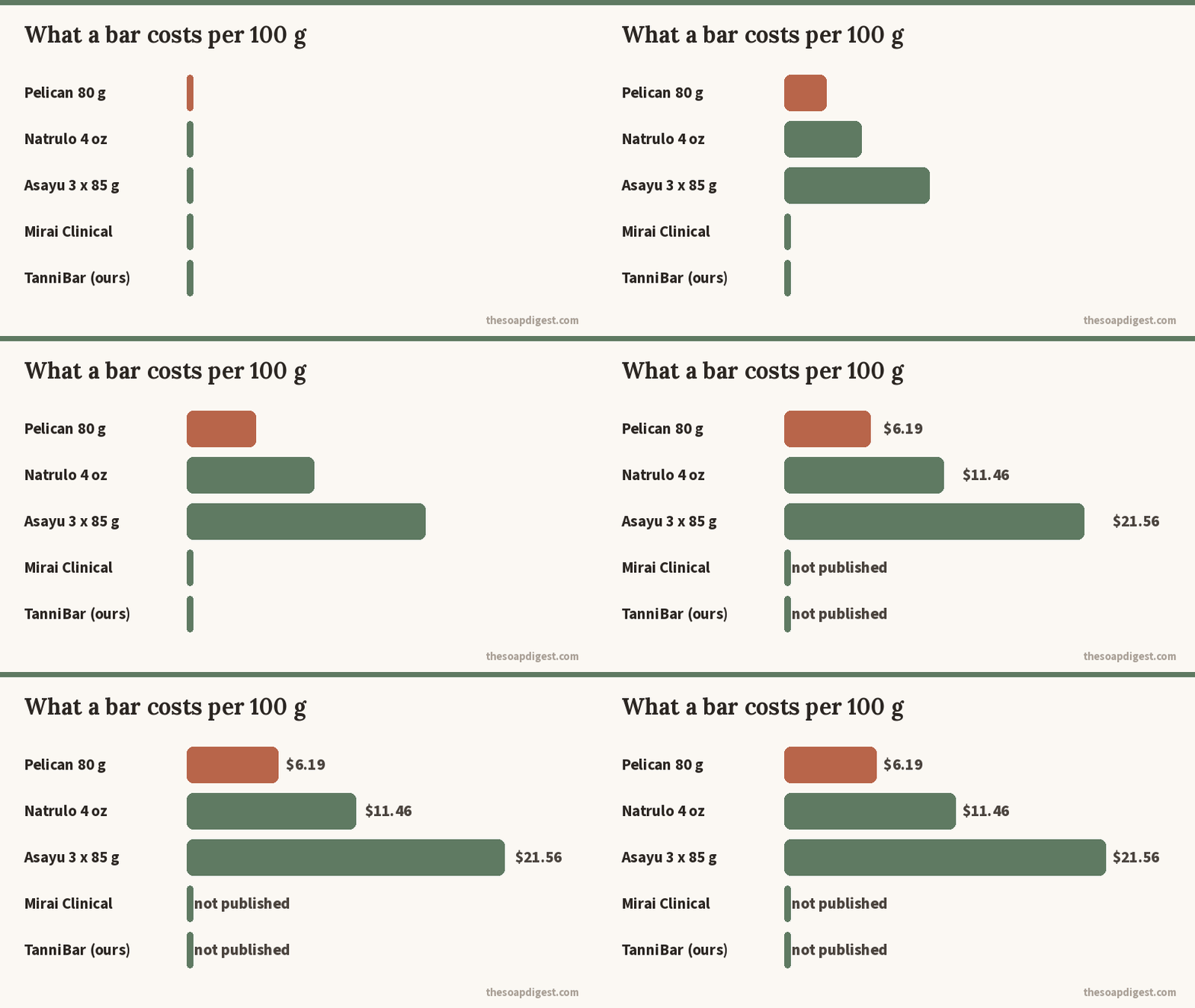
Two things fall out immediately. The cheapest bar in the category is a long-standing Japanese drugstore product at under five dollars, which rather undercuts the premise of the question. And the ordering is not what the sticker prices suggest: the largest number on the table, $54.99, belongs to a bar that costs less each than the $19.97 single. A three-pack looks like a bigger commitment because it is a bigger number, not because it is a worse deal.
Why two of them cannot be compared at all
The missing weights are not a labelling quirk. They are why this question is hard to answer and why it keeps being asked.
Under the FDA’s cosmetics labelling guide, the net quantity of contents must appear on the container and “must accurately reveal the quantity of cosmetic in the container”. That requirement attaches to the package, not to the web page where you decide whether to buy. So for two of our five bars the weight almost certainly exists — printed on a box you will be holding only after you have paid. In place of one, our own page offers a duration: “One bar covers a month of daily showers.” Mirai’s page offers nothing. A duration is friendlier than a weight, and it is also unfalsifiable at the point of sale.
“Some don't have enough persimmon in them”
That reader is circling a related gap. Ingredient lists are published, and they are more informative than most shoppers realise, because the rule is that ingredients go in descending order of predominance — with the important exception that anything at 1% or less can be listed in any order after the rest. On Mirai’s unscented bar, persimmon tannin appears eighth, after the soap base, dipropylene glycol, water, sucrose, glycerin, sorbitol and a betaine surfactant. On ours it appears first.
That comparison is weaker than it looks and it would be dishonest to lean on it: the lists are not in the same format, one is plain English rather than regulatory, and neither brand publishes a percentage. A position in a list is not a concentration. What it does tell you is that nobody here quantifies the ingredient the category is named after.
The same bar has three different prices
Before concluding that any of this is expensive, check which price you are looking at. On Mirai’s own page the identical unscented bar is $19.97 bought singly, $16.97 each in a two-bar pack, and $12.98 each on a four-month subscription — a 54% premium for buying one at a time. Our own page runs the same structure on a tea tree add-on: $9.95 for one, falling to $7.95 each for three.

This is not a soap phenomenon. A 2026 economic evaluation in JAMA Dermatol found that for sunscreens with similar ingredients and SPF ratings, unit price varied by up to 17.5-fold across three products. So the number that lodges in memory, and that generates the search, is usually the single-unit price — the worst price on the page. Readers in buying threads have worked this out for themselves.
“it's cheaper on Amazon if you're willing to wait”
Does a dearer bar buy you a better one
Nobody has tested this in persimmon soap. But the question has been asked properly in the nearest categories, more than once, and the answers are consistent.
In 174 best-selling whole-body moisturisers, median price was $0.59 per ounce across a range of $0.10 to $9.51 — a 9400% spread — and only 12% were free of the allergens in a standard dermatology series. The finding that matters here: products free of all those allergens were not significantly more expensive than products containing one or more.
A separate study went at it directly, comparing 50 expensive against 50 inexpensive moisturisers from one drugstore chain. The expensive ones averaged significantly more allergens per product, 8.28 against 5.60, and the conclusion is unusually blunt: “monetary value is not a suitable proxy for evaluating the risk of ACD.” Last month a paper in Menopause found the same across 65 vulvar products — 78% contained at least one allergen, and “product price was not associated with allergen burden”, nor were the descriptors “natural”, “hypoallergenic” and “fragrance-free”.
Three studies, three categories, one direction. None is about soap or about odour, so none settles what a persimmon bar should cost. What they settle is that dearer, therefore better formulated has been tested wherever it could be and has not held up.
One finding cuts the other way, and we state it because it happens to favour our own product. In 150 top-rated deodorants analysed last month, products labelled fragrance-free carried significantly fewer allergens. That claim is cheap to make, and here it did correspond to something real — which is not the same as being worth a premium.
Lasts a month is a duration, not a measurement
The most common justification for a premium bar is that it is harder, mills better and therefore lasts longer, so the price per shower converges. Our page makes a version of that argument: triple-milled, hard-pressed, a month of daily showers. We cannot show you a measurement behind it. A search for “triple-milled” in the indexed literature returns nothing, and so does any attempt to find published figures for how long a consumer bar lasts in a shower.

The one place the question has been measured is public health. Investigators in Dhaka visited 220 households twice weekly for two months, weighing the soap each time and subtracting it from the previous weight. Mean consumption was 1.5 g of bar soap per person per day — with a caveat the authors state themselves, that the same bars were used for bathing and laundry as well as handwashing.
That is a different climate, washing pattern and product from a daily shower with a premium milled bar, so it cannot be turned into a number for your bathroom. It is still the only published figure anyone has, and every “lasts a month” claim in this category, ours included, sits on top of nothing published. Keeping the bar dry is the only variable you control, which is covered in how to use persimmon soap.
What the price is definitely not buying
It is not buying evidence. A title-and-abstract search pairing persimmon with soap returns zero indexed records, re-verified today. Our longer evidence review sets out what does and does not exist; for a pricing question the point is that there is no published effectiveness figure for any bar at any price, so a premium can be neither defended nor dismissed on results.
Nor, as far as anyone can tell, is it buying a costly raw material. The only published literature on what persimmon tannin costs is industrial separation chemistry: six papers, walked in full, on recovering uranium, chromium, lead, palladium and gold from waste water and electronic waste, plus one on dye adsorption. The tannin is cheap enough to be used as a bulk sorbent for mine effluent. Whatever makes a $29 bar cost $29, it is not that.
Who the package is aimed at is part of the price
One well-documented contributor is worth naming, because this category is marketed overwhelmingly to women over forty. Across 110 facial moisturisers classified by marketing language, container colour and container shape, there was no significant difference between the men’s and women’s products in how many were fragrance-free, carried SPF, were anti-ageing, or claimed to be hypoallergenic or dermatologist-recommended. The women’s products cost on average $3.09 more per ounce: $9.29 against $6.20.
Nor is it the regulated information that drives sales. Among the top 100 best-selling sunscreens, the factors that significantly predicted a product’s position were the number of reviews and the presence of six or more unregulated marketing claims; FDA-regulated claims did not move the needle. A product that competes on unregulated claims has every reason to be priced as a premium.
What we can and cannot tell you about our own bar
The Soap Digest is owned by the same company that makes TanniBar, so this is the section to read most sceptically. Here is the whole of it.
Our bar is among the most expensive in our own comparison and cannot be ranked on price per gram, because we do not publish a weight. We publish a duration instead, and that duration is not backed by any measurement we can show you. Our page says “six ingredients” and then lists seven. The $29 / $69 / $114 figures in our table come from the brand’s page, and an automated read of that page does not return them, so unlike the other four they have not been machine-verified since September — a gap we have flagged repeatedly and not closed.
What we can stand behind, because it is stated on the page and it reduces what a high price costs you if you are wrong: thirty days, a refund that does not require posting the bars back, free shipping. That is the one respect in which the dearest option here is the lowest-risk one, and it is a policy rather than a product quality. If you want the cheapest possible way to find out whether persimmon tannin does anything for you, it is not our bar — it is a Japanese drugstore bar for under five dollars, and we would rather say so. The same applies if you are weighing this against a different mechanism, which is the subject of persimmon soap versus Lume.
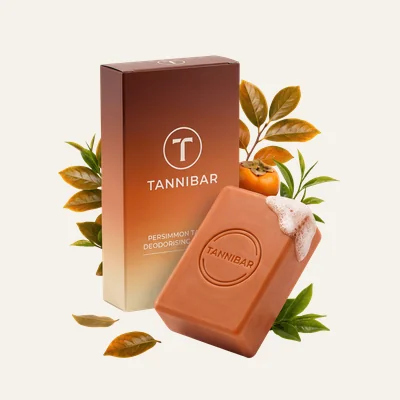
TanniBar Persimmon Tannin Bar
If you have already decided you want a fragrance-free bar and want the price risk removed rather than minimised, the refund-without-return policy is the thing to compare, not the sticker price.
Check price →We own TanniBar and earn from sales. 30-day refund, no return needed.How to work out whether a bar is worth it to you
- Convert to price per 100 g first. Price divided by grams, times 100. If the page gives no weight, you cannot — and that is itself information about the seller.
- Find the per-unit price at every quantity offered. The single-bar price is usually the worst one, sometimes by 50% or more.
- Read the ingredient list, not the claims — the conclusion of last month’s deodorant analysis, almost word for word. Note where the named active sits, and that anything at 1% or less can be anywhere in the list.
- Buy the smallest format first. Three weeks on a cheap bar costs five dollars and tells you more about your own skin than any listing can. Buy the bundle afterwards, if it works.
- Check what happens if you dislike it. A thirty-day refund with no return required is worth real money on an unproven product; one requiring you to post a used bar back is worth much less.
- Keep it dry. A bar sitting in water is the fastest way to make whatever you paid per gram worse.
When this is not a shopping question
If the smell is new, changing, or worrying you, no bar at any price is the right first step. The NHS advises seeing a GP, though not urgently, if body odour has not improved after treating it yourself and you notice a change in how it usually smells, you suddenly begin to sweat much more than usual, or it is affecting your self-esteem. The same page notes that conditions such as diabetes, kidney disease and liver disease, and medicines such as antidepressants, can make body odour worse.
The bottom line
The premise is mostly wrong: persimmon soap spans a tenfold range and starts under five dollars. Where it is expensive, the premium goes to brand, format, channel, packaging, policy and audience rather than to the tannin — and the two bars that look dearest are the two you cannot price per gram at all. In every adjacent category anyone has studied, a higher price has failed to predict a better ingredient list.
None of which makes a dear bar a bad buy. It means the decision is yours to make on grounds you can verify — size, scent, ingredient order, unit price at the quantity you will actually buy, and what the seller does if you want your money back — rather than on a price tag standing in for evidence that does not exist. Our comparison of the five bars lays those out side by side, including where our own entry comes off worst.
Frequently asked questions
Why is persimmon soap so expensive?
The honest answer is that most of it is not. The five bars in our comparison run from $4.95 for an 80 g Japanese drugstore bar to $54.99 for a handcrafted three-pack, checked on each seller's own page on 6 November 2026. What makes the category feel expensive is that the bars people find first are the branded, imported, direct-to-consumer ones, which are small, sold one at a time at the worst unit price on their own page, and marketed to a specific audience. Persimmon tannin itself is not a rare or costly input compared with the cost of a brand, a small production run, international shipping and a return policy.
Is persimmon soap worth the money?
That depends on a figure nobody has published. There is still no peer-reviewed human trial of persimmon soap for age-related body odour, re-checked against PubMed on 6 November 2026, so no price can be justified by published effectiveness and no price can be ruled out by it either. What you can do is bound your downside. Buy the smallest and cheapest format you can find first, use it for two to three weeks, and decide on your own evidence before committing to a bundle. A $4.95 bar is a cheap experiment; a $114 bundle is not.
How much should a bar of persimmon soap cost?
There is no standard, because the bars are different sizes and some sellers do not publish a size at all. The useful comparison is price per 100 g. Among the three bars in our comparison that publish a weight, that figure runs from about $6.19 to about $21.56 per 100 g, a spread of roughly three and a half times. If a bar works out at well over $20 per 100 g, you are paying a premium over the rest of the category, and the thing to establish is what that premium is buying.
Is the cheap Japanese persimmon soap as good as the expensive one?
Nobody has compared them in a trial, so there is no evidence-based answer. On the published facts, the cheapest bar in our comparison and some of the dearest list persimmon tannin and green tea extract in the same way, and the cheapest is a long-standing Japanese drugstore product. The real differences you can verify are size, whether a fragrance is added, whether the maker publishes a weight, and what happens if you dislike it. Readers in buying threads regularly report that the inexpensive Japanese bars work for them, and readers in the same threads report preferring a dearer brand. Both are reports, not measurements.
Do more expensive skincare products have better or cleaner ingredients?
In the nearest categories that have actually been studied, no. A cross-sectional analysis of 174 best-selling moisturisers found that products free of all the allergens in a standard dermatology series were not significantly more expensive per ounce than products containing one or more. A comparison of 50 expensive and 50 inexpensive moisturisers found the expensive ones averaged significantly more allergens per product, 8.28 against 5.60. A 2026 analysis of 65 over-the-counter vulvar products found product price was not associated with allergen burden, and that the claims natural, hypoallergenic and fragrance-free were not either. None of these studied persimmon soap, but all three point the same way: price is not a proxy for a cleaner ingredient list.
How long does a bar of persimmon soap actually last?
No manufacturer claim about this is backed by a published measurement, including the lasts-a-month claim on our own product page. The only published figures for how fast people get through bar soap come from handwashing research, where investigators weighed households' soap at repeated visits. In 220 households in Dhaka the mean consumption was 1.5 g of bar soap per person per day, and the same bars were used for bathing and laundry as well as handwashing. That is a different population and a different pattern of use from a daily shower in a temperate climate, so it cannot be turned into a prediction for your bathroom. Keeping a bar dry between showers is still the one thing under your control.
Is it cheaper to buy a multipack?
Almost always, and the difference is larger than most people expect. On one brand's own page the identical unscented bar is listed at $19.97 bought singly, $16.97 each in a two-bar pack and $12.98 each on a four-month subscription, which is about 54 percent more for the same bar bought one at a time. The pattern is not specific to soap: an analysis of 607 sunscreens across seven countries found unit price fell with container size, and the cost of protecting a family dropped 41 percent when large formats were used. The catch is that a multipack of something you have not tried is a larger bet on an unproven product.
Sources
- Xu S., Kwa M., Agarwal A., Rademaker A., Kundu R.V. (2016). Sunscreen Product Performance and Other Determinants of Consumer Preferences. JAMA Dermatol 152(8):920-7. (Top 1 percentile of sunscreen products on Amazon.com by average consumer review and review count, 65 products evaluated. "The median price per ounce was $3.32 (range, $0.68-$23.47)." "Of products, 40% (26 of 65) did not adhere to AAD guidelines (broad spectrum, SPF >=30, and water resistant) for sunscreens." "The most striking variation in this cohort was price, which varied by more than 3000%." Cosmetic elegance was the most cited positive feature, in 198 of 325 comments. Cited here as the nearest studied category, not as evidence about soap.)
- Xu S., Kwa M., Lohman M.E., Evers-Meltzer R., Silverberg J.I. (2017). Consumer Preferences, Product Characteristics, and Potentially Allergenic Ingredients in Best-selling Moisturizers. JAMA Dermatol 153(11):1099-1105. (174 unique best-selling whole-body moisturisers across Amazon, Target and Walmart, 109,713 reviews. "The median price per ounce was $0.59 (range, $0.10-$9.51 per ounce) with a wide range (9400%)." "Only 12% (n = 21) of best-selling moisturizer products were free of NACDG allergens." Products claiming "dermatologist recommended" had a higher median price per ounce than those without, $0.79 against $0.59. "For products with a claim of fragrance free, 18 (45%) had at least 1 fragrance cross-reactor or botanical ingredient." Crucially: "Products without any ingredients in the NACDG (median, $0.83) were not statistically more expensive per ounce than products with 1 or more allergens (median, $0.60)." The authors note "the lack of readily available comparison data on moisturizer efficacy".)
- Chou M., Mikhaylov D., Lazic Strugar T. (2018). Moisturizers: A Comparison Based on Allergens and Economic Value. Dermatitis 29(6):339-344. (Cross-sectional study of ingredients in 50 expensive and 50 inexpensive moisturisers sold online by one large US drugstore chain, matched against the American Contact Dermatitis Society and NACDG core allergen series. "The expensive moisturizers averaged significantly more allergens per product (8.28 vs 5.60, P = 0.003) than the inexpensive products." Conclusion: "Physicians may counsel cosmetic-induced allergic contact dermatitis (ACD) patients that monetary value is not a suitable proxy for evaluating the risk of ACD.")
- McAleer L., Negris O., Mauskar M.M., Dixon S.R. (2026). Natural, clean, yet still allergenic: contact allergen burden in vulvar soothing products. Menopause, online ahead of print 20 October 2026. (Cross-sectional analysis of 65 over-the-counter nonhormonal vulvar soothing products sold through major US retailers, ingredients compared with the North American Contact Dermatitis Group 80-allergen series. "Among 65 products, 78% contained at least one allergen, and 49% contained botanical-derived allergens." "Marketing descriptors, including natural, hypoallergenic, and fragrance-free, were not associated with lower allergen burden." "Twenty-eight percent of fragrance-free products contained botanical scent allergens, and all hypoallergenic products contained at least one allergen." "Ointments had lower allergen burden than other vehicles (P = 0.02), while product price was not associated with allergen burden.")
- Joshi A., Giuffre S.N., Marquez C.R., Gawey L., Insler E., et al. (2026). Allergens and Marketing Claims of Popular Over-the-Counter Deodorants. Dermatitis, online ahead of print 1 October 2026. (Top 50 products rated four stars or above from each of three major retailer websites, evaluated against the 2020 American Contact Dermatitis Society Core Allergen Series. "On average, most products (94%) had 2.3 allergens (0-7)." "Most prevalent allergens were fragrance (90%) and butylated hydroxytouline (46%)." "Products labeled unisex (10%, P = 0.0436) and fragrance free (6%, P = 0.0175) had significantly fewer allergens." "Mean price was $4.13/oz ($1.51-$18.82/oz)." Conclusion: clinicians should counsel patients to "examine ingredient labels rather than relying on product labels".)
- Prado G., Ederle A.E., Shahriari S.R.K., Svoboda R.M., Farberg A.S., Rigel D.S. (2019). Online sunscreen purchases: Impact of product characteristics and marketing claims. Photodermatol Photoimmunol Photomed 35(5):339-343. (Top 100 best-selling sunscreens from one online retailer, 41,788 reviews, analysed by ordinal logistic regression. "The median price per ounce was $3.02 (range $0.34-$309.18)." "For 26 unregulated product claims analyzed, the mean number of claims per sunscreen was 5.2." The factors that significantly influenced sales were "number of reviews, the claim decreases the risk of skin cancer and early aging, and the presence of six or more unregulated claims", while "FDA-regulated claims ... are not as impactful in this purchasing cohort".)
- Mundada M., Schneider J., Wei M.L. (2026). Sunscreen Costs in Association With Sun Protective Behaviors. JAMA Dermatol 162(4):402-405. (Economic evaluation using 2025 prices from an online retailer. "For sunscreens with similar ingredients and sun protection factor ratings, the unit price of sunscreen varied by up to 17.5-fold across 3 sunscreens." Annual cost of recommended use was estimated at between $39.28 and $1429.42, a 36-fold difference, depending on unit price and on what else the person wore.)
- Mahe E., Beauchet A., de Maleissye M.F., Saiag P. (2011). Are sunscreens luxury products? J Am Acad Dermatol 65(3):e73-e79. (Price analysis of 607 sunscreens from 17 internet drugstores in 7 countries, costed against the recommended application amount of 2 mg/cm2. "Median price of sunscreen was $1.7 US per 10 grams. The price decreased with the size of the bottle." The modelled cost for a family fell "by 41% if large-volume bottles were used". Cited here only for the unit-price-versus-format finding.)
- Manatis-Lornell A.J., Marks D.H., Hagigeorges D., Okhovat J.P., Senna M.M. (2019). Gender-related cost discrepancies in a cohort of 110 facial moisturizers. J Cosmet Dermatol 18(6):1765-1766. (110 facial moisturisers from three online retailers, classified as men's, women's or gender-neutral on marketing language, container colour and graphics, and container shape. "No statistically significant difference was found between the number of facial moisturizers listed as fragrance-free, SPF-containing, anti-aging, or those labeled as sensitive, hypoallergenic, or dermatologist recommended between the two groups. However, facial moisturizers marketed to women were on average $3.09 more per ounce than those marketed to men." Men's $6.20 per ounce against women's $9.29, P = 0.013.)
- Gadgil M.A., Sharker Y., Unicomb L., Ram P.K., Luby S.P. (2018). Serial Measurements of Soap Weights and Soap Availability to Describe Handwashing Behavior. Am J Trop Med Hyg 99(4):899-904. (220 households in a low-income community in Dhaka, Bangladesh, approached twice weekly over two months; soap was weighed at each visit and the difference from the previous weight used to estimate consumption. "Households consumed a mean 1.5 g of bar soap and 3.2 g detergent cake per person per day." "Soap consumption was not associated with household wealth, education of the household head, the presence of a handwashing station ..." The authors note that "the frequent use of a soap product for purposes other than handwashing complicates using soap consumption as a handwashing measure" - in this community the same bars were used for bathing and laundry. Cited here as the only published method and figure for how fast a bar of soap is used up, with the caveat that the population and the use pattern are not those of a daily shower.)
- PubMed title-and-abstract searches run on 6 November 2026. (persimmon[TIAB] AND soap[TIAB] returns 0, re-verified today: there is still no indexed paper on persimmon soap at all, which is why no price for one can be justified or refuted by published effectiveness. ("persimmon tannin"[TIAB] OR kakishibu[TIAB]) AND (cost[TIAB] OR price[TIAB]) returns 6, walked in full, and every one is industrial separation chemistry - recovering uranium, chromium, lead, palladium and gold from waste water and electronic waste, plus dye adsorption. The only published literature on what persimmon tannin costs is about using it to pull metals out of water. "body odor"[TIAB] AND (cost[TIAB] OR price[TIAB]) returns 5, walked in full, and not one concerns the price of a product: a breast cancer care study in Ghana, two chemical-sensor papers, a bed-net review and a 1994 survey from Bali. ("bar soap"[TIAB] OR "soap bar"[TIAB]) AND (longevity[TIAB] OR consumption[TIAB] OR "use rate"[TIAB] OR lifespan[TIAB]) returns 6, of which only the Gadgil handwashing study above measures how fast a bar is used up.)
- FDA: Cosmetics Labeling Guide (accessed 6 November 2026). "The ingredients must be listed in descending order of predominance." Ingredients "present at a concentration not exceeding 1% may be listed in any order" after the listing of ingredients present at more than 1%, and colour additives may also be listed in any order after the non-colour ingredients. On net contents, the declaration "must accurately reveal the quantity of cosmetic in the container" and must appear within the bottom 30 percent of the principal display panel, a placement requirement waived for panels of 5 square inches or less.
- TanniBar product page (prices, bundles, ingredients, milling claim, guarantee and shipping; page as fetched 6 November 2026). The page states "Triple-milled to last a month of daily showers", "Triple-milled and hard-pressed", "One bar covers a month of daily showers", "100% fragrance-free", "Subscribe & save up to 55%", a "30-day money-back guarantee" under which "if the smell hasn't changed, email us, keep the bars, and we'll refund you in full" and "You don't need to post anything back", and "Free worldwide shipping, plain packaging". Bundles of one to five bars are offered. The ingredient list is given as persimmon tannin, green tea leaf extract, vegetable glycerin, shea butter, saponified coconut and palm oil, vitamin E and water. No bar weight or net weight is stated anywhere on the page. A tea tree add-on bar is priced at $9.95 for one, $8.95 each for two and $7.95 each for three. Disclosure: this is our own product.
- Mirai Clinical: Deodorizing Soap with Persimmon (page as fetched 6 November 2026). The unscented bar is listed at $19.97 for one bar; $33.95 for two bars, shown as $16.97 per bar against a struck-through $39.94 and labelled SAVE 15%; and $51.92 for a four-month supply on subscription, shown as $12.98 per bar against a struck-through $79.88 and labelled SAVE 35%. Lavender and mint are $21.97 for one bar. A starter kit is $29.68 against a struck-through $34.91. No bar weight or net weight is stated on the page. The unscented ingredient list begins Sekken-Na/K, dipropylene glycol, water, sucrose, glycerin, sorbitol, lauramidopropyl betaine, then persimmon tannin.
- Pelican persimmon tannin soap, 80 g, at Japanese Taste (page as fetched 6 November 2026). Priced $4.95 against a struck-through $6.54, shown as "You save: 24% ($1.59)", in stock, with "Net contents: 80g (2.8 oz)". No ingredient list is shown on the page.
- Asayu Japan Persimmon Body Soap 3-pack (page as fetched 6 November 2026). Priced $54.99 with no struck-through price; the specifications list 85 g and the product title gives three bars, although the specifications do not restate the bar count. Ingredients are given as water, coconut oil, palm oil, rice bran oil, sodium hydroxide, castor oil, sesame seed oil, shea butter, evening primrose oil, tea extract, persimmon tannin and Japanese red pine leaf oil.
- Natrulo Persimmon Soap (page as fetched 6 November 2026). Priced $12.99 against a struck-through $14.99 and marked Sold out. The page describes a "4oz persimmon body wash soap bar" and names persimmon tannins, green tea extract, lemongrass oil and vegan glycerin in its description, but carries no full ingredient list.
- NHS: Body odour (BO) (accessed 4 November 2026 and unchanged on re-reading). Advises seeing a GP, though not urgently, if body odour has not got better after treating it yourself and "it's affecting your self-esteem", "you notice a change in how it usually smells", or "you suddenly begin to sweat much more than usual". Names "having a condition like diabetes, kidney disease or liver disease" and "certain types of medicine, such as antidepressants" among the things that can make body odour worse.
- r/AskIreland, "Persimmon soap?", posted 5 November 2026 and read for this article on 6 November 2026. (A reader asks whether any shop or pharmacy in Ireland sells the bars, says explicitly that they do not want to buy from Amazon, and asks whether it really works. Replies name two high-street chains as possible stockists, and other readers describe buying in packs of three from Amazon, eBay or Etsy. Cited as evidence of what readers are asking about price and availability; the retailer claims in the thread are readers' own and are not reproduced as fact.)
- r/HygieneTips, "Has anyone tried persimmon soap for body odor?", posted 20 October 2026 and read for this article on 6 November 2026. (A 17-entry thread in which readers report their experiences and advise each other on which listings to buy, including warnings that some bars contain too little persimmon and that an authentic brand matters. One reader buys from a Japanese grocery, another says ordering online is the only option available to them.)
- r/AusSkincare, "Persimmon soap recommendations please", posted 27 August 2026 and re-read for this article on 6 November 2026. (A 33-entry buying thread. Readers name a named brand as the best and twice describe it as expensive, recommend cheaper multipack listings, compare a bricks-and-mortar shop with online pricing, and one reader independently observes that the available data on persimmon and nonenal comes from the companies themselves.)