Home › Laundry & Home › Why your pillow smells
Laundry & HomeWhy Does My Pillow Smell, Even With a Clean Case On It?
Bed linen reaches its full microbial load in about a week and then stops getting worse. The pillow underneath has never been measured at all.

Disclosure: The Soap Digest is owned by the same company that makes TanniBar. We rank it first and we earn money when you buy it. Every other brand here is linked without payment, and we try to describe each one fairly. Check the facts for yourself. How we handle this.
In this guide
- A pillow is two objects, and only one of them goes in the wash
- What a week of use actually puts there
- The pillow samples the room as well as you
- The oil in the middle is the part that keeps changing
- The yellow stain and the stale smell share a cause
- The pillow has been studied in detail, just never for smell
- What to do, in the order that matters
- What a bar of soap can and cannot do here
- The bottom line
Almost everything written about this problem treats a pillow as one thing. It is not. It is a washable cotton sleeve wrapped around an unwashable block of fibre or foam, and those two parts have completely different histories. The sleeve has been through the machine fifty times. The block has been in contact with the oiliest skin on your body for eight hours a night, for years, and in most houses it has never been washed at all.
That split is the whole answer, and it explains the specific complaint that brings people here: the case is clean, the smell is still there, and it comes back within days of putting a fresh case on.
The short version
- A pillowcase is a thin layer of cotton, not a barrier. Skin oil passes through it into the filling and stays there.
- Bed linen reaches close to its full bacterial and fungal load within one week of use and then stops getting worse for at least a month. Most of what arrives, arrives early.
- Nobody has measured what a pillow smells of. A search pairing pillow with odour returns three records and none of them is about this.
- The durable fix is not a stronger cleaner. It is a zipped washable protector, which turns an unwashable reservoir into ordinary laundry.
- A stale, greasy smell points to skin oil. A sharp, sweaty one points somewhere else, and the two have different fixes.
A pillow is two objects, and only one of them goes in the wash
Start with the material. The compound behind age-related body odour, 2-nonenal, is formed when unsaturated fatty acids in skin surface lipids are oxidatively degraded — a chain reaction initiated by lipid peroxides, with no bacteria in the mechanism at all (Haze et al., 2001, authors employed by Shiseido). And it is oil-soluble: PubChem lists it as soluble in most fixed oils and insoluble in water, with an XLogP of 3.1.
Oil-soluble means it travels with sebum rather than with sweat, and sebum goes wherever skin presses against fabric. Your face and scalp are among the most sebum-rich surfaces you own, and they spend a third of every day pressed into one object. The cotton case intercepts some of that. It does not stop it, any more than a tea towel stops water.
Fibre matters as well: polyester absorbed more sebum and adhered more bacteria than cotton in laboratory testing (Møllebjerg et al., 2021), which is a reason to care what the filling is, not just the case.
What a week of use actually puts there
Here the measurement is better than you would expect, and newer. A 2026 study from De Montfort University followed polycotton bed linen through real domestic use in nine households, taking swatches from the pillow, hip and foot regions after periods from one day to four weeks.
Bacterial loads rose from 3.61 to 3.96 log CFU per 25 cm² over the first week, and fungal loads from 3.25 to 3.63. Then they stopped. Over the remaining three weeks the counts stayed essentially flat — bacteria above 3.9 log, fungi above 3.5 (Cayrou et al., 2026).
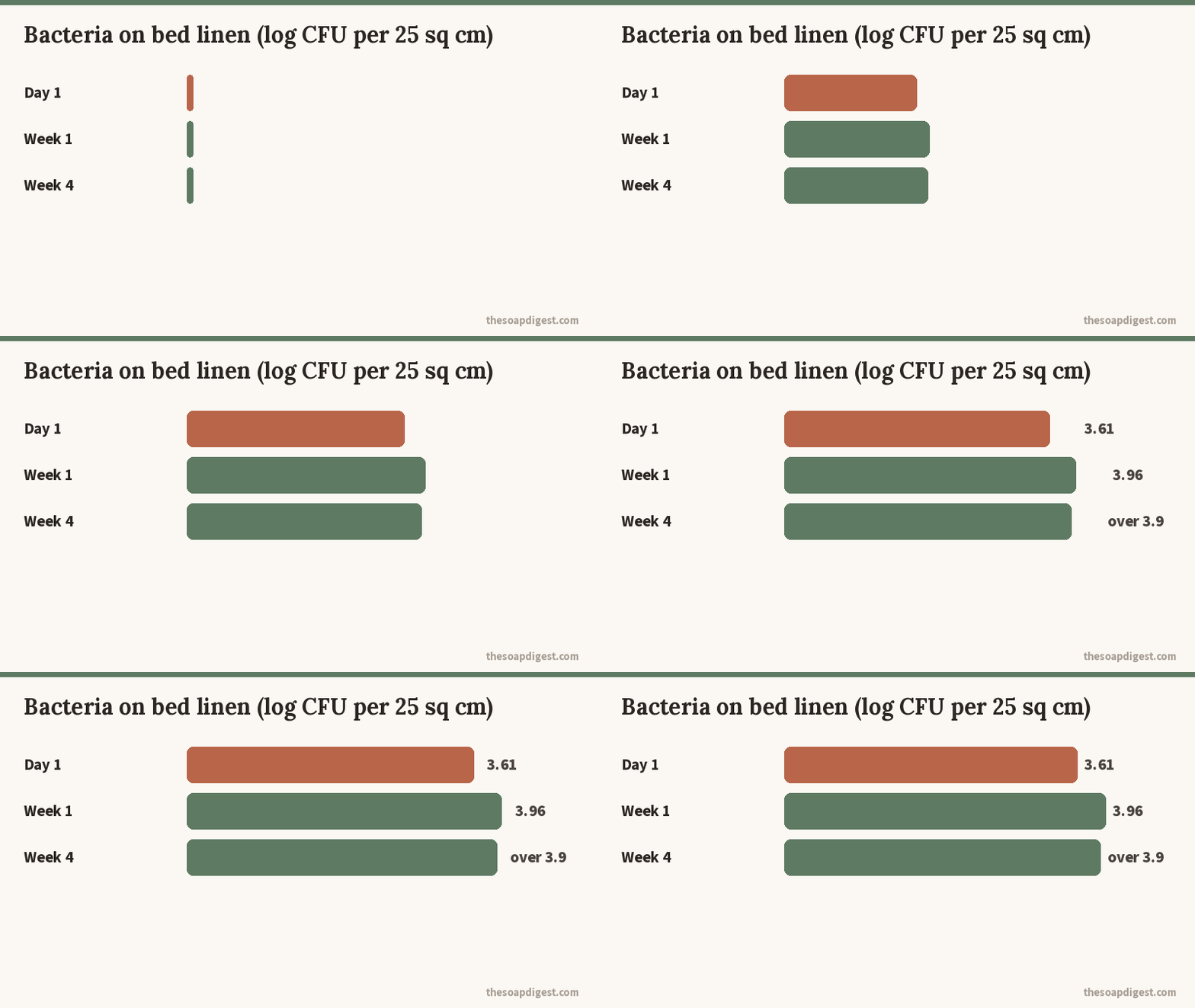
Two things follow. The first is that the intuition driving most bedding guilt — that every extra night makes it meaningfully worse — is not what the one relevant measurement shows. Week four looked much like week one. The second is more interesting: 65% of samples were dominated by Staphylococcus, with S. capitis, S. hominis and S. epidermidis the most frequent species. S. hominis is the organism identified as the principal producer of the sulphurous thioalcohol behind underarm odour (Minhas et al., 2018) — though that work was done in an armpit, with a precursor secreted by apocrine glands that your scalp does not have. The organism being present is not the same as the pathway running.
It is nine households, and the authors say so. It is also the only longitudinal measurement of its kind, and worth more than any amount of confident advice about bedding hygiene.
The pillow samples the room as well as you
A detail from a completely different field reframes this. Researchers studying tobacco residue in homes needed a cheap passive sampler, and used an ordinary cotton travel pillow — left in the house for a median of nine days, then taken apart and analysed.
It worked remarkably well. Nicotine in the pillow’s components correlated with measured air nicotine at rho 0.76 to 0.88, and with the children’s urinary cotinine at 0.65 to 0.81 (Quintana et al., 2024). Median pillowcase nicotine ran at 337.7 ng/g per day in smoking homes without a ban, against 0.1 in non-smoking homes.
That is tobacco, not body odour, and the inference does not transfer automatically. But it establishes something about the object: a pillow is an accumulator that reports on the air around it, accurately enough to be used as an instrument. In a pilot study of eight adults, pillow dust carried significantly higher microbial richness and phylogenetic diversity than either saliva or bedroom air, and clustered closer to the air than to the mouth (Jang et al., 2026).
So part of what you are smelling is not you. If the whole room smells, the pillow will smell, and washing it is treating a symptom — which is the argument running through our room-by-room guide to household odour.
The oil in the middle is the part that keeps changing
Skin oil on a surface is not inert. Squalene, a major component of skin lipids, breaks down continuously indoors — and a 2026 paper in Science Advances found that the dominant route is not the one everyone assumed. Exposure to ozone alone gave simple first-order decay; exposure to indoor air gave accelerating decay and rising reactive oxygen species, with condensed-phase products enriched in highly oxidised hydroperoxides matching what is actually observed indoors. The authors conclude that gas-phase radical-induced autoxidation governs squalene ageing, “challenging the prevailing ozone-centric view” (Wang et al., 2026).
Practically, that means the deposit does not need anything done to it to keep reacting. It is not waiting for a cleaning product or an open window.
The conditions also matter, and a pillow is the worst case on every axis. Work on skin-oil-soiled surfaces found that plates soiled by direct skin contact released more than ten times the volatile products of plates dusted with shed skin flakes, and that higher humidity and lower air change rates increased both uptake and gas-phase products (Wojnowski et al., 2026). Direct contact, high humidity, almost no ventilation, for eight hours: that is a description of a pillow under a sleeping head. We set out what that chemistry means for armrests and headrests elsewhere; the bed is the same mechanism with the dial turned up.
The yellow stain and the stale smell share a cause
This is the most-searched question in the family, and it deserves an honest answer rather than a confident one: no published chemical analysis of a yellowed pillow exists, so what follows is mechanism, not measurement.
What is established is that the principal lipid deposited on bedding is skin oil, that squalene is a large fraction of it, and that squalene autoxidises. Yellowing is what oxidised lipid looks like on pale cotton — the same colour an old cooking-oil mark develops on a cupboard shelf.

The useful consequence is diagnostic. A yellowed pillow is a pillow that has absorbed a lot of oil, so it is also a pillow with a large reservoir of the thing that produces this odour. Bleaching the stain out — the advice almost every page on this subject gives — addresses the colour and not the lipid. Our laundry guide covers why a cool cycle leaves oil-borne odour behind and what changes that.
The pillow has been studied in detail, just never for smell
It is worth saying plainly how thin the ground is, because the internet does not.
A title-and-abstract search pairing pillow with odour or odor returns three records. One is a randomised trial of a herbal sleep sachet, one is about deliberately scenting a bedroom to improve sleep, and one is about antimicrobial food packaging. None is about a pillow smelling. A search for bed linen with odour returns zero, and 2-nonenal has never been looked for in a pillow at all.
Set that against the same object searched for allergens: house dust mite with pillow returns fifty records. And the pillow has been cultured properly — ten used pillows in Manchester, aged from eighteen months to over twenty years, yielded between four and sixteen fungal species each, most commonly Aspergillus fumigatus, with 47 further species across pillows and vacuumed dust (Woodcock et al., 2006).
So the pillow is not an unstudied object. It is a well-studied object that nobody has ever put a nose or a gas chromatograph to. Everything you will read about why your pillow smells, including this page, is built on reasoning from adjacent evidence, and anyone presenting it as settled is overstating what exists.
What to do, in the order that matters
Deliberately boring, and in this order:
- Put a zipped washable protector on, today. Every other method on this list is an attempt to remove oil from something it has already soaked into. A protector stops the oil arriving and then goes in the wash with the towels. It is the only step that keeps working without being repeated.

- Wash the pillow itself if the label allows, and dry it properly. Most synthetic and down pillows are machine washable; memory foam and latex usually are not. Drying is the step people get wrong — a pillow holds water deep in the middle, and a damp pillow is a worse problem than a stale one.
- Change the case weekly, on a schedule. Not when you notice a smell, because you adapt to your own odour within minutes and cannot judge it; see why you cannot smell your own body odour.
- Replace a pillow that is years old and yellow through. If the filling cannot be washed and is saturated, there is no product that fixes it. A new pillow plus a protector costs less than the sequence of sprays people try first.
- Wash the body oil off before bed, not just in the morning. This is the only step that reduces what gets deposited tonight.
Skip the fabric refresher. A spray lands on the top millimetre of a reservoir that is centimetres deep, which is why it works on curtains and fails on pillowcases.
What a bar of soap can and cannot do here
The site you are reading is owned by the company that makes one of the persimmon soaps in our comparison, so take the following as the limit rather than the pitch.
A persimmon tannin bar is a rinse-off soap aimed at the oil-borne, stale half of this problem. The most it can do for a pillow is reduce how much oxidisable sebum arrives on it from tonight onwards. It cannot reach what is already in the filling, it will not strip a stain, and on an old saturated pillow the laundry and the replacement matter more than the soap does. If your complaint is a sharp, sweaty smell that arrives with heat rather than a stale greasy one, this is the wrong product class entirely and our comparison of the best persimmon soap options says so in each entry.
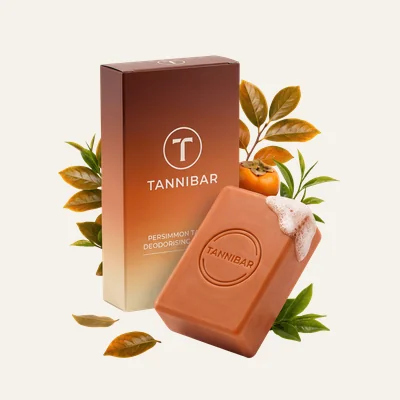
TanniBar Persimmon Tannin Bar
Fragrance-free and aimed at the oil-borne odour rather than masking it — which makes it the right class of product for the deposit, and no substitute for washing the bedding.
Check price →We own TanniBar and earn from sales. 30-day refund, no return needed.When this belongs with a doctor
The NHS advises seeing a GP, non-urgently, if body odour has not improved after self-treatment and it is affecting your self-esteem, you notice a change in how it usually smells, or you suddenly start sweating much more than usual. The same page notes that conditions including diabetes, kidney disease and liver disease, and some medicines such as antidepressants, can make body odour worse.
Separately: if your bedding is associated with a cough or breathlessness, that is a medical question rather than a cleaning one. There is a published case of fibrotic hypersensitivity pneumonitis attributed to foam bedding, in which the patient improved after removing it and deteriorated again after sleeping on a foam pillow, with Penicillium cultured from the pillow (Coppola Lamas et al., 2024). That is one case report, not a general risk — but it is a reason to take breathing symptoms to a clinician rather than to a laundry routine.
The bottom line
The washable layer stops getting worse after about a week. The layer nobody washes has never been measured at all. That asymmetry is why a clean case on an old pillow smells stale within days, and it is why the answer is a protector and a laundry schedule rather than a stronger cleaner.
If the smell is stale and greasy and strongest on bedding and collars, you are dealing with oxidised skin oil, and the laundry, the furniture and the shower all contribute. If it arrives with heat and sweat instead, read why night sweats smell first, because that is a different mechanism with a different fix.
Frequently asked questions
Why does my pillow smell even with a clean pillowcase on it?
Because a pillowcase is a thin layer of cotton, not a barrier. Skin oil passes through it into the filling, where it stays. 2-Nonenal, the stale, greasy compound behind age-related body odour, is oil-soluble and listed by PubChem as insoluble in water, so it travels with sebum rather than with sweat and accumulates in whatever has absorbed that sebum. A fresh case over a pillow that has had years of contact can smell stale within a few days, and that is the pillow talking, not the case.
How often should I change my pillowcase?
Weekly is a reasonable default, and the one piece of relevant measurement supports changing on a schedule rather than when you notice something. A 2026 study followed polycotton bed linen in nine domestic households and found bacterial and fungal counts rose over the first week of use and then stayed essentially flat for the remaining three weeks. The implication is that most of what is going to arrive arrives early, so a long interval is not progressively worse in the way people assume. No study has measured how often bedding needs changing to control odour specifically.
Can you wash the pillow itself, not just the case?
Most synthetic and down pillows can be machine washed, and the care label is the thing to follow rather than any general rule. Two practical cautions apply. The first is drying: a pillow holds a lot of water in the middle, and a pillow that goes back on the bed damp is a worse problem than a pillow that smells, so it needs a long, thorough dry until it is dry to the touch throughout. The second is that memory foam and latex are usually not washable at all, which is why a zipped, washable protector matters more for those than for anything else.
Why do pillows turn yellow?
The honest answer is that nobody has published a chemical analysis of a yellowed pillow, so this is mechanism rather than measurement. What is known is that the main lipid deposited on bedding is skin oil, that squalene makes up a large fraction of it, and that squalene on indoor surfaces undergoes radical-driven autoxidation, breaking down into a mixture of oxidised products. The staining and the stale smell share a starting material and a chemistry, which is why a yellow pillow and a stale pillow tend to be the same pillow. The stain is not proof of anything on its own.
Does a pillow protector actually help?
It is the only step here that keeps working without being repeated, because it changes the problem rather than treating it. Every other method is an attempt to get oil out of something it has already soaked into. A zipped protector intercepts the oil before it arrives and then goes in the wash with the towels, which converts an unwashable reservoir into ordinary laundry. It does nothing for the oil already in an old pillow, so on an old pillow it is a step to pair with washing or replacing it, not a substitute.
Can my pillow make me ill?
For most people it is a comfort and odour question rather than a health one, but the bedding literature is not empty on this. Ten used pillows cultured in Manchester yielded between four and sixteen fungal species each, most commonly Aspergillus fumigatus, and the authors raised the implications for people with asthma and sinusitis. There is also a single published case of fibrotic hypersensitivity pneumonitis attributed to foam bedding, where the patient improved after removing it and worsened again after sleeping on a foam pillow. That is one case report rather than a general risk, but if your bedding is associated with a cough or breathlessness, that belongs with a doctor rather than with a cleaning routine.
Will persimmon soap stop my pillow smelling?
It can only affect what you deposit from tonight onwards, and it does nothing to what is already in the pillow. A persimmon tannin bar is a rinse-off soap aimed at 2-nonenal from skin oils; washing more carefully reduces the amount of oxidisable oil going onto the bedding, which is a real contribution to the problem and not the whole of it. If the pillow has been in use for years, the reservoir in the filling will keep producing odour regardless of what you wash with. This site is owned by the company that makes one of those bars, and on this particular question the laundry comes first.
Sources
- Cayrou C., Abu-Aita M., Laird K. (2026). From clean to colonized: microbial dynamics of bed linen over time. Lett Appl Microbiol 79(9):ovag078. (Nine participants used polycotton bed linen for periods from one day to four weeks in a domestic environment; swatches were taken from the pillow, hip and foot regions and analysed by viable counts and amplicon sequencing. "After use, bacterial and fungal loads increased, respectively, from 3.61 log10CFU/25 cm2 and 3.25 log10CFU/25 cm2 at day one to 3.96 log10CFU/25 cm2 and 3.63 log10CFU/25 cm2 after one week. Loads remained stable over four weeks (bacteria > 3.9 log10; fungi > 3.5 log10CFU/25 cm2)." Sequencing showed "65% of samples were dominated by Staphylococcus spp. (50%-99% relative abundance), with S. capitis, S. hominis, and S. epidermidis most frequent". Fungal communities "commonly included Naganishia spp., Candida spp., and Penicillium spp." The authors state the findings are "based on a small domestic cohort". The endpoint is microbial load, not odour.)
- Jang J.Y., Lee J., Yun H., Yang J. (2026). A Tri-Source Microbiome Dataset from Human Sleep Environments: Saliva, Pillow Dust, and Bedroom Air. Lifestyle Genom 19(1). (A pilot study of eight healthy adults, with paired saliva, pillow dust and bedroom air samples characterised by 16S rRNA amplicon sequencing. "Pillow dust exhibited significantly higher alpha diversity, including species richness and phylogenetic diversity, compared to saliva and air (p < 0.05)." Beta diversity clustered by sample type, "with pillow dust and air showing greater similarity to each other than to saliva". The authors state that "given the small sample size, findings should be interpreted as exploratory".)
- Quintana P.J.E., Lopez-Galvez N., Matt G.E., Merianos A.L., Dodder N.G., Hoh E., et al. (2024). Cotton pillow samplers for assessment of thirdhand smoke in homes of smokers and nonsmokers with children. J Environ Expo Assess 3:1. (A commercially available organic cotton travel pillow was left in homes for a median of 9.1 days and its components analysed. "Pillow component nicotine levels were significantly higher in homes of smokers without a ban as compared to smokers and nonsmokers who had a ban (e.g., median pillowcase nicotine 337.7 ng/g per day vs. 72.5 ng/g per day and 0.1 ng/g per day, respectively)." Nicotine in the pillow components "were highly correlated with air nicotine levels (rho=0.76-0.88, all p<0.001)" and with urinary cotinine in the children (rho=0.65 to 0.81). Cited here only for the demonstration that a pillow accumulates and reports on airborne residues in a home; the pollutant studied is tobacco residue, not body odour.)
- Wang X., Downey J.P., Gobbi G., Fahy W.D., Wu W., Xie L., Hou X., Peng H., Abbatt J.P.D. (2026). Radical-induced autoxidation dominates squalene oxidative aging under environmental conditions. Sci Adv 12(42):eaei2144. (Squalene, described as "a major component of skin lipids", was exposed to indoor air and to laboratory flow reactors. "With exposure to indoor air, SQ decay and reactive oxygen species (ROS) formation accelerated over time, consistent with autoxidation." Exposure to ozone and hydroxyl radical together "produced nonexponential SQ decays, higher ROS yields, a much stronger in-film OH source, and condensed-phase products enriched in highly oxidized organic hydroperoxides that closely match those observed indoors". The authors conclude that "gas-phase radical-induced autoxidation governs SQ aging, challenging the prevailing ozone-centric view of indoor skin oil oxidation". They also report, unexpectedly, that "gas-phase OH strongly suppressed VOC emissions".)
- Wojnowski W., Wisthaler A., Mikoviny T., Beko G., Weschler C.J., Sjoblom A., Langer S. (2026). Ozone Reactions with Indoor Surfaces Soiled by Human Skin Oil are Impacted by Manner of Soiling, Relative Humidity, and Air Change Rate. Environ Sci Technol 60(31):21837-21848. (Glass plates were soiled by long-term natural accumulation, fresh squame deposition or direct dermal contact, then exposed to about 42 ppb ozone at 20% or 70% relative humidity. "Ozone exposure consumed 22-98% of the squalene, depending on the soiling mode." "Elevated relative humidity and lower air change rates enhanced ozone uptake and gas-phase product formation." "Plates soiled by direct contact produced more than an order of magnitude higher volatile product mixing ratios than plates soiled with freshly deposited squames." Gas-phase products included acetone, 4-oxopentanal and 6-methyl-5-hepten-2-one. The surfaces are glass plates in a chamber, not bedding.)
- Woodcock A.A., Steel N., Moore C.B., Howard S.J., Custovic A., Denning D.W. (2006). Fungal contamination of bedding. Allergy 61(1):140-2. (Ten used synthetic and feather pillows, aged between 1.5 and more than 20 years, were quantitatively cultured for fungi from swatches taken at nine sections, with dust also vacuumed from five of them. "The commonest three species isolated were Aspergillus fumigatus (n = 10), Aureobasidium pullulans (n = 6) and Rhodotorula mucilaginosa (n = 6). Another 47 species were isolated from pillows and vacuum dust. The number of species isolated per pillow varied from 4 to 16, with a higher number from synthetic pillows." The authors conclude that "the typical used pillow contains a substantial load of many species of fungi" with "important implications for patients with respiratory disease, and especially asthma and sinusitis". Ten pillows, and the endpoint is fungal flora rather than smell.)
- Coppola Lamas M.A., Boag A., Dabreo D., Moran-Mendoza O. (2024). Hypersensitivity pneumonitis secondary to foam exposure in mattress and pillows. BMJ Case Rep 17(8):e260517. (A single case report. A woman referred for breathlessness and cough was found to have fibrotic hypersensitivity pneumonitis on imaging, lung function testing and cryobiopsy. "She had foam in mattress and pillows but no other exposures. Her symptoms, PFTs, and imaging improved after avoiding foam in her bedding. After re-exposure to a foam pillow, her symptoms, PFTs, and HRCT worsened. Microbiological analysis of the foam pillow reported Penicillium spp, known to cause HP." One patient, reported as a novel cause; not a general estimate of risk.)
- Haze S., Gozu Y., Nakamura S., Kohno Y., Sawano K., Ohta H., Yamazaki K. (2001). 2-Nonenal newly found in human body odor tends to increase with aging. J Invest Dermatol 116(4):520-4. (2-Nonenal was "detected only in older subjects (40 y or older)". Omega-7 unsaturated fatty acids in skin surface lipids are oxidatively degraded, with lipid peroxides acting as the initiator of the oxidative chain reaction. The authors were employed by Shiseido, a cosmetics company.)
- PubChem compound summary for 2-nonenal (CID 5283335). Molecular weight 140.22, XLogP 3.1, and listed as soluble in most fixed oils and insoluble in water.
- Mollebjerg A., Palmen L.G., Gori K., Meyer R.L. (2021). The Bacterial Life Cycle in Textiles is Governed by Fiber Hydrophobicity. Microbiol Spectr 9(2):e0118521. (Polyester adhered more bacteria and absorbed more sebum than cotton.)
- Minhas G.S., Bawdon D., Herman R., Rudden M., Stone A.P., et al. (2018). Structural basis of malodour precursor transport in the human axilla. eLife 7:e34995. (Underarm malodour is produced when skin bacteria, principally Staphylococcus hominis, take up an odourless precursor secreted in apocrine sweat and release the volatile thioalcohol 3-methyl-3-sulfanylhexan-1-ol. Cited here for the identity of the organism only; the site studied is the armpit, not a pillow.)
- PubMed title-and-abstract search for pillow with odor or odour (18 November 2026). (three records, and none is about a pillow smelling: a randomised trial of a herbal sleep sachet, a study of deliberate night-time odour exposure and sleep quality, and a paper on antimicrobial food packaging.)
- PubMed title-and-abstract searches for bed linen with odor or odour, and for 2-nonenal with pillow (18 November 2026). (both zero. Bed linen has been cultured, sequenced and sampled, but what it smells of has not been measured, and 2-nonenal has never been looked for in a pillow.)
- PubMed title-and-abstract search for house dust mite with pillow (18 November 2026). (fifty records. The pillow is a well-studied object in allergy research, which is what makes the three-record odour result worth stating.)
- NHS: Body odour (BO) (accessed 18 November 2026). Advises seeing a GP, non-urgently, if body odour has not improved after self-treatment and "it's affecting your self-esteem", "you notice a change in how it usually smells", or "you suddenly begin to sweat much more than usual". The page also lists exercise, hot weather, hormonal changes, being overweight, "having a condition like diabetes, kidney disease or liver disease" and "certain types of medicine, such as antidepressants" among the things that can make body odour worse.
- TanniBar product page (claims as stated by the manufacturer): 100% fragrance-free; triple-milled; ingredients persimmon tannin, green tea leaf extract, vegetable glycerin, shea butter, saponified coconut and palm oil, vitamin E and water; 30-day refund with no return required. The company that makes TanniBar also owns this website.