Home › Sensitive & Mature Skin › Persimmon soap for sensitive skin
Sensitive & Mature SkinPersimmon Soap for Sensitive Skin: What Is Actually Measurable
A laboratory method for ranking soaps by how much they irritate skin has existed since 1979. In nearly fifty years, no persimmon tannin bar has been put through it.

Disclosure: The Soap Digest is owned by the same company that makes TanniBar. We rank it first and we earn money when you buy it. Every other brand here is linked without payment, and we try to describe each one fairly. Check the facts for yourself. How we handle this.
In this guide
- The short version
- What sensitive skin means in the research
- Soap harshness has been measurable since 1979
- Where a persimmon bar sits on that scale
- What the literature does not contain
- The label will not settle it for you
- The fragrance question has data, and it cuts both ways
- What you can check before you buy
- When to see a doctor rather than change soap
- The bottom line
Searching for the best persimmon soap for sensitive skin returns a great many confident answers, and almost none of them rest on anything you could check. Not because the question is unanswerable in principle: skin scientists have had a laboratory method for ranking soaps by how much they irritate skin since 1979, and it has been used on dozens of products. It has never been used on a persimmon tannin bar. So the honest version of this page is not a winner, but a short list of what has been measured, a shorter list of what you can verify on a label, and the gap between them.
The short version
- Sensitive skin is defined by what you feel, not by what an instrument reads. The international expert definition is built entirely from reported sensations in skin that may look completely normal.
- It is also the majority report. Pooled across 26 studies in 18 countries, 71 per cent of adults describe their skin as sensitive to some degree. A label aimed at everybody distinguishes nothing.
- Soap harshness, by contrast, is measurable — and alkaline true soaps measure worse than milder cleanser types on skin pH and redness. Every persimmon tannin bar in our comparison is an alkaline true soap, including the one we make.
- No persimmon bar has ever been through an irritancy test. Three separate literature searches come back empty.
- The words on the packaging have no legal definition. The FDA says so about “hypoallergenic” in its own words, and names “safe for sensitive skin” in the same breath.
- Fragrance is the one variable with relevant data, and it cuts both ways. Buy unscented to remove a variable, not to buy comfort.
What sensitive skin means in the research
In 2017 an international expert group working under the International Forum for the Study of Itch used a formal consensus process to settle on a definition. Sensitive skin, they agreed, is “a syndrome defined by the occurrence of unpleasant sensations (stinging, burning, pain, pruritus, and tingling sensations) in response to stimuli that normally should not provoke such sensations”, where “these unpleasant sensations cannot be explained by lesions attributable to any skin disease”, and where “the skin can appear normal or be accompanied by erythema” (Misery et al., 2017).
Read that twice, because the whole of this page follows from it. The definition is a description of sensations: no threshold, no marker, no number. Instruments are not absent from the field — a 2021 paper was still proposing a burden questionnaire and a perception-threshold measurement as diagnostic tools (Polena et al., 2021) — but the condition itself is anchored in self-report.
That matters commercially, because self-report is nearly universal. A meta-analysis pooling 26 studies and 51,783 people across 18 countries found 71 per cent described their skin as sensitive to some degree, and 40 per cent as very or moderately sensitive; women more often than men, 45 against 33 per cent. The authors add their own caution: the figure depends heavily on how the question is asked, and questionnaire studies probably overstate it (Chen et al., 2020). A separate survey of 10,743 adults in five countries put it at 48.2 per cent, with several authors employed by a cosmetics company (Misery et al., 2022).
A product feature aimed at seven adults in ten is not a feature. It is an audience.
Soap harshness has been measurable since 1979
Here is the asymmetry that makes this page worth writing. “Sensitive skin” resists measurement; the harshness of a bar of soap does not, and has not for nearly half a century.
In 1979, Peter Frosch and Albert Kligman published the soap chamber test. The method is deliberately brutal: five weekday exposures to an 8 per cent soap solution under occlusion, then readings of scaling, redness and fissuring the following Monday. They ran eighteen well-known toilet soaps through it. “Great differences were noted,” they wrote. “Most had an appreciable irritancy potential” — explicitly against earlier work concluding that soaps were much of a muchness, or harmless (Frosch & Kligman, 1979).
Two more recent studies fill in what that means for someone standing in a shower rather than a laboratory, and they disagree instructively.

The first put an alkaline soap bar against a syndet — a synthetic detergent bar formulated near skin pH — in a double-blind trial where 50 healthy women used one or the other at home for ten consecutive weeks. The instruments found almost nothing: no significant change at any body site, except a small rise in skin pH with the soap bar. But the women using the alkaline bar reported it as more irritating, and in the soap chamber test run alongside, that bar was significantly harsher. The authors’ conclusion is the useful bit: an exaggerated patch test is not predictive of normal use, yet the soap chamber result tracked what consumers actually said (Barel et al., 2001).
The second is closer to a real routine. Four groups of 15 people washed one forearm with an alkaline, creamy or glycerin soap or a syndet, at least four times a day for a week. Water loss through the skin rose after the very first wash in every group; the alkaline soap raised skin pH at every time point, and redness was significantly higher in that group than in the glycerin and creamy ones. The authors conclude that adding compounds such as glycerin can modify those effects (Khosrowpour et al., 2022). Fifteen people per arm, one week, no blinding — a hint, not a verdict.
Where a persimmon bar sits on that scale
Persimmon tannin bars are, with few exceptions, true soaps: saponified oils, alkaline by the chemistry of how they are made. Our own bar is one of them, and its published ingredient list says so — persimmon tannin, green tea leaf extract, vegetable glycerin, shea butter, saponified coconut and palm oil, vitamin E and water. The glycerin and shea butter are real, and the study above is why they are not merely decorative. But they do not change the pH. A true soap is alkaline because of what it is, and no humectant added to it makes it a syndet.
So the uncomfortable summary, for a site owned by the company that makes one of these bars, is this: on the only axis of mildness anyone has quantified, every persimmon soap on the market sits on the harsher side, ours included. The gentlest cleanser types in this literature are not persimmon bars at all — they are the syndets and non-foaming cleansers dermatology has recommended for decades, and those do nothing for 2-nonenal. That is a real trade-off rather than something to talk around, and it is the odour-side half of our evidence review of whether persimmon soap works.
What the literature does not contain
Three searches, run today, define the hole.
A title-and-abstract search for persimmon alongside sensitive skin returns nothing at all. A search for persimmon alongside irritation or irritant returns two records, and neither is about washing: one is the sex pheromone of a nettle moth whose host plant happens to be persimmon, and the other gave persimmon leaf extract to mice in an allergy model. A search for soap chamber alongside tannin, plant, botanical or persimmon also returns nothing — in nearly fifty years, the eighteen-soap method has not been pointed at a plant-tannin bar.
One search doubles as a warning about reading other people’s citations. Tannin alongside sensitive skin returns nine papers, and all nine are about tanning — sunbeds, sunburn, solarium compliance, melanoma risk. The wildcard that catches “tannins” also catches “tanning”. If you are shown a long reference list proving persimmon tannin is skin-friendly, check the papers are about the right word.
The label will not settle it for you
This is where the FDA is unusually direct. Its page on hypoallergenic cosmetics states that “there are no Federal standards or definitions that govern the use of the term ‘hypoallergenic’”, that “the term means whatever a particular company wants it to mean”, and that manufacturers using it “are not required to submit substantiation of their hypoallergenicity claims to FDA”. The page adds that dermatologists “say it has very little meaning”, and reproduces a much older agency article that lists “hypoallergenic”, “safe for sensitive skin” and “allergy tested” together as claims which imply fewer reactions while “there has been no assurance to consumers that this actually was the case” (FDA).
The phrase in the middle of that list is the search term that brought you here.
A 2021 review in Skin Therapy Letter makes the same point across the whole shelf: terms such as “hypoallergenic”, “sensitive skin” and “baby product” lack legal definitions, “fragrance-free” is frequently misinterpreted, and current labelling law permits language that is “incomplete, misinterpreted, or applied solely for marketing purposes” (Tantry et al., 2021). One author declares a cosmetics-industry advisory role, noted for the same reason we note it about everyone else.
What the same regulations do give you is the ingredient list — a legal requirement, and the only part of the packaging that has to be true.
The fragrance question has data, and it cuts both ways
Fragrance is the single checkable difference between persimmon bars that connects to any published evidence, so it is worth getting right rather than sloganising.
On one side: the EDEN Fragrance Study patch-tested a random sample of 3,119 adults from the general population of five European countries and interviewed them about the scented products they used. Self-reported sensitive skin was associated both with exposure to scented products and with fragrance contact allergy, and the authors name female sex and sensitive skin as relevant indicators for developing it, most strongly for leave-on products (van Amerongen et al., 2021). It was funded by a fragrance-industry research institute, which if anything makes the direction of the finding more notable.
On the other side: a three-week, double-blind, randomised, two-centre study of 153 people with clinically diagnosed sensitive skin found a gentle fragranced foaming cleanser as well tolerated as a fragrance-free benchmark, with itching and irritation improving in both groups. The authors worked for a consumer-products company — and, more importantly, the fragrance had been deliberately composed to be “free of common allergens and irritating essential oils” (Draelos et al., 2015).
That caveat is the whole of it. The trial does not show that scent is harmless to reactive skin; it shows that a scent screened to exclude the known offenders behaved like no scent at all. You cannot tell from a wrapper which kind you are holding, and essential oils — lemongrass, pine, citrus — are not screened out by being natural.
Across the five bars in our comparison of the best persimmon soap options, one is sold as entirely fragrance-free, one in both an unscented and a scented version, and three carry a scent by default, two of those from essential oils. If you react to things, that is a verifiable way to narrow five options to two.

What you can check before you buy
Nothing above establishes that any persimmon bar is gentle. It establishes what is knowable, which is shorter and more useful.
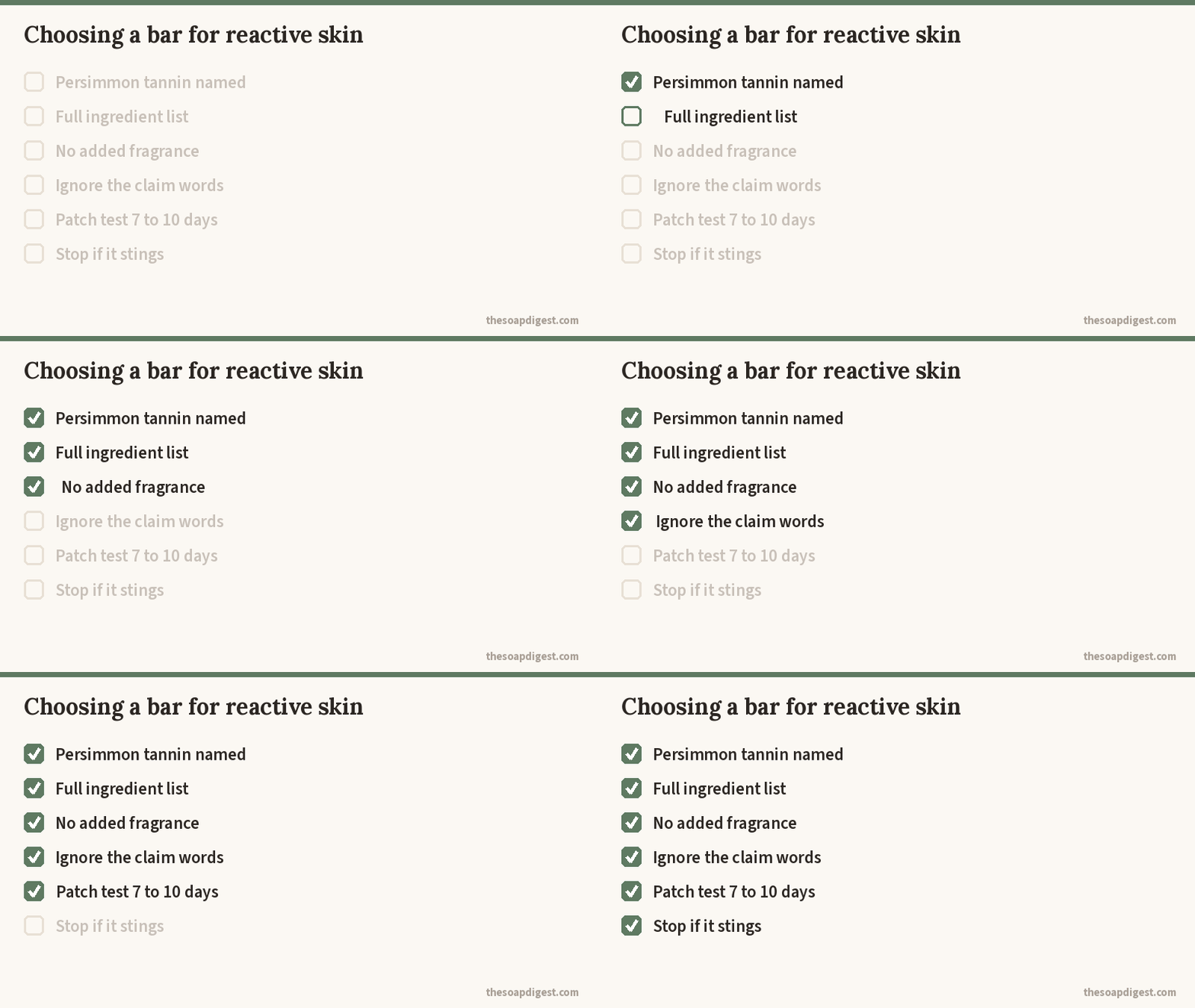
- Read the full ingredient list, not the headline. It is the one part of the label with legal force behind it, and persimmon tannin should be named — as persimmon, kaki, Diospyros kaki or kakishibu — not implied by a fruit on the wrapper.
- Decide about scent deliberately. Unscented removes a variable linked to fragrance allergy in a general-population sample. That is a reduction in risk, not a promise of comfort.
- Treat claim words as marketing. “Hypoallergenic”, “for sensitive skin” and “allergy tested” carry no definition anyone has to meet.
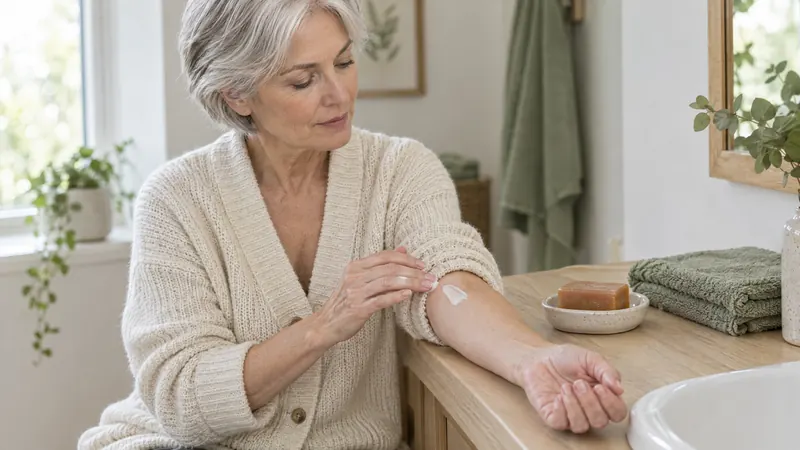
- Patch-test before you commit, twice daily for seven to ten days. Our guide to persimmon soap side effects sets out the dermatologist-recommended method adapted for a wash-off product.
- Use it where the odour is, not everywhere. Age-related odour concentrates on oil-rich skin, and limiting an alkaline bar to those areas limits the exposure; our how-to guide covers the technique.
- Stop if it stings. Pushing on in the hope the skin will adapt is not a strategy this literature supports.
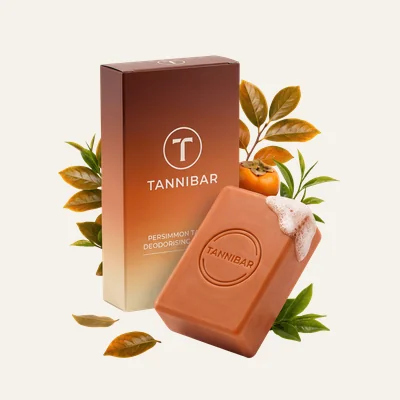
TanniBar Persimmon Tannin Bar
Of the five bars we compare, it is the one sold as entirely fragrance-free, with no perfume and no essential oils, and with glycerin and shea butter in the formula. It is still a true soap, so it is still alkaline, and it still needs patch-testing like any other.
Check price →We own TanniBar and earn from sales. 30-day refund, no return needed.When to see a doctor rather than change soap
Skin sensations that keep recurring, hurt, or come with a visible rash are worth a GP or dermatologist appointment rather than another product trial. The expert definition of sensitive skin explicitly excludes sensations explained by a skin disease, and telling the two apart is a clinical job.
On the odour side, the NHS advises seeing a GP if body odour has not got better after treating it yourself and it is affecting your self-esteem, you notice a change in how it usually smells, or you suddenly begin to sweat much more than usual. The same page notes that things which can make body odour worse include having a condition like diabetes, kidney disease or liver disease, and certain types of medicine such as antidepressants (NHS).
The bottom line
The question “which persimmon soap is best for sensitive skin” has no evidence-based answer, and the reason is specific rather than hand-waving: the test that would answer it has existed since 1979 and has never been run on this category. Sensitive skin is a report about sensations rather than a measurable property, seven adults in ten make that report, and every bar here — ours included — sits at the harsher end of the only scale anyone has quantified.
So choose on the two things that are real: the ingredient list and the scent. Then test it on a small patch of your own skin for a week, which is, absent any published trial, the only irritancy test ever run on the bar you are actually going to use. If it does not suit you, the reasons persimmon soap does not work covers what else the smell might be — and a good deal of it lives in fabric rather than on skin.
Frequently asked questions
Which persimmon soap is best for sensitive skin?
No persimmon bar has been tested for irritancy in a way that would let anyone answer that honestly, so the choice has to be made on what the brands themselves publish rather than on evidence of mildness. The checkable differences are the full ingredient list and whether any fragrance or essential oil is added. Of the five bars in our comparison, one is sold as fragrance-free, one is sold in both an unscented and a scented version, and three are scented by default, two of them with essential oils. That narrows the field; it does not tell you the remaining bar is gentle.
Is persimmon soap safe for sensitive skin?
There is no study that answers this directly. What is known is that persimmon tannin bars are generally true soaps, meaning alkaline ones, and alkaline soaps have been measured raising skin pH and producing more redness than milder cleanser types. If your skin stings or burns easily, that is the category you are buying into, whichever brand you pick. Patch-test before you commit, keep it to the oil-prone areas where age-related odour actually collects, and stop if the skin reacts. Our guide to persimmon soap side effects covers the testing method in full.
Does hypoallergenic mean a soap is safe for sensitive skin?
No. The US Food and Drug Administration states plainly that there are no federal standards or definitions governing the use of the term hypoallergenic, that it means whatever a particular company wants it to mean, and that manufacturers are not required to submit any substantiation of the claim. The same page records that the agency knows of no scientific studies showing that cosmetics labelled this way cause fewer adverse reactions than conventional ones. A 2021 dermatology review makes the same point about the phrase sensitive skin itself, which also has no legal definition.
Should I choose a fragrance-free persimmon soap?
It is the one choice in this category with any relevant data behind it, and the data point in two directions. A European general-population study that patch-tested over three thousand people found self-reported sensitive skin associated both with using scented products and with fragrance contact allergy. Against that, a randomised trial in 153 people with clinically diagnosed sensitive skin found a gentle fragranced cleanser as well tolerated as a fragrance-free benchmark, though the fragrance in that product had been deliberately screened to exclude common allergens and irritating essential oils. Buying unscented removes a variable; it does not guarantee comfort.
Does adding glycerin or shea butter make a persimmon soap gentler?
It does not change the pH. A true soap is alkaline because of how it is made, and adding a humectant does not alter that. There is some measured signal that it changes other things: in a seven-day forearm study comparing four cleanser types, redness was significantly higher in the alkaline soap group than in the glycerin and creamy soap groups, and the authors concluded that adding compounds such as glycerin can modify the effects of strong cleansing. That compared different products rather than one product with and without glycerin, with fifteen people per group and no blinding, so it is a hint rather than a finding about any particular bar.
What does sensitive skin actually mean?
An international expert group defined it by consensus in 2017 as a syndrome of unpleasant sensations — stinging, burning, pain, itching and tingling — in response to things that should not normally cause them, where those sensations cannot be explained by any skin disease, and where the skin may look completely normal. That definition is built entirely out of what the person reports. It is also extremely common: a meta-analysis of 26 studies across 18 countries put the pooled figure for self-declared sensitive skin to some degree at 71 per cent of adults.
If my skin reacts to persimmon soap, what should I do instead?
Stop using it and let the skin settle before you try anything else; a reaction is not a reason to push on in the hope of adapting. If odour is the problem you were trying to solve, the useful thing to know is that a great deal of it lives in fabric rather than on skin, and washing pillowcases, collars and bedding changes the smell without going anywhere near your face or underarms. If the sensations persist, are painful, or come with a rash, that is a question for a GP or a dermatologist rather than for a different bar of soap.
Sources
- Misery L., Stander S., Szepietowski J.C., Reich A., Wallengren J., Evers A.W., Takamori K., Brenaut E., Le Gall-Ianotto C., Fluhr J., Berardesca E., Weisshaar E. (2017). Definition of Sensitive Skin: An Expert Position Paper from the Special Interest Group on Sensitive Skin of the International Forum for the Study of Itch. Acta Derm Venereol 97(1):4-6. (Using the Delphi method, sensitive skin was defined as "A syndrome defined by the occurrence of unpleasant sensations (stinging, burning, pain, pruritus, and tingling sensations) in response to stimuli that normally should not provoke such sensations. These unpleasant sensations cannot be explained by lesions attributable to any skin disease. The skin can appear normal or be accompanied by erythema. Sensitive skin can affect all body locations, especially the face". The paper also summarises "unresolved aspects of sensitive skin".)
- Chen W., Dai R., Li L. (2020). The prevalence of self-declared sensitive skin: a systematic review and meta-analysis. J Eur Acad Dermatol Venereol 34(8):1779-1788. (26 studies representing the general population in 18 countries, 51,783 individuals. "The pooled proportion of individuals with self-reported sensitive skin to some degrees was 71% [95% confidence interval (CI) 62%-81%] in the general population and 40% (95% CI 32%-47%) among individuals having very or moderately sensitive skin." Women 45% and men 33%, with a risk ratio of 1.741 (1.38-2.20). The authors note that "the prevalence of sensitive skin was dependent on the diagnostic method and the prevalence might be over-estimated in the questionnaire-based epidemiological studies".)
- Misery L., Reaux-Le Goazigo A., Morisset S., Seite S., Delvigne V., Cochener B., Taieb C. (2022). Association of Sensitive Eyes with Sensitive Skin: A Worldwide Study of 10,743 Subjects. Skin Pharmacol Physiol 35(3):148-155. (A survey of 10,743 adults in Brazil, China, France, Russia and the USA. "Among them, 48.2% reported having sensitive skin and 46.0% reported having sensitive eyes." Several of the authors were employed by La Roche-Posay Dermatological Laboratories, a cosmetics company, and one by a health-economics consultancy.)
- Frosch P.J., Kligman A.M. (1979). The soap chamber test. A new method for assessing the irritancy of soaps. J Am Acad Dermatol 1(1):35-41. (The founding description of the method. "The chamber test for assessing the irritancy of soaps entails five weekday exposures to 8% solutions with readings of scaling, redness, and fissuring on the following Monday. Eighteen well-known toilet soaps were evaluated. Great differences were noted. Most had an appreciable irritancy potential. These results contrast with a number of studies which failed to show differences among soaps or which concluded that soaps were innocuous.")
- Barel A.O., Lambrecht R., Clarys P., Morrison B.M. Jr, Paye M. (2001). A comparative study of the effects on the skin of a classical bar soap and a syndet cleansing bar in normal use conditions and in the soap chamber test. Skin Res Technol 7(2):98-104. (A double-blind comparison of an alkaline soap bar and a syndet bar used at home for 10 consecutive weeks by two groups of 25 healthy female subjects. "The bioengineering measurements did not show any significant changes on all the anatomical skin sites, except for a small increase in skin pH with the classical soap bar. However, a trend appeared, showing that the alkaline soap bar is perceived by the subjects themselves as more of an irritant than the syndet bar. In the soap chamber test, the bar soap showed a significantly higher irritancy than the syndet bar." The authors conclude that "cutaneous irritation induced by cleansing products in patch testing is not necessarily predictive of the irritation likely to occur in normal use conditions" while "a clear relationship could be demonstrated between the results of the soap chamber test and the consumer perception of both cleansing bars".)
- Khosrowpour Z., Ahmad Nasrollahi S., Samadi A., Ayatollahi A., Shamsipour M., Rajabi-Esterabadi A., Yadangi S., Firooz A. (2022). Skin biophysical assessments of four types of soaps by forearm in-use test. J Cosmet Dermatol 21(7):3127-3132. (A nonblinded comparative study in which alkaline, creamy and glycerin soaps and a syndet were each used by a group of 15 healthy subjects, washing one forearm at least four times a day for seven days. "After the first wash, a significant increase in TEWL was observed for all groups compared to the pre-intervention period. For the alkaline soap, a substantial increase in pH was observed at all time points compared to the baseline... The mean value of erythema was significantly higher in alkaline soap users than glycerin and creamy soap users." The authors conclude that "alkaline-based soaps could cause erythema and increase TEWL and skin pH due to their strong cleansing action, and the addition of compounds such as glycerin can modify these effects". Fifteen people per arm, one week, no blinding.)
- US Food and Drug Administration: "Hypoallergenic" Cosmetics (content current as of 25 February 2022; read 20 November 2026). ("There are no Federal standards or definitions that govern the use of the term 'hypoallergenic.' The term means whatever a particular company wants it to mean." "Manufacturers of cosmetics labeled as hypoallergenic are not required to submit substantiation of their hypoallergenicity claims to FDA." The page notes that "dermatologists say it has very little meaning". The reproduced 1978 FDA Consumer article names "hypoallergenic", "safe for sensitive skin" and "allergy tested" together as claims that imply fewer allergic reactions, adds that "there has been no assurance to consumers that this actually was the case", and states that "FDA knows of no scientific studies which show that 'hypoallergenic' cosmetics actually cause fewer adverse reactions than competing conventional products".)
- Tantry E., Perez-Sanchez A., Fu S., Potula S., Katta R. (2021). Labeling Laws for Personal Care Products: Potential Pitfalls for The Consumer. Skin Therapy Lett 26(5):1-6. ("For example, terms such as 'hypoallergenic', 'sensitive skin', and 'baby product' lack legal definitions, and terms such as 'fragrance-free' are frequently misinterpreted." The review states that "current labeling laws permit the use of language that may be incomplete, misinterpreted, or applied solely for marketing purposes". One author declares an advisory-board role with a cosmetics company and authorship of a consumer dermatology book.)
- van Amerongen C.C.A., Ofenloch R.F., Cazzaniga S., Elsner P., Goncalo M., Naldi L., Svensson A., Bruze M., Schuttelaar M.L.A. (2021). Skin exposure to scented products used in daily life and fragrance contact allergy in the European general population - The EDEN Fragrance Study. Contact Dermatitis 84(6):385-394. (A cross-sectional study of randomly selected individuals aged 18 to 74 from the general population of five European countries; a random sample of 3,119 was patch tested and interviewed about exposure to scented products. "Sensitive skin was associated with exposure to scented products and with fragrance allergy." "Female sex and sensitive skin are relevant indicators for developing fragrance allergy." The association was strongest for leave-on products. The study was supported by the Research Institute for Fragrance Materials and one author sits on a fragrance safety expert panel.)
- Draelos Z.D., Fowler J., Larsen W.G., Hornby S., Walters R.M., Appa Y. (2015). Tolerance of fragranced and fragrance-free facial cleansers in adults with clinically sensitive skin. Cutis 96(4):269-74. (Two studies. In the first, 8 participants with clinically diagnosed fragrance sensitivity used a gentle foaming cleanser with or without fragrance for 3 weeks, and "both cleansers improved global disease severity, irritation, and erythema with similar cleansing effectiveness". The second was "a 3-week, prospective, double-blind, randomized, 2-center study of 153 participants with clinically diagnosed sensitive skin", in which "the fragranced gentle foaming cleanser with HMP was as well tolerated as a benchmark gentle, fragrance-free, nonfoaming cleanser". The fragrance used was specified as one "that was free of common allergens and irritating essential oils", and several authors were employed by Johnson & Johnson Consumer Inc.)
- Polena H., Chavagnac-Bonneville M., Misery L., Sayag M. (2021). Burden of Sensitive Skin (BoSS) Questionnaire and Current Perception Threshold: Use as Diagnostic Tools for Sensitive Skin Syndrome. Acta Derm Venereol 101(11):adv00606. (Cited for the state of the field: diagnostic instruments for sensitive skin syndrome were still being proposed and evaluated as of 2021.)
- NHS: Body odour (BO). Page last reviewed 14 May 2025; re-verified 20 November 2026. (Non-urgent advice to see a GP if body odour "has not got better after treating it yourself" and "it's affecting your self-esteem", "you notice a change in how it usually smells", or "you suddenly begin to sweat much more than usual". Under causes, things that can make body odour worse include "having a condition like diabetes, kidney disease or liver disease" and "certain types of medicine, such as antidepressants".)
- TanniBar product page (ingredients, fragrance-free claim, guarantee).
- Mirai Clinical: Deodorizing Soap with Persimmon (unscented and scented versions).
- Pelican persimmon tannin soap, 80 g (Japanese Taste listing; light citrus scent).
- Asayu Japan Persimmon Body Soap 3-pack (contains Japanese red pine leaf oil).
- Natrulo Persimmon Soap (lemongrass essential oil).
- PubMed title-and-abstract search for persimmon with sensitive skin (20 November 2026). (zero records.)
- PubMed title-and-abstract search for persimmon with irritation or irritant (20 November 2026). (two records, neither about soap on human skin: the sex pheromone of a nettle moth whose host plant is persimmon, and persimmon leaf extract given to mice in an allergic-response model.)
- PubMed title-and-abstract search for tannin with sensitive skin (20 November 2026). (nine records, and all nine are about tanning, sunbeds and sunburn rather than tannins. The wildcard collides with the tan- stem.)
- PubMed title-and-abstract search for soap chamber with tannin, plant, botanical or persimmon (20 November 2026). (zero records. The published literature using that method does not include a plant-tannin soap.)