Home › Nonenal & Body Odor › Chlorophyll and odor
Nonenal & Body OdorChlorophyll for Body Odor: The Trial Nobody Quotes
Liquid chlorophyll is one of the most-recommended internal deodorants on the internet. There is a randomised, placebo-controlled trial of it for odour — in exactly the people this site writes for — and it failed. Everything chlorophyllin has been shown to do, it does in the gut.

Disclosure: The Soap Digest is owned by the same company that makes TanniBar. We rank it first and we earn money when you buy it. Every other brand here is linked without payment, and we try to describe each one fairly. Check the facts for yourself. How we handle this.
In this guide
- The green in the bottle is not chlorophyll
- There is a randomised trial, and it is from 1983
- What chlorophyllin has actually been shown to do in people
- Why a gut mechanism cannot reach nonenal
- The one smell with a measured result is a diagnosed condition
- Liquid, capsules, gummies: nobody has compared them
- What chlorophyllin is, legally, and what follows from that
- What we sell, and what it does not do either
- If you are going to try it anyway
- The bottom line
Of all the things people swallow hoping to smell better, liquid chlorophyll has the most confident following and the least examined evidence. The threads have moved past whether it works and on to delivery: pills or liquid, which brand, how many drops, copper or copper-free. That is a strange place for the discussion to be, because the underlying question has been tested — with a placebo, in older adults whose odour was rated by other people — and almost nobody cites the result.
The short version
- There is one randomised, double-blind, placebo-controlled trial of chlorophyllin for a body odour: 1983, 20 incontinent geriatric patients, and it did not beat placebo.
- The thing in the bottle is usually not chlorophyll but chlorophyllin — chlorophyll with its magnesium replaced by copper, which is why “copper-free” products are not the substance in any of these studies.
- Chlorophyllin does have a good randomised trial behind it. That trial was about aflatoxin, and the mechanism is binding a bulky molecule in the gut.
- 2-nonenal, the stale age-related smell, is made on the skin surface. There is no digestive step for a gut binder to intercept, and no study has ever paired the two.
- The one odour chlorophyllin has measurably changed is trimethylaminuria, a diagnosed condition — and the NHS trust leaflet on managing it does not mention chlorophyllin at all.

The green in the bottle is not chlorophyll
Chlorophyll is the pigment plants use to catch light, and it is built around a magnesium atom. It is also fat-soluble and unstable, which makes it a poor thing to put in a bottle of water, so the supplement industry almost universally sells something else: chlorophyllin, a semi-synthetic, water-soluble derivative.
The clearest description of it is in the US regulation that lists it as a colour additive. Sodium copper chlorophyllin is “a green to black powder prepared from chlorophyll by saponification and replacement of magnesium by copper” (21 CFR 73.125). The parallel listing for drug colouring adds that “the source of the chlorophyll is dehydrated alfalfa” (21 CFR 73.1125).
That settles a question readers keep asking and nobody answers. In one r/bodyodor thread, somebody taking a chlorophyll capsule wanted to know whether it was safe for them, mentioning that it was
“supposedly copper-free but I'm not sure”
The copper is not a stray contaminant to be screened out; it is how chlorophyllin is made. A genuinely copper-free preparation is a different material from the one in every study below, and nobody has tested it for anything described here. If you avoid copper for a medical reason, note that the food-colour specification sets total copper at 4 to 6 per cent by weight, with free copper capped at 200 parts per million.
There is a randomised trial, and it is from 1983
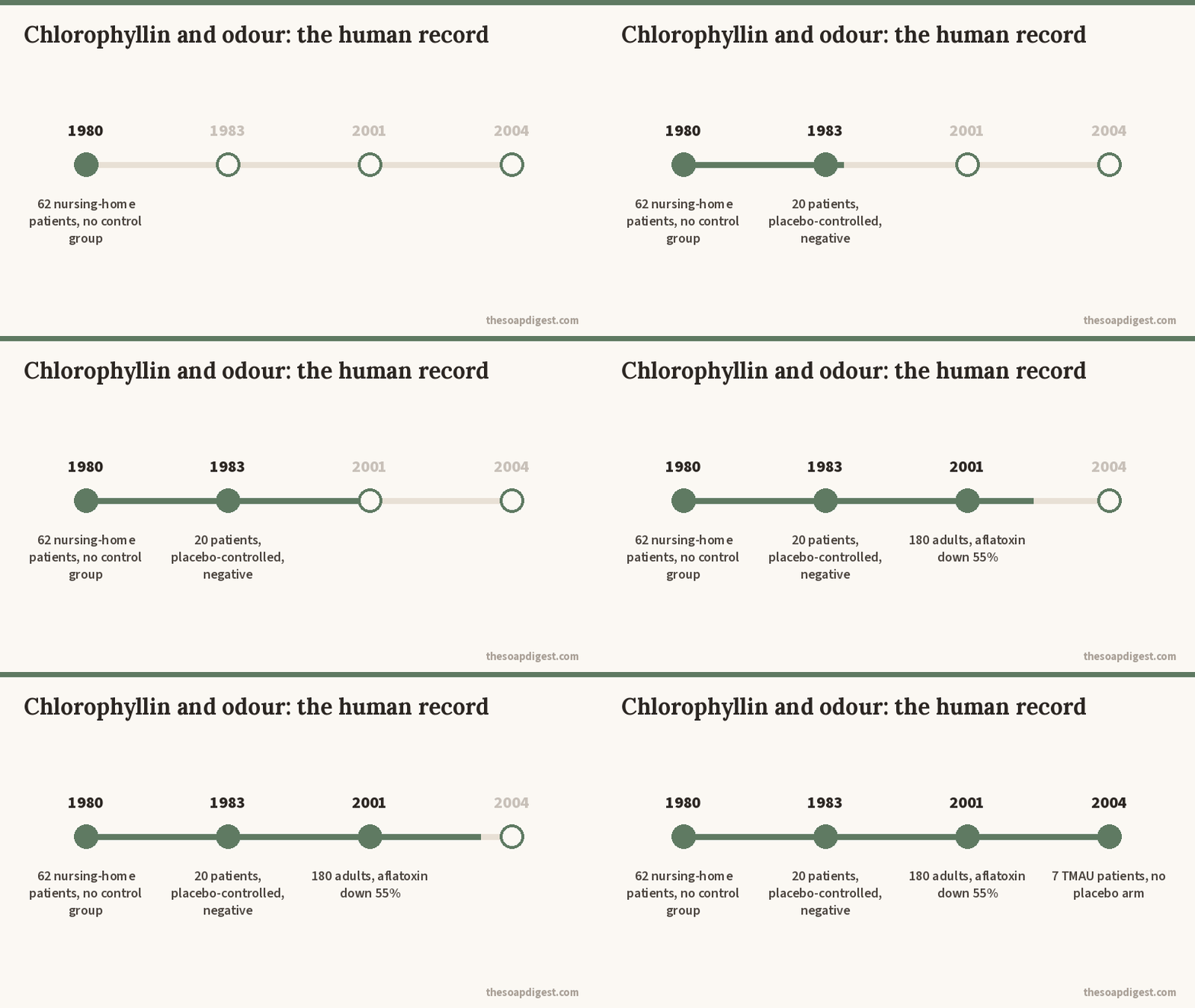
In 1980, two clinicians reported in the Journal of the American Geriatrics Society on giving chlorophyllin tablets to 62 geriatric nursing home patients, and found it “helpful in controlling body and fecal odors”, with no ill effects (Young & Beregi, 1980). There was no control group and no blinding, and the authors were candid about what that meant: in the same abstract they record that the tablets “served at times as a useful and morale-building placebo”.
Three years later somebody did the controlled version. Twenty incontinent geriatric patients, all catheterised, each took chlorophyllin 100 mg a day for two weeks and an identical placebo for two weeks, in a randomised, double-blind crossover, with odour intensity rated ten times on each arm. The numbers went the way enthusiasts would hope: chlorophyllin was associated with a 21 per cent decrease in mean urinary odour intensity, while placebo increased it by about 9 per cent. It still was not enough. The effect “was not significantly greater than that of placebo”, and the authors concluded that chlorophyllin 100 mg a day for two weeks “may not be effective in incontinent geriatric patients with mild to moderate urinary odor” (Nahata, Slencsak & Kamp, 1983).
Two things deserve saying plainly rather than being used selectively. The first is a fair caveat against our framing: that dose was low. The studies with positive results used 100 mg three times a day, or 180 mg a day; this one used 100 mg a day for a fortnight, and nobody has repeated it higher. A negative result at one dose is not a negative result at every dose.
The second cuts the other way and is the more useful. The placebo arm did not sit still — rated odour rose 9 per cent on sugar pills, in patients whose smell was being assessed by other people ten separate times. If ratings wander that much under placebo, two weeks of noticing your own armpits is a very poor instrument, and that is most of what the internet is running on.

What chlorophyllin has actually been shown to do in people
It would be unfair to leave the impression that chlorophyllin is inert. It is not, and the evidence is better than for most things sold alongside it. In Qidong, China, where liver cancer risk is raised partly by aflatoxin-contaminated food, 180 healthy adults were randomly assigned to 100 mg of chlorophyllin or placebo three times a day for four months, double-blind. Urinary aflatoxin-N7-guanine, a biomarker of the aflatoxin dose reaching DNA, fell by 55 per cent against placebo (P = 0.036), with no adverse events reported (Egner et al., 2001). The mechanism the authors describe is “blocking carcinogen bioavailability”: chlorophyllin forms a tight complex with a bulky, flat, aromatic molecule in the gut, so less of it crosses into the body.
That is a real pharmacological effect, in people, with a control arm. The shape of it is what matters: a binder, acting in the digestive tract, on a large planar molecule, reducing how much is absorbed.
Why a gut mechanism cannot reach nonenal
Now put the stale, greasy, slightly cardboard smell most readers of this site are chasing next to that mechanism. It is attributed to 2-nonenal, and the paper that identified it says where it comes from: it is generated when omega-7 unsaturated fatty acids are “oxidatively decomposed” using lipid peroxides as the initiator, and across ages 26 to 75 it was “detected only in older subjects (40 y or older)” (Haze et al., 2001). The reaction runs in the oil film on the outside of your skin. There is no bacterium in it and, more to the point here, no digestive step at all. Nothing is absorbed, metabolised and excreted; sebum reaches the surface and the air does the rest.
A gut binder has nothing to bind — and 2-nonenal is the wrong shape for it anyway: a small, strongly fat-preferring molecule of molecular weight 140 (PubChem CID 5283335), not a bulky flat ring system. Unsurprisingly, nobody has looked. A title-and-abstract search pairing any chlorophyll word with 2-nonenal returns six records: four plant biology, one on herbs and spices slowing lipid oxidation in heated beef, and one on 4-hydroxy-2-nonenal in a freshwater alga — a different compound, and the standing false friend of this subject. Not one involves human skin or smell.
If the smell you are shifting comes off collars and pillowcases, it is a washing problem rather than a swallowing one, which is why our comparison of the best persimmon soap options exists. What a bar can and cannot do is set out in does persimmon soap work.
The one smell with a measured result is a diagnosed condition
There is a genuine exception, and it is the only place in this literature where chlorophyllin and a human odour meet with numbers attached. Trimethylaminuria, sometimes called fish odour syndrome, is a metabolic disorder in which the enzyme FMO3 fails to convert dietary-derived trimethylamine into its odourless N-oxide, so the amine leaves in breath, sweat and urine (Yamazaki & Shimizu, 2007). Here there is a digestive step: gut bacteria make trimethylamine out of what you eat.
In seven Japanese patients with reduced conversion capacity, copper chlorophyllin at 180 mg a day for three weeks reduced free urinary trimethylamine and brought the N-oxide back into the normal range, with effects lasting several weeks — longer than the activated charcoal tested alongside it (Yamazaki et al., 2004). Seven people, no placebo arm, one molecule in a condition defined by that molecule.
And then the detail that keeps this honest: an NHS trust leaflet on dietary management of trimethylaminuria, issued in February 2026, does not mention copper chlorophyllin anywhere, nor charcoal. Its advice is a low-choline, low-trimethylamine diet, with vitamin D and a dietitian-agreed multivitamin the only supplements named. Even where chlorophyllin has a measured odour result, the guidance a patient is handed has not adopted it.
When this is a doctor’s question, not a supplement question
A smell that is new, that has changed character, or that other people notice and you cannot, is worth a consultation rather than a purchase. The NHS advises seeing a GP if body odour has not improved after treating it yourself and it is affecting your self-esteem, if you notice a change in how it usually smells, or if you suddenly start sweating much more than usual. It also lists conditions like diabetes, kidney disease and liver disease, and medicines such as antidepressants, among things that can make body odour worse. A fishy or ammoniacal smell, or one that tracks specific foods, is a particular reason to ask.
Liquid, capsules, gummies: nobody has compared them
The most common question in these threads is one of the few that can be answered quickly: nobody has compared the forms, for odour or anything else. What is worth noticing is that all three studies with measured results used a stated milligram dose in a solid form — 100 mg three times daily, 180 mg daily, 100 mg daily. Drops and teaspoons are not a dose until somebody converts them, and the conversion is often not on the label in comparable terms. If you want an amount that has been studied, the only products you can match are the ones that tell you their milligrams.
The threads converge on the same conclusion from the other direction. In one discussion comparing two brands, two commenters reported no effect from either, and a third landed on what the evidence also says:
“it depends on the cause of the odor”
That is the useful frame. Gut-origin odour has a plausible route for a binder; oxidised skin oil does not, and neither does the sharp, sour underarm kind made by skin bacteria out of sweat. For that one, the options with any human measurement behind them are topical — see hypochlorous acid and glycolic acid.
What chlorophyllin is, legally, and what follows from that
One last piece of context explains why the evidence base looks the way it does. The two places chlorophyllin appears by name in US federal regulation are both colour listings: one permits it in citrus-based dry beverage mixes at up to 0.2 per cent, the other for colouring drug toothpaste at up to 0.1 per cent. Its regulatory identity is a green dye with two narrow permitted uses. Sold as a supplement, it sits in a category where, as the NIH Office of Dietary Supplements puts it, FDA “does not determine whether dietary supplements are effective before they are marketed”, and where supplements “can also interact with some medicines in ways that might cause problems”. None of that makes chlorophyllin dangerous. It does mean no regulator has ever asked anybody to prove the deodorant claim — which is why there is one small negative trial from 1983 and then forty years of anecdote.
What we sell, and what it does not do either
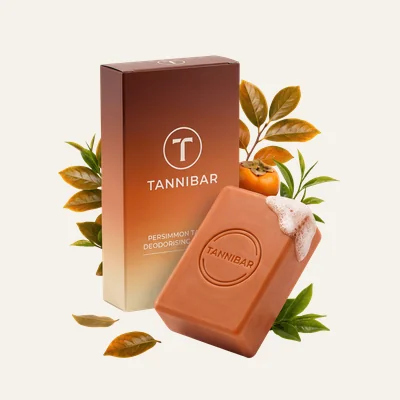
We should be explicit about where we are standing. The Soap Digest is owned by the same company that makes TanniBar, the persimmon tannin bar ranked first in our own comparison, and this article argues against a category that competes with it. Judge the argument accordingly.
Then judge this, which cuts the other way. A persimmon tannin bar has no published human trial behind it either: a search pairing persimmon with soap still returns zero results, re-run today. Our bar is a rinse-off true soap acting on the oil film on the skin surface while it is in contact with it. It does nothing for odour arising from the gut, nothing for a metabolic condition, and nothing between showers. On the question this article is about, we have no evidence in our own favour — only the observation that the competing product has one controlled trial and it is negative, which is a weaker argument for us than it sounds.
TanniBar Persimmon Tannin Bar
If you want to test the washing route instead, the sensible version is the cheapest bar you can find, used for two to three weeks, before anybody spends money on a bundle.
Check price →We own TanniBar and earn from sales. 30-day refund, no return needed.If you are going to try it anyway
Plenty of readers will, and that is reasonable with a cheap, widely sold supplement. A few points make the attempt more informative.
- Clear it with a pharmacist or doctor first, particularly on blood thinners or immunosuppressants, and particularly if you avoid copper.
- Pick a product that states milligrams, so you are taking a dose somebody has at least studied.
- Expect green or very dark stools. That is the dye, not a result.
- Change one thing at a time. These experiments usually produce nothing usable because a new soap, a new deodorant and a new supplement all started the same week.
- Get a second nose. The 1983 trial had other people rating the smell ten times for a reason, and self-assessment is unreliable — the whole subject of can you smell your own body odor.
- Give it a fair window, then stop. If three or four weeks at a stated dose changes nothing, the record suggests that is the expected outcome, not a dosing error.
The bottom line
Chlorophyll supplements are not a scam and chlorophyllin is not inert. It has a respectable randomised trial behind it, and that trial was about aflatoxin. What it has for odour is one uncontrolled 1980 report whose own authors called it partly a morale-building placebo, one small randomised trial in 1983 that did not beat placebo, a measured effect on one specific amine in seven people with a diagnosed disorder, and nothing at all on the oxidised skin oil behind the smell most people are trying to fix.
If your smell is stale, greasy and comes off fabric, the mechanism points outward rather than inward, and a wash is the logical place to start — which is what our persimmon soap comparison is for. If it is sharp and localised, look at topicals. And if it is fishy, ammoniacal or newly changed, that is a doctor’s appointment, not a bottle of green drops.
Frequently asked questions
Does chlorophyll help body odor?
There is one randomised, double-blind, placebo-controlled trial of chlorophyllin for a body odour, and it is negative. Twenty incontinent geriatric patients took chlorophyllin 100 mg a day for two weeks and placebo for two weeks in crossover, with odour intensity rated ten times on each arm. Chlorophyllin was associated with about a 21 per cent fall in mean odour intensity and placebo with a 9 per cent rise, but the difference was not statistically significant, and the authors concluded that 100 mg a day for two weeks "may not be effective" in that group. That is the whole controlled record for odour. Everything else is uncontrolled reports, and most of the enthusiasm online is neither.
Is liquid chlorophyll better than capsules for body odor?
Nobody has compared them for odour, so there is no evidence-based answer. What can be said is that the human studies with measured results used tablets or capsules at a stated milligram dose — 100 mg three times a day in the aflatoxin trial, 180 mg a day in the trimethylaminuria study, 100 mg a day in the negative odour trial. Liquid products are usually dosed in drops or teaspoons, and the milligram content is not always stated in a comparable way. If you want to match anything that has been studied, a product that tells you its milligrams is the only one you can match.
What is the difference between chlorophyll and chlorophyllin?
Chlorophyll is the green pigment in plants and contains magnesium. Chlorophyllin is a semi-synthetic, water-soluble derivative made from it. US federal regulation describes sodium copper chlorophyllin as "a green to black powder prepared from chlorophyll by saponification and replacement of magnesium by copper", with dehydrated alfalfa named as the source in the drug-colouring listing. The copper is not a contaminant; it is part of the definition. That matters for anyone shopping for a copper-free product, because a copper-free chlorophyll preparation is not the substance used in the studies described here.
Does chlorophyll do anything for nonenal or old person smell?
There is no reason from the published mechanism to expect it to, and no study either way. The stale, greasy odour associated with ageing is attributed to 2-nonenal, which forms when unsaturated fatty acids already on the skin surface are oxidatively broken down. That reaction happens on the outside of the body, downstream of anything swallowed, which is why washing is the usual approach to it. A title-and-abstract search pairing any chlorophyll word with 2-nonenal returns six records and not one concerns human skin or smell — four are plant and food chemistry, one is a beef-cooking study, and one is a freshwater alga.
Is there any odour chlorophyllin has been shown to change?
Yes, one, and it is a diagnosed metabolic condition rather than ordinary body odour. In trimethylaminuria, the body cannot efficiently convert dietary trimethylamine into its odourless oxide, and the amine leaves in breath, sweat and urine. In seven Japanese patients, copper chlorophyllin at 180 mg a day for three weeks reduced free urinary trimethylamine and brought the oxide back into the normal range, with effects the authors said appeared to last several weeks. That is seven people, no placebo arm, and a specific molecule. If you suspect a condition like this, it is a conversation with a doctor, not a supplement purchase.
Is chlorophyll safe to take?
It is widely sold and the trials described here reported no adverse events, but that is not the same as a safety assessment, and a few specifics are worth knowing. The material is defined by its copper content — the food colour specification sets total copper at 4 to 6 per cent, with free copper capped at 200 parts per million — so anyone avoiding copper for a medical reason should read labels closely. Green or very dark stools are an expected cosmetic effect. More generally, the NIH Office of Dietary Supplements notes that supplements "can also interact with some medicines in ways that might cause problems" and that FDA "does not determine whether dietary supplements are effective before they are marketed". Tell your doctor or pharmacist what you are taking, particularly on blood thinners or immunosuppressants.
Why do so many people say it worked for them?
Partly because the question is harder to answer about yourself than it looks, and partly because the one properly controlled trial shows how misleading self-rated odour is. In that study the placebo arm did not stay flat; rated odour went up 9 per cent on placebo while it went down 21 per cent on the drug, and the gap between the two was still not significant. Ratings of smell move around for reasons that have nothing to do with what is being tested. That is also the most useful thing in the record for a reader: not that chlorophyll is a fraud, but that two weeks of noticing is a poor instrument.
Sources
- Nahata M.C., Slencsak C.A., Kamp J. (1983). Effect of chlorophyllin on urinary odor in incontinent geriatric patients. Drug Intell Clin Pharm 17(10):732-4. (The only controlled trial of chlorophyllin for a body odour that we can find. "This randomized, double-blind, crossover, placebo-controlled study involved 20 incontinent geriatric patients; all had indwelling Foley catheters." Each received chlorophyllin 100 mg/d for two weeks and placebo for two weeks with a one-week washout; odour intensity was measured ten times on each regimen on a visual analogue scale. "Chlorophyllin treatment was associated with about a 21-percent decrease in mean urinary odor intensity, whereas placebo increased the odor by about 9 percent" — but "its effect was not significantly greater than that of placebo", and the authors conclude that "chlorophyllin 100 mg/d for two weeks may not be effective in incontinent geriatric patients with mild to moderate urinary odor".)
- Young R.W., Beregi J.S. Jr. (1980). Use of chlorophyllin in the care of geriatric patients. J Am Geriatr Soc 28(1):46-7. (The uncontrolled report that preceded the trial above. "In a test group of 62 geriatric nursing home patients, the administration of chlorophyllin tablets was found to be helpful in controlling body and fecal odors." The same abstract records that it "served at times as a useful and morale-building placebo", that no toxic or ill effects were observed, and that "bacteriologic studies failed to confirm reports in the literature of antibacterial properties for chlorophyllin". No control group, no blinding and no reported statistics.)
- Egner P.A., Wang J.B., Zhu Y.R., Zhang B.C., Wu Y., Zhang Q.N., Qian G.S., Kuang S.Y., Gange S.J., Jacobson L.P., Helzlsouer K.J., Bailey G.S., Groopman J.D., Kensler T.W. (2001). Chlorophyllin intervention reduces aflatoxin-DNA adducts in individuals at high risk for liver cancer. Proc Natl Acad Sci U S A 98(25):14601-6. (The best human trial chlorophyllin has. "One hundred and eighty healthy adults from Qidong were randomly assigned to ingest 100 mg of chlorophyllin or a placebo three times a day for 4 months" in a randomised, double-blind, placebo-controlled design. "Chlorophyllin consumption at each meal led to an overall 55% reduction (P = 0.036) in median urinary levels of this aflatoxin biomarker compared with those taking placebo." The stated mechanism is "blocking carcinogen bioavailability" — binding a bulky planar molecule in the gut so that less of it is absorbed. Nothing in the study concerns smell.)
- Yamazaki H., Fujieda M., Togashi M., Saito T., Preti G., Cashman J.R., Kamataki T. (2004). Effects of the dietary supplements, activated charcoal and copper chlorophyllin, on urinary excretion of trimethylamine in Japanese trimethylaminuria patients. Life Sci 74(22):2739-47. (Seven Japanese individuals with reduced capacity to convert trimethylamine to its odourless N-oxide. "Copper chlorophyllin (total 180 mg per day for 3 weeks) was also effective at reducing free urinary TMA concentration and increasing TMAO to those of concentrations present in normal individuals", with effects that "appeared to last longer (i.e., several weeks) than those observed for activated charcoal". Seven patients, no placebo arm, and a specific diagnosed disorder.)
- Yamazaki H., Shimizu M. (2007). Genetic polymorphism of the flavin-containing monooxygenase 3 (FMO3) associated with trimethylaminuria (fish odor syndrome): observations from Japanese patients. Curr Drug Metab 8(5):487-91. (Minireview describing trimethylaminuria as "a metabolic disorder characterized by the inability to convert malodorous dietary-derived trimethylamine (TMA) to odorless TMA N-oxide by the flavin-containing monooxygenase 3 (FMO3)", and listing liver damage, menstruation and treatment with copper chlorophyllin among the other factors affecting measured FMO3 capacity.)
- PubMed title-and-abstract search for chlorophyllin with ostomy, colostomy or incontinence, run 9 November 2026. (Exactly one result: the 1983 Nahata trial above. The entire indexed literature pairing chlorophyllin with the clinical settings where it was historically sold as a deodorant consists of that single negative study.)
- PubMed title-and-abstract search for any chlorophyll word with 2-nonenal, walked record by record on 9 November 2026. (Six results, and not one concerns human skin or body odour. Four are plant biology — aldehyde oxidase function in Arabidopsis leaves and siliques, PMIDs 39190782, 34587326 and 28188272, and cucumber fruit volatiles after bagging, 32150913. One is herbs and spices slowing lipid oxidation in a heated beef product, 29196013. One is 4-hydroxy-2-nonenal in the freshwater alga Chlorella kessleri as a pollution indicator, 21937009 — and 4-hydroxy-2-nonenal is a different compound from the 2-nonenal of body odour. An informative absence: nobody has studied these two things together in people.)
- PubMed title-and-abstract search for chlorophyll with body odour, re-run 9 November 2026. (One record, a 1951 French-language report on chlorophyll A for halitosis and body odour, PMID 12986476. Note the search-design lesson recorded on this site: the narrower phrase "body odor" misses the 1983 randomised trial entirely, because that trial's own title says "urinary odor". Pairing chlorophyllin with odor or odour returns four records and is the better search.)
- Masson H. (1951). [Chlorophyll A in the treatment of halitosis and body odor; results; drugs]. Ann Otolaryngol. (The oldest record pairing chlorophyll with body odour, from the mid-century period when chlorophyll was marketed heavily as a deodorant. A companion 1951 paper by Masson and Levier in Rev Laryngol Otol Rhinol, PMID 14865411, describes its deodorising action in halitosis. Both predate controlled trial reporting standards; cited as history, not as evidence.)
- Tsunoda M., Sato H., Ohkushi T. (1981). [The experimental study for the effect of sodium copper chlorophyllin in halitosis]. Nihon Shishubyo Gakkai Kaishi. (A Japanese-language experimental study of sodium copper chlorophyllin in halitosis — breath odour from the mouth, a different site and a different chemistry from skin odour. Listed to show what the small chlorophyllin-and-odour literature actually consists of.)
- Haze S., Gozu Y., Nakamura S., Kohno Y., Sawano K., Ohta H., Yamazaki K. (2001). 2-Nonenal newly found in human body odor tends to increase with aging. J Invest Dermatol 116(4):520-4. (Headspace gas chromatography/mass spectrometry in subjects aged 26 to 75. 2-Nonenal was "detected only in older subjects (40 y or older)" and was generated when omega-7 unsaturated fatty acids were oxidatively decomposed using lipid peroxides as initiator. The reaction is an oil-phase process on the skin surface, with no microbial and no digestive step in it. All authors were at Shiseido Co. Ltd., which later sold products aimed at this odour; company-affiliated research.)
- PubChem compound summary for 2-nonenal (CID 5283335), via PUG REST, 9 November 2026. (Molecular weight 140.22, XLogP 3.1 — a small, strongly fat-preferring molecule. Relevant here only to make the point that it is nothing like the bulky planar carcinogens chlorophyllin is documented to bind.)
- 21 CFR 73.125 — Sodium copper chlorophyllin (eCFR, accessed 9 November 2026). ("A green to black powder prepared from chlorophyll by saponification and replacement of magnesium by copper", with chlorophyll extracted from alfalfa. It "may be safely used to color citrus-based dry beverage mixes in an amount not exceeding 0.2 percent in the dry mix" — the only food use listed. Specifications include total copper 4 to 6 per cent, free copper not more than 200 parts per million, lead not more than 10 ppm, arsenic not more than 3 ppm and mercury not more than 0.5 ppm.)
- 21 CFR 73.1125 — Potassium sodium copper chlorophyllin, chlorophyllin-copper complex (eCFR, accessed 9 November 2026). (The drug-colouring listing: "a green to black powder obtained from chlorophyll", where "the source of the chlorophyll is dehydrated alfalfa", which "may be safely used for coloring dentifrices that are drugs at a level not to exceed 0.1 percent". The listing explicitly does not waive the new drug requirements of section 505 of the Act for the drug in which it is used. Note that the section title is printed in the regulation with the misspelling "chloropyhllin".)
- NIH Office of Dietary Supplements: Dietary Supplements — What You Need to Know (accessed 4 November 2026). (Supplements "can also interact with some medicines in ways that might cause problems"; FDA "does not determine whether dietary supplements are effective before they are marketed"; tell your health care providers about any supplement you take.)
- University Hospitals Birmingham NHS Foundation Trust. Dietary management for trimethylaminuria, inherited metabolic disorders patient information leaflet PI25/1969/02, issued February 2026 (fetched 9 November 2026). (An official NHS trust leaflet on managing the one condition where chlorophyllin has a measured effect on odour. Its management advice is a low-choline, low-trimethylamine diet, with restriction of sea fish and shellfish and limits on egg yolks, offal and cod liver oil, and a caution that choline should not be restricted in pregnancy or breastfeeding. The only supplements it mentions are vitamin D and a multivitamin discussed with a dietitian. Neither copper chlorophyllin nor activated charcoal appears anywhere in it.)
- NHS. Body odour (BO) (accessed 4 November 2026). ("See a GP if" body odour has not improved after treating it yourself and "it's affecting your self-esteem", "you notice a change in how it usually smells" or "you suddenly begin to sweat much more than usual". Things that can make body odour worse are listed as exercise, hot weather, hormonal changes, being overweight, "having a condition like diabetes, kidney disease or liver disease" and "certain types of medicine, such as antidepressants".)
- r/bodyodor thread on chlorophyll brand and copper content (4 entries, read 9 November 2026). (The thread in which a reader asks how often to take a chlorophyll capsule and whether it is copper-free, because of reactions to metals, and the replies divide between one person saying it did nothing and two describing their own liquid-and-capsule routines. Source of the first quoted fragment, and of the observation that the copper question is being asked and not answered.)
- r/bodyodor thread comparing two chlorophyll supplement brands (14 entries, read 9 November 2026). (A reader asking which of two brands works before spending money. The replies include two people reporting no effect at any brand and one arriving at the conclusion this article also reaches — that it depends what is producing the odour. Source of the second quoted fragment. Also contains personal medical discussion, which is not reproduced or interpreted here.)
- r/bodyodor thread asking which supplements help (12 entries, read 9 November 2026). (Read for demand rather than quoted. The poster has already tried "all forms of chlorophyll"; the replies move to diet, activated charcoal and spirulina, and one commenter raises the possibility of a metabolic disorder needing medical advice — independently arriving at the two comparators in the published literature.)
- r/Perimenopause: "Do chlorophyll pills work as well as liquid in eliminating body odor?" (read 9 November 2026). (Cited for the question in its title, which is the exact comparison nobody has published. No quotation taken.)
- Google autocomplete, suggestqueries.google.com, 9 November 2026. (Five stems checked. "chlorophyll for body odor" is returned verbatim, alongside a pills, capsules, liquid and drops family; "does chlorophyll help body odor" carries "does chlorophyll reduce body odor", "does chlorophyll prevent body odor" and "does chlorophyll help armpit odor"; and "chlorophyll deodorant" returns "chlorophyll internal deodorant" as a named product category.)
- PubMed title-and-abstract search for persimmon and soap (re-run 9 November 2026). (Zero results. Any published study of a persimmon soap would be expected to carry both words in its title or abstract, so there is still no peer-reviewed trial of persimmon soap on human body odour — including ours.)
- TanniBar product page (brand's own claims: "100% fragrance-free", ingredients, triple-milled duration claim, 30-day refund with no return required, free worldwide shipping in plain packaging; page fetched 9 November 2026, and the bundle prices are again not returned by a fetch)